₹25,060 Crore Export Promotion Mission: How MSMEs Can Benefit
A ₹25,060 Crore Push to Get Small Exporters Selling Abroad, Piece by Piece
India is making a major push to help Micro, Small and Medium Enterprises (MSMEs) enter international markets, particularly through e-commerce.
For a small business trying to sell products overseas, two challenges often appear immediately: getting access to working capital while waiting for international payments and managing the packaging, compliance, logistics, and market-access requirements involved in selling abroad.
The government's response is the Export Promotion Mission, approved with a total outlay of ₹25,060 crore for the period from the current financial year through 2030–31.
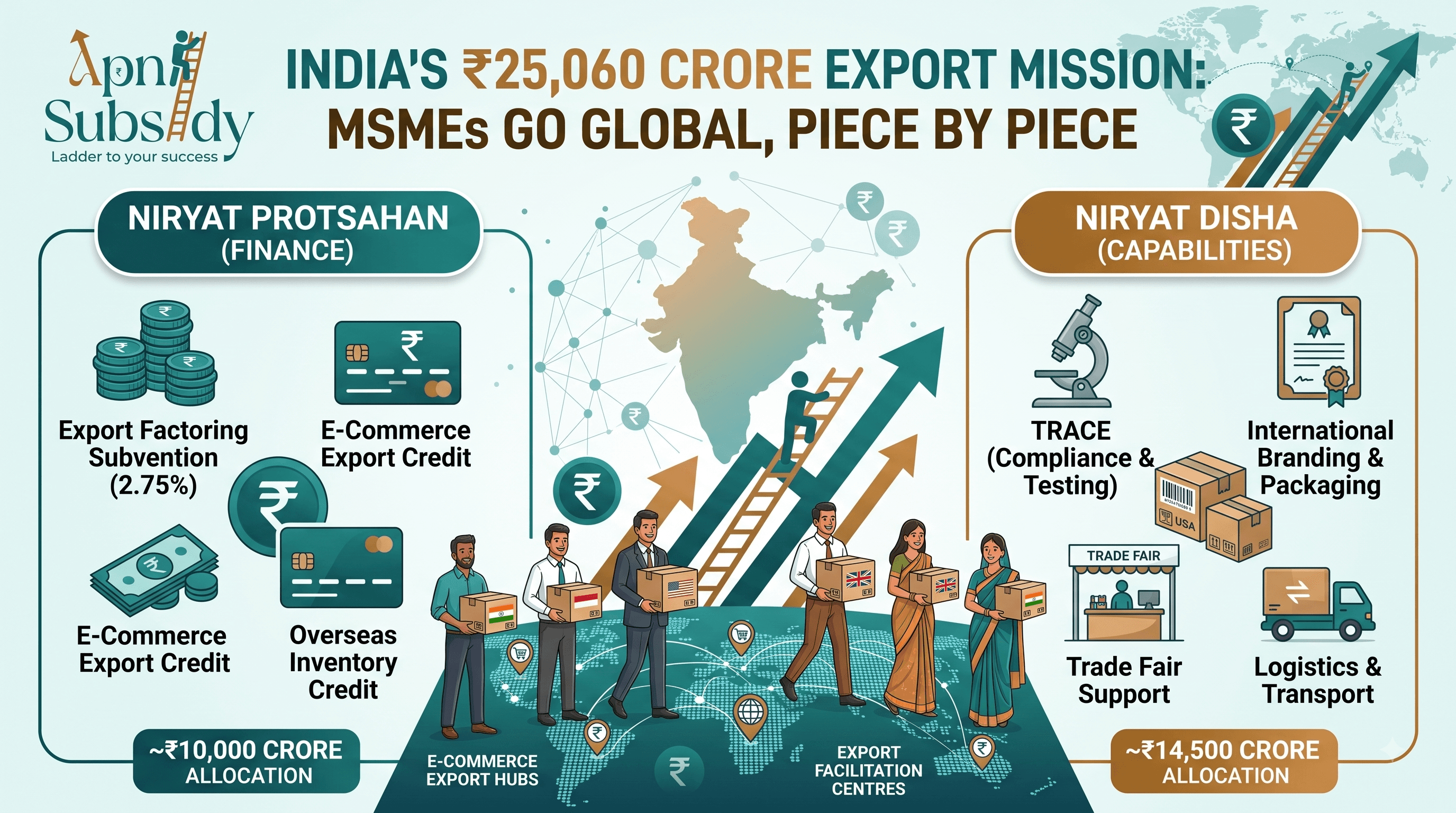
The mission brings several export-support initiatives together under two broad tracks: NIRYAT PROTSAHAN, focused on finance, and NIRYAT DISHA, focused on market access and export capabilities.
NIRYAT PROTSAHAN: Financial Support for Exporters
The financial arm of the mission, NIRYAT PROTSAHAN, is designed to address one of the biggest problems faced by small exporters: cash flow.
An exporter may ship products today but receive payment from an overseas buyer only after a certain period. During that gap, the business still needs money to purchase raw materials, pay employees, manufacture additional products, and fulfil new orders.
The scheme introduces several financial support mechanisms.
Export Factoring Support
Export factoring support provides an interest subvention of 2.75%, with the benefit capped at ₹50 lakh per MSME per year.
The objective is to reduce the cost of working capital for exporters waiting for payments after shipping their goods.
E-Commerce Export Credit
The mission also provides a dedicated e-commerce credit facility of up to ₹50 lakh, supported by 90% guarantee coverage.
This is particularly relevant for small businesses selling through international online marketplaces, where individual orders may be smaller but more frequent.
Overseas Inventory Credit
Exporters that need to maintain inventory in warehouses outside India can access overseas inventory credit of up to ₹5 crore, supported by 75% guarantee coverage.
This can help businesses move from shipping individual orders from India to maintaining stock closer to international customers.
Around ₹10,000 crore of the overall Export Promotion Mission allocation is earmarked for this financial support track.
NIRYAT DISHA: Helping Businesses Actually Export
The second component, NIRYAT DISHA, receives a larger allocation of nearly ₹14,500 crore.
While NIRYAT PROTSAHAN focuses on money, NIRYAT DISHA addresses the practical challenges involved in entering and operating in foreign markets.
One important component is TRACE, which stands for Trade Regulations, Accreditation and Compliance Enablement.
Its objective is to help exporters deal with requirements such as:
Product testing
Inspections
Certifications
International regulatory requirements
Market-specific compliance
These requirements can become major obstacles for small businesses entering a new export market.
Support for Branding, Packaging and Logistics
Exporting isn't simply about finding an overseas customer.
A product may need different packaging, branding, certifications, and documentation depending on the target market.
NIRYAT DISHA also covers areas such as:
International branding
Packaging
Overseas trade fairs
Export warehousing
Logistics
Inland transportation costs
For an MSME operating with limited margins, these expenses can quickly add up.
Government support in these areas could reduce some of the upfront costs involved in entering international markets.
A More Unified Export Support System
Another important feature of the Export Promotion Mission is consolidation.
Several older programmes, including the Interest Equalisation Scheme and the Market Access Initiative, have been brought together within the broader mission framework.
Previously, exporters often had to navigate multiple programmes, applications, documentation requirements, and timelines.
A more unified, digitally managed structure could make it easier for MSMEs to identify and access the support relevant to their export activities.
E-Commerce Export Hubs
The government is also developing E-Commerce Export Hubs, currently being implemented on a pilot basis.
These hubs are designed to create an integrated ecosystem covering areas such as:
Logistics
Customs clearance
Cross-border shipments
E-commerce export processes
This is particularly important for small manufacturers, artisans, and other businesses selling individual products through online marketplaces.
A company shipping one product at a time faces very different logistical challenges from a large exporter sending containers overseas.
The dedicated e-commerce infrastructure recognises this difference.
Export Facilitation Centres
The Ministry of MSME has also established 65 Export Facilitation Centres across the country.
These centres provide exporters with mentoring, guidance, and handholding as they explore international markets.
In addition, the existing International Cooperation Scheme continues to support eligible businesses participating in international trade fairs and buyer-seller meets.
What Does This Mean for MSMEs?
The individual components of the Export Promotion Mission are not necessarily new.
What has changed is that they are now being brought together under one coordinated framework with a defined ₹25,060 crore budget and a six-year implementation horizon.
For a small exporter, that could make the process of finding the right support considerably easier.
Instead of searching through multiple disconnected schemes, an MSME can begin with one broader mission covering financing, compliance, branding, logistics, market access, and international exposure.
Final Thoughts
India's MSMEs have significant potential to expand their presence in global markets, but finance and export-related operational challenges can often hold smaller businesses back.
The Export Promotion Mission attempts to address both problems simultaneously.
With financial support through NIRYAT PROTSAHAN, market and capability support through NIRYAT DISHA, dedicated e-commerce infrastructure, and Export Facilitation Centres, the government is building a more coordinated support system for small exporters.
For MSMEs looking to sell internationally—especially through e-commerce—the mission could provide the financial and operational support needed to move from a domestic business to a global one.