India's MSMEs Now Report 8 Crore Jobs. The Real Story Is in the Breakdown
India's MSMEs Now Report 8 Crore Jobs. The Real Story Is in the Breakdown
India's Micro, Small, and Medium Enterprises (MSMEs) have crossed another important milestone.
According to data shared by the Government in the Lok Sabha on 23 July, MSMEs registered on the Udyam Portal reported more than 8.04 crore jobs during FY 2025–26.
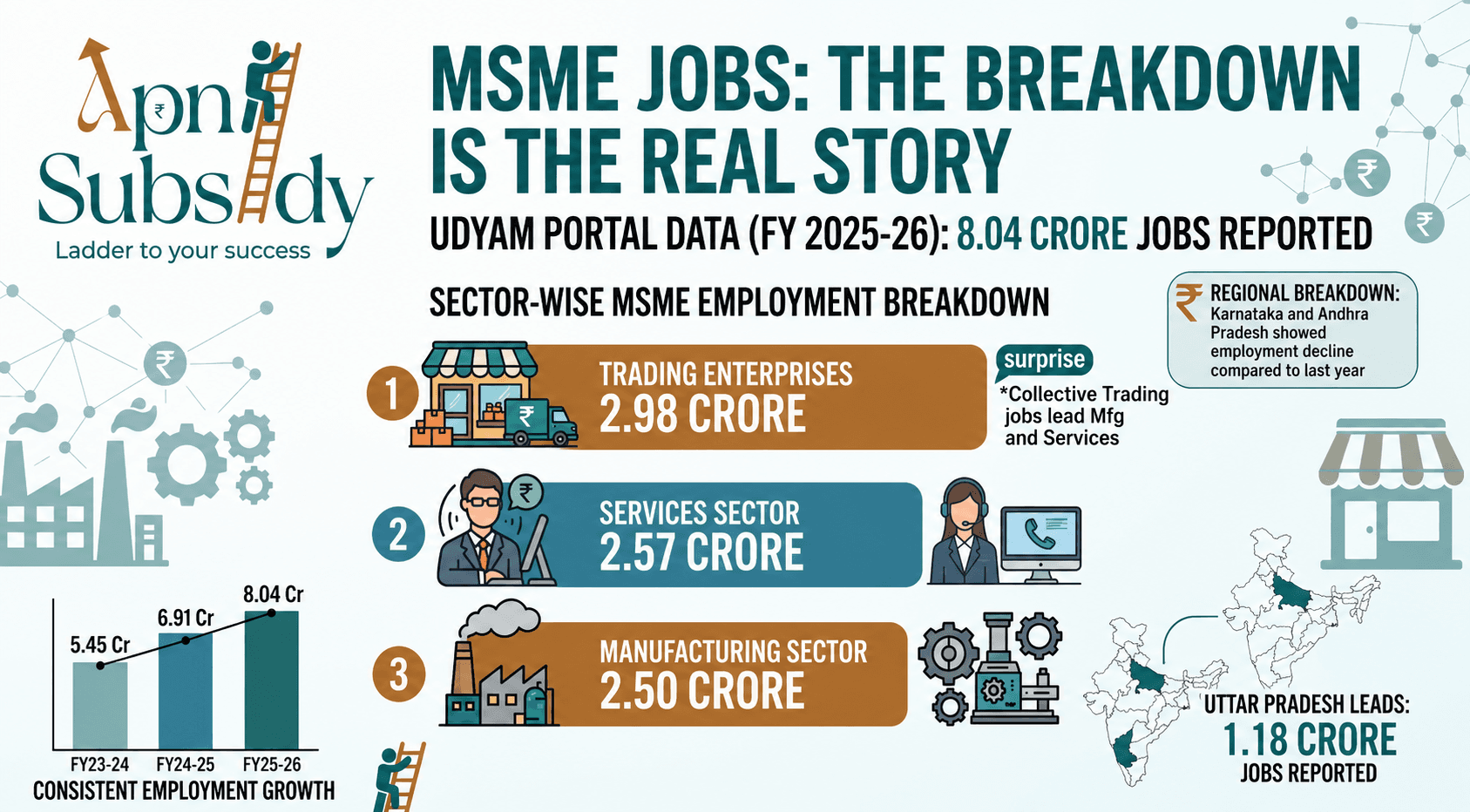
This represents steady growth from:
FY 2023–24: 5.45 crore jobs
FY 2024–25: 6.91 crore jobs
FY 2025–26: 8.04 crore jobs
At first glance, these figures simply indicate rising employment.
However, a closer look at the state-wise and sector-wise data released by Minister of State for MSMEs, Shobha Karandlaje, reveals some surprising trends about where India's MSME jobs are actually being created.
Trading Businesses Lead MSME Employment
One of the biggest surprises in the latest Udyam data is the sector-wise employment distribution.
Many people naturally associate MSMEs with manufacturing.
Government initiatives like Make in India, Production Linked Incentive (PLI) schemes, and technology upgradation programmes have traditionally placed manufacturing at the centre of MSME policy.
But the latest employment figures tell a different story.
According to the Udyam Portal:
Trading enterprises: 2.98 crore jobs
Services sector: 2.57 crore jobs
Manufacturing sector: 2.50 crore jobs
This means businesses involved in buying and selling goods collectively employ more people than either manufacturing units or service providers.
The findings challenge the common perception that factories are the primary source of MSME employment.
Instead, retailers, wholesalers, distributors, and trading businesses are emerging as India's largest MSME employers.
Uttar Pradesh Tops the List
The state-wise employment figures also highlight interesting regional trends.
The highest reported MSME employment came from:
State | Reported Employment |
Uttar Pradesh | 1.18 crore |
Maharashtra | 67.97 lakh |
Tamil Nadu | 61.47 lakh |
Telangana | 60.56 lakh |
Bihar | 55.54 lakh |
Uttar Pradesh's significant lead can be attributed to several factors.
Apart from being India's most populous state, the government has actively encouraged businesses to register on the Udyam Portal, linking registration with various MSME support schemes and incentives.
Higher formal registration naturally contributes to higher reported employment figures.
Not Every State Reported Growth
While most major states recorded an increase in MSME employment, the data also highlights an important exception.
States such as Andhra Pradesh and Karnataka reported a decline in employment compared to the previous financial year.
Given that both states have relatively strong MSME ecosystems, this decline stands out.
Rather than drawing immediate conclusions, however, these figures should be viewed as indicators requiring further analysis rather than definitive evidence of weakening business activity.
Understanding an Important Limitation
One crucial aspect of the Udyam employment data often goes unnoticed.
The employment figures are self-reported by businesses during registration or when they update their Udyam details.
This means the numbers are not collected through an independent labour survey.
A business may register once and never update its employee count, even if its workforce grows or shrinks over time.
As a result, the data reflects information submitted by businesses rather than a real-time employment census.
That said, the consistent increase from 5.45 crore to 8.04 crore jobs over three years likely reflects two important developments:
Genuine employment growth among MSMEs.
Increasing formalisation as more businesses register under the Udyam Portal.
Both trends are positive indicators for India's MSME ecosystem.
What This Means for MSME Policy
Perhaps the most important implication of this data lies in future policymaking.
For years, many government support schemes have primarily focused on manufacturing businesses through:
Technology upgradation incentives
Machinery subsidies
Manufacturing-focused credit schemes
Production-linked initiatives
However, if trading enterprises now account for the largest share of MSME employment, policymakers may need to broaden their focus.
Retailers, wholesalers, distributors, and trading businesses could increasingly become eligible for greater financial support, digital transformation initiatives, and business development programmes.
Whether future Union Budgets and MSME schemes reflect this shift remains to be seen.
Why MSME Owners Should Pay Attention
For business owners, the headline figure of 8.04 crore jobs is encouraging.
But the more meaningful takeaway is where those jobs are being created.
The latest Udyam data suggests that India's MSME landscape is evolving.
Trading businesses are becoming major employment generators, while formal registration continues to expand across the country.
As policymakers rely more heavily on Udyam data to design future schemes, businesses that are properly registered and actively updating their information may be better positioned to benefit from upcoming government initiatives.
Final Thoughts
India's MSME sector continues to strengthen its contribution to employment, with registered businesses now reporting over 8 crore jobs.
Beyond the headline number, the latest data offers valuable insights into how employment patterns are changing across sectors and states.
While manufacturing remains an important pillar of the economy, the rise of trading enterprises as the largest MSME employer could influence the direction of future government policies and support programmes.
For MSME owners, staying registered on the Udyam Portal and keeping business information updated may become increasingly important as policymakers continue to shape schemes based on the country's evolving MSME landscape.