MSMEs at Pre-Budget Consultation 2026: Focus Shifts to Making Existing Schemes Work
MSMEs Are Back at the Pre-Budget Table. This Year's Asks Are About Making Existing Schemes Work
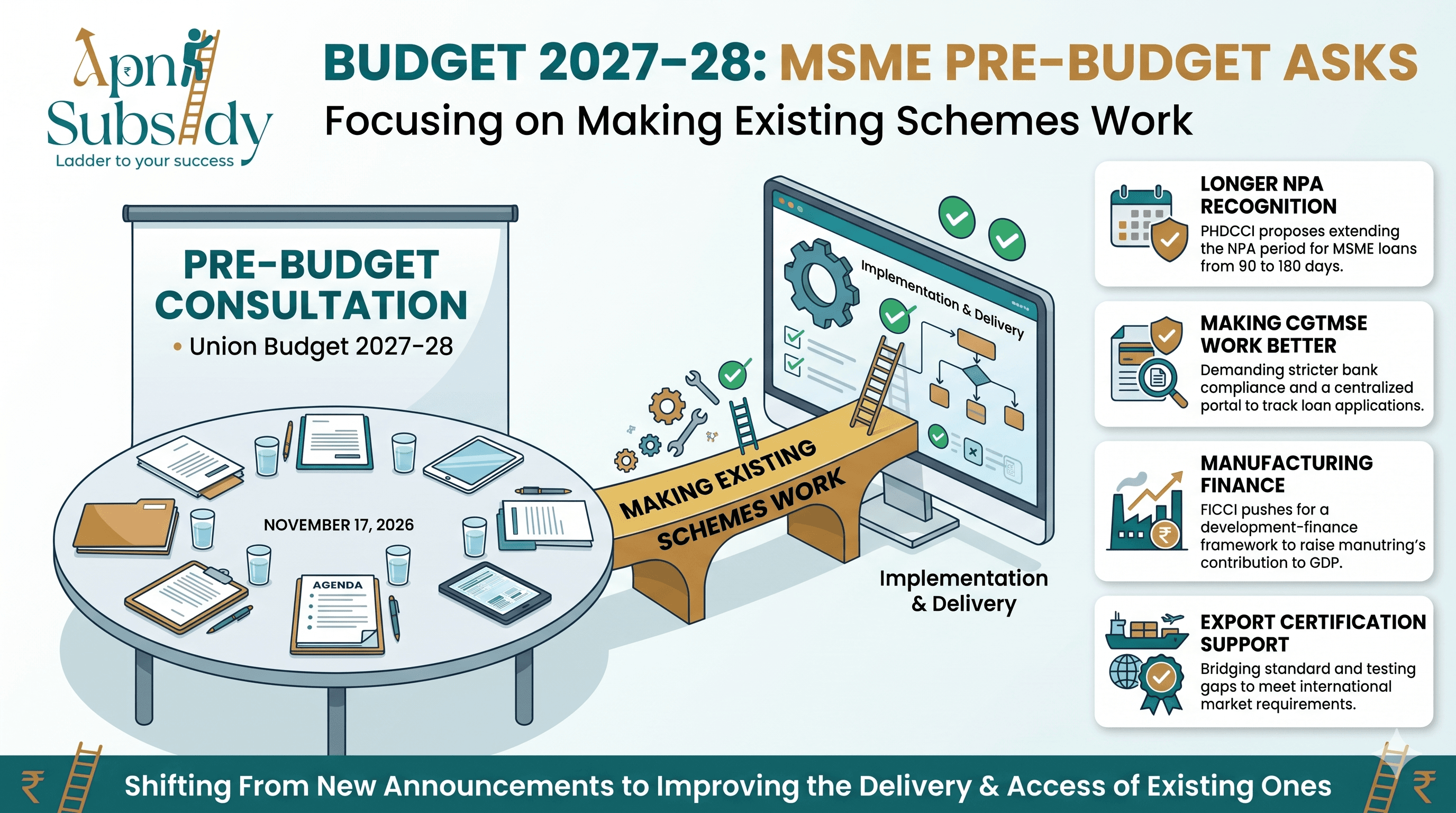
Finance Minister Nirmala Sitharaman held the fourth pre-Budget consultation of the season on November 17, 2026, with representatives from the MSME sector and startup ecosystem ahead of the Union Budget 2027–28.
Senior officials from the Department of Economic Affairs, Department for Promotion of Industry and Internal Trade (DPIIT), and the Ministry of MSME participated in the consultation, along with the Chief Economic Adviser.
The Finance Ministry confirmed the meeting but did not publicly disclose the specific issues discussed. The clearest indication of what the sector is seeking therefore comes from written Budget proposals submitted by industry bodies in recent weeks.
This year's demands are notable because the previous Budget already introduced several measures aimed at MSMEs. The focus now is increasingly shifting from announcing new schemes to ensuring that existing measures actually work for businesses on the ground.
Why the Focus Is Shifting to Implementation
The Union Budget 2026–27 introduced several significant changes for MSMEs.
These included higher investment and turnover limits for MSME classification, helping growing businesses remain within the framework for longer. The government also increased credit guarantee coverage for micro and small enterprises to ₹10 crore, while exporters were allowed to access term loans of up to ₹20 crore.
Another major change was the requirement for Central Public Sector Enterprises to procure from MSMEs through the TReDS platform.
Since then, the government has also approved the ₹10,000 crore SME Growth Fund, while Parliament has passed the MSME Development (Amendment) Bill.
With several major policy measures already in place, industry proposals are increasingly focused on how these initiatives are implemented and accessed.
PHDCCI Seeks Longer NPA Recognition Period for MSME Loans
One of the more significant proposals has come from the PHD Chamber of Commerce and Industry (PHDCCI).
The chamber has proposed extending the period after which an MSME loan is classified as a non-performing asset (NPA) from 90 days to 180 days.
The argument is that smaller businesses often operate with longer working-capital cycles and may face delays in receiving payments from larger customers. As a result, a business can experience temporary cash-flow stress even when its underlying operations remain viable.
Once a loan account is classified as an NPA, banks have to make additional provisions and the borrower's credit profile can be affected, potentially making future borrowing more difficult.
However, there is also a counterargument. Extending the recognition period could delay the identification of genuinely stressed loans and allow financial problems to remain unresolved for longer.
The proposal therefore involves a trade-off between giving viable MSMEs more breathing room and maintaining timely recognition of banking-sector stress.
Making CGTMSE Work Better, Not Just Bigger
PHDCCI has also called for stronger implementation of the Credit Guarantee Fund Trust for Micro and Small Enterprises (CGTMSE).
Rather than simply increasing the guarantee limit, the chamber has proposed stricter compliance by banks and a centralised portal through which borrowers could track loan applications and understand why an application was rejected.
The demand highlights an important issue in MSME lending.
A credit guarantee can reduce the lender's risk, but it does not automatically guarantee that an eligible business will receive a loan. If a borrower cannot understand why an application was rejected, it becomes difficult to correct the problem or pursue an alternative.
A more transparent application-tracking system could therefore make existing credit-support mechanisms more useful without necessarily requiring a new scheme.
FICCI Pushes for Manufacturing Finance
The Federation of Indian Chambers of Commerce and Industry (FICCI) has approached the Budget from a broader manufacturing perspective.
Its recommendations call for a dedicated development-finance framework for manufacturing. FICCI estimates that more than ₹100 trillion in additional credit could be required over the next decade if India is to raise manufacturing's contribution to GDP to 25%.
The industry body has also highlighted the cost of borrowing in India, arguing that interest costs can be significantly higher than those faced by businesses in countries such as China and South Korea.
For smaller manufacturers, the difference can be particularly important because they typically have less bargaining power with lenders and fewer financing alternatives.
Export Standards and Certification Also Feature
FICCI has also proposed a programme focused on standards, testing, and certification.
The objective is to address gaps between the testing and certification capabilities available domestically and the requirements imposed by international markets.
For MSME exporters, access to finance is only one part of the problem. Meeting overseas standards, obtaining certifications, developing compliant products, and navigating international market requirements can also determine whether a business is able to scale exports.
The proposal comes alongside broader government efforts to support MSME exporters through initiatives such as the Export Promotion Mission.
SME Growth Fund Fits Into the Equity Push
PHDCCI's call for greater direct equity support also aligns with the government's recently approved ₹10,000 crore SME Growth Fund.
The fund is intended to provide equity capital to growth-oriented small and medium enterprises, particularly businesses that have moved beyond the micro-enterprise stage and need capital for expansion.
However, the available summary of PHDCCI's proposals does not establish whether the chamber is seeking an expansion of the SME Growth Fund or simply supporting the broader direction toward equity financing. It is therefore too early to interpret the proposal as criticism of the government's existing initiative.
What MSMEs Should Watch in Budget 2027–28
Pre-Budget consultations rarely translate directly into policy announcements, and industry recommendations are not guarantees of what will appear in the final Budget.
For MSMEs, however, the current consultation highlights an important shift.
The policy conversation is increasingly moving from creating new schemes to improving the delivery of existing ones.
Higher credit-guarantee limits, mandatory TReDS usage, expanded MSME classification thresholds, export financing, and the SME Growth Fund can all be meaningful if businesses can actually access them.
The next Budget will therefore be closely watched not only for new announcements, but also for whether the government strengthens the systems that connect existing policies with the businesses they are intended to support.
For India's MSMEs, the question may no longer be simply “What new scheme is coming?” but “Will the schemes already announced work better this time?”