vendor-development-programme-msmes-psu-procurement-gem-treds
Seven PSUs, One Room in Ranchi: What a Vendor Development Programme Actually Does
A two-day event that began on September 9 at CMPDI's Rabindra Bhawan in Ranchi offers a useful look at what it actually takes for a small business to start selling to a public sector company.
The Central Mine Planning & Design Institute (CMPDI), a Mini-Ratna coal-planning subsidiary of Coal India, jointly organised a Vendor Development Programme-cum-Product Exhibition with the MSME Development Office in Ranchi.
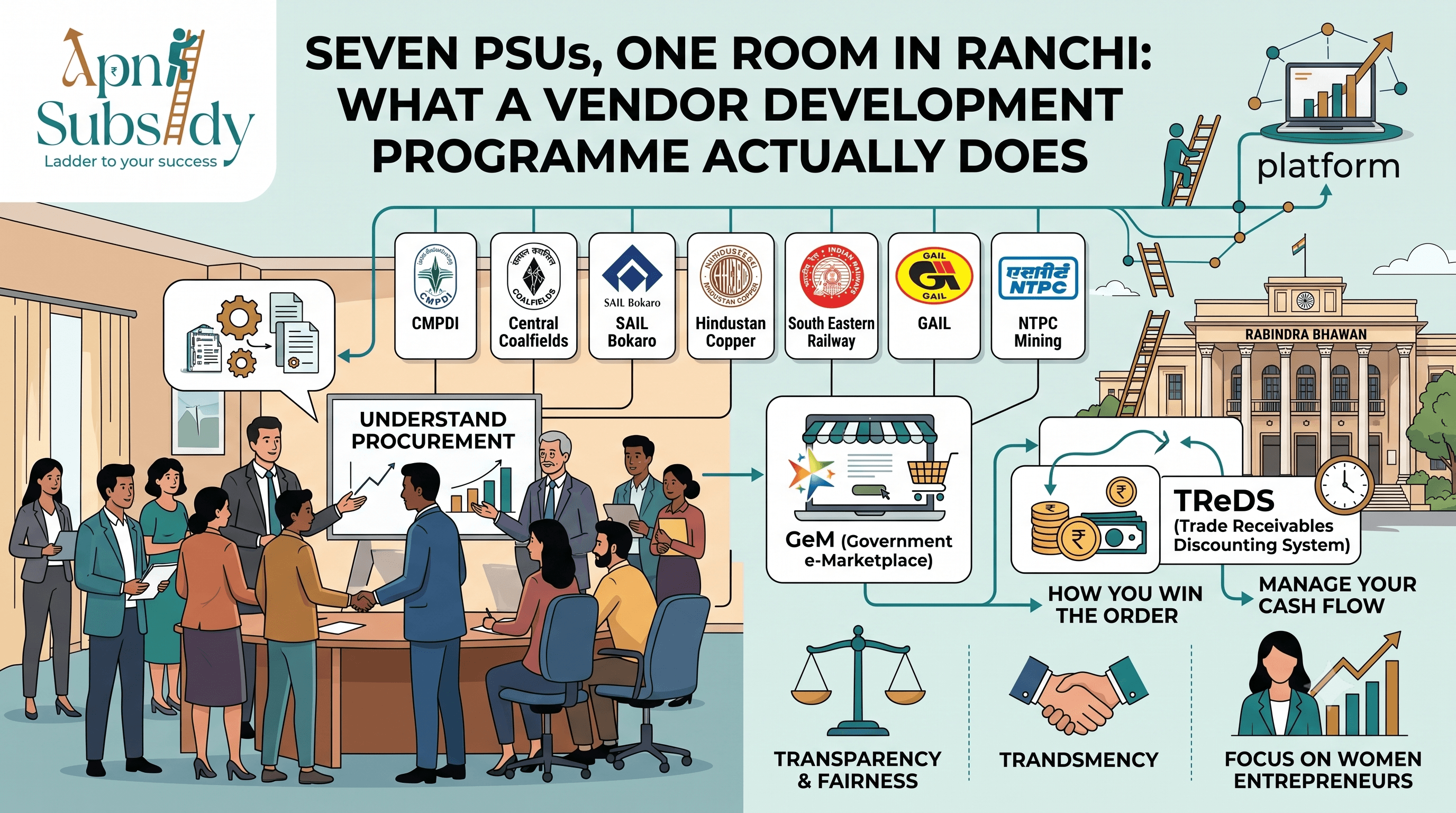
What made the programme particularly significant was the participation of seven major public sector buyers:
CMPDI
Central Coalfields Limited
SAIL's Bokaro Steel Plant
Hindustan Copper
South Eastern Railway
GAIL
NTPC Mining
Officials from the Government e-Marketplace (GeM) also participated in the programme.
Why Vendor Development Programmes Matter
Government departments and public sector undertakings are required to procure at least 25% of their annual purchases from micro and small enterprises (MSEs).
While this procurement target creates an important opportunity for MSMEs, meeting a national target does not automatically mean that an individual small business will receive a purchase order.
An MSME still needs to understand:
Which PSU buys its products or services
How to register on the relevant procurement platform
How to participate in tenders and bids
What technical requirements need to be met
How to establish credibility with a large institutional buyer
This is where Vendor Development Programmes (VDPs) become useful.
Instead of leaving small businesses to figure out the procurement system on their own, these programmes bring MSMEs and procurement officials together and explain how the purchasing process works.
GeM: Understanding How Government Buyers Purchase
One of the key parts of the Ranchi programme was training and guidance on GeM, or the Government e-Marketplace.
GeM has become a major digital procurement platform through which government organisations and public sector entities purchase a wide range of goods and services.
For an MSME, simply knowing that GeM exists isn't enough.
Entrepreneurs need to understand how to:
Register their business and products
Create accurate product listings
Identify relevant procurement opportunities
Submit bids
Meet buyer specifications
Participate effectively in the bidding process
A vendor development programme gives entrepreneurs the opportunity to learn these processes directly from people involved in public procurement.
TReDS: What Happens After You Win the Order?
Winning a PSU order is only one part of the equation. For an MSME, getting paid on time can be equally important.
The Ranchi programme also covered TReDS (Trade Receivables Discounting System).
TReDS allows eligible MSMEs to get their trade receivables financed by financiers, helping them access funds against invoices instead of waiting for the buyer's entire payment cycle to finish.
This can be particularly valuable for small businesses because a large order can create a working-capital problem if payment arrives much later.
In simple terms:
GeM helps determine how you can win the order. TReDS can help you manage the cash flow after winning it.
Transparency and Fair Procurement
The programme was also organised as part of the Vigilance Awareness Campaign.
CMPDI's Chief Vigilance Officer highlighted transparency and fairness in PSU procurement from small businesses.
This is important because smaller vendors can sometimes hesitate to enter government procurement due to the perception that established relationships or insider knowledge are necessary to win contracts.
A structured platform where procurement officials openly explain their requirements and procedures can help reduce that information gap.
It gives new vendors a clearer understanding of how the process works and what buyers actually expect.
Focus on Women Entrepreneurs
The organisers also encouraged women entrepreneurs to participate and use public procurement opportunities to expand their businesses.
This aligns with the broader public procurement framework, which includes specific targets for procurement from women-owned MSEs.
For women-led businesses that have the required products, services and capacity, PSU procurement can therefore represent an additional route to business growth.
The Bigger Lesson for MSMEs
The Ranchi programme was local, and the participating PSUs were connected to procurement requirements in the region. But the model itself has wider relevance.
The Ministry of MSME, through its network of Development Offices, conducts various vendor development and buyer-seller programmes to connect MSMEs with government departments and PSUs.
For a small business owner who has already obtained Udyam Registration, the bigger lesson is simple:
Registration is only the entry ticket.
The real opportunity comes from understanding which government or PSU buyers need what you sell, learning their procurement process and actively participating in the platforms and programmes through which those buyers source products and services.
For MSMEs looking to enter government procurement, getting into the right room—whether physical or digital—can be just as important as getting registered in the first place.