Bihar MSME Policy 2026: One Crore Entrepreneurial Families and 75% Credit Target
Bihar Wants One Crore Entrepreneurial Families. The Number to Watch Is 75 Percent.
Bihar | October 28, 2026
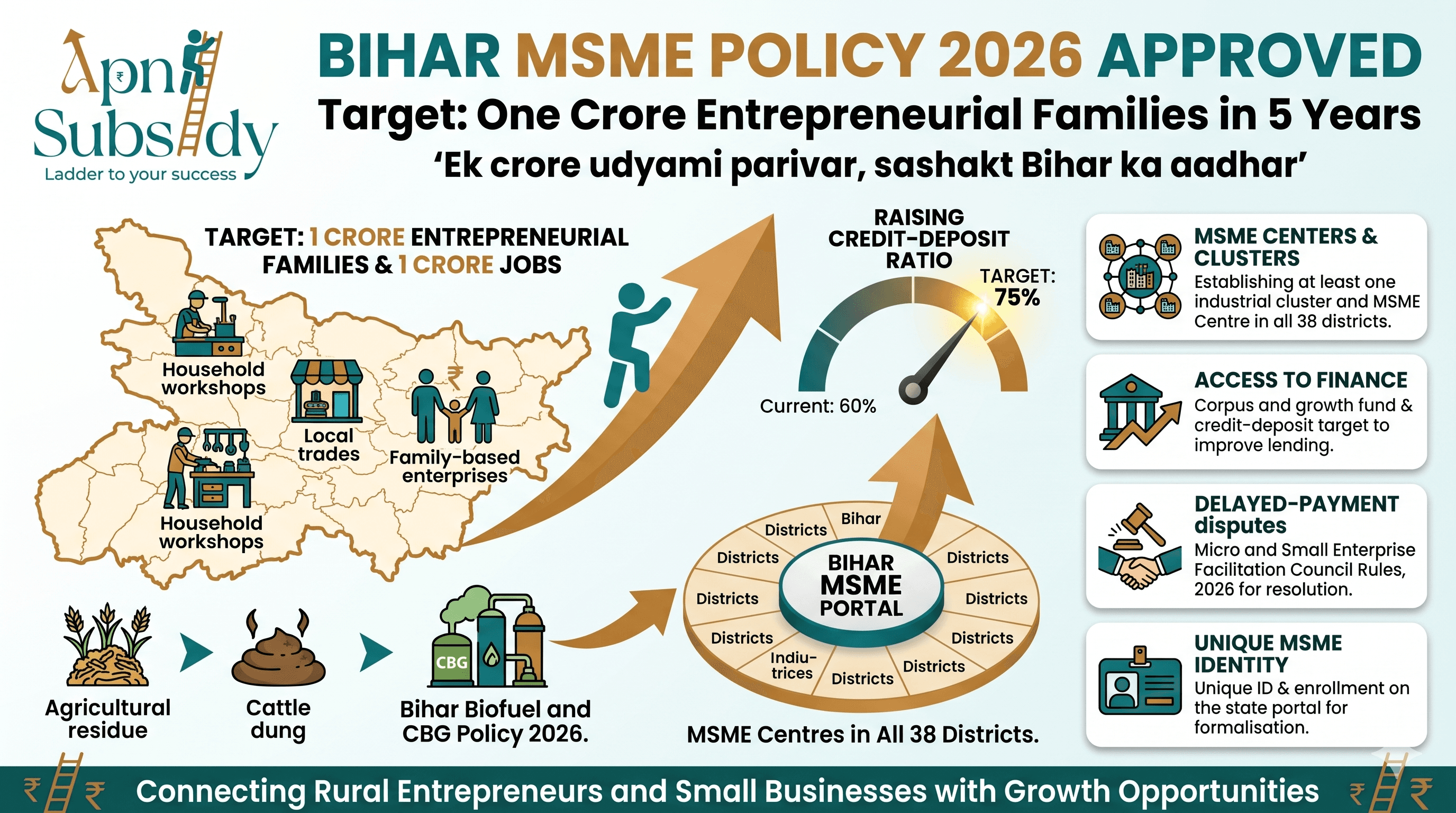
The Bihar Cabinet has approved an ambitious five-year target: turn one crore families into entrepreneurial households and create one crore direct and indirect jobs.
The Bihar MSME Policy 2026, approved on October 28 under Chief Minister Samrat Choudhary, carries the motto “Ek crore udyami parivar, sashakt Bihar ka aadhar.”
The headline target is significant, but another number could be more important for determining whether Bihar's small businesses actually benefit from the policy: 75 percent.
That is the state's target for its credit-deposit ratio, which currently stands at a little over 60 percent.
Why the 75% Credit-Deposit Ratio Matters
The credit-deposit ratio measures how much banks lend in a state compared with the deposits they collect there.
For example, a 60 percent ratio broadly means that for every ₹100 deposited with banks in the state, around ₹60 is returned as loans within the state, while the remaining amount may be deployed elsewhere.
For a state where smaller enterprises face challenges accessing formal finance, this difference matters.
Bihar wants to increase its credit-deposit ratio to 75 percent, which would mean a greater share of the state's financial deposits being converted into loans for businesses and other borrowers within Bihar.
For MSMEs, the success of this target could ultimately be more important than the headline number of entrepreneurs the policy aims to create.
What the Bihar MSME Policy 2026 Proposes
The policy uses several measures to improve the environment for small and medium enterprises.
Among its key provisions are:
An MSME corpus and growth fund to improve access to finance.
An MSME centre in each of Bihar's 38 districts.
At least one industrial cluster in every district.
A unique identity number for MSMEs in the state.
Integration of businesses with the state MSME portal.
Greater access to finance and markets.
Skill development and technology adoption.
Support for emerging sectors.
Promotion of cooperatives.
Greater focus on environmental sustainability.
The framework is organised around ten broad pillars covering formalisation, skills, clusters, finance, markets, technology, emerging sectors, and sustainability.
Formalisation Could Be the First Step
One of the policy's important components is bringing MSMEs into a more formal system.
The state plans to provide MSMEs with a unique identity number and bring them onto its MSME portal.
For businesses, formalisation can make it easier to establish their presence when applying for government schemes, financial assistance, and other forms of institutional support.
However, registration alone does not guarantee access to credit or incentives. Banks and government departments will still apply their respective eligibility and appraisal requirements.
Cluster Development Gets Its Own Scheme
The same Cabinet meeting also approved the Chief Minister's MSME Cluster Development Scheme 2026.
This gives the state's cluster-development objective a dedicated scheme rather than leaving it only as a policy goal.
The plan to establish at least one industrial cluster in each of Bihar's 38 districts could potentially help businesses benefit from shared infrastructure, local supply chains, common facilities, and greater market connectivity.
The actual impact, however, will depend on how these clusters are designed, funded, and implemented at the district level.
Delayed Payments Get a State-Level Mechanism
Another important decision from the Cabinet meeting was approval of the Micro and Small Enterprise Facilitation Council Rules, 2026.
The rules provide the state-level framework for addressing delayed-payment disputes involving micro and small enterprises.
Delayed payments can create serious working-capital pressure for smaller businesses. Even a profitable business can face financial stress when customers do not pay on time.
The new rules therefore matter because an effective dispute-resolution mechanism can help MSMEs recover dues and manage cash flow more effectively.
This comes alongside changes at the national level through the MSME Development (Amendment) Bill, which introduced timelines around the resolution of such disputes.
Biofuel and CBG Policy Opens Another Opportunity
The Bihar Cabinet also approved the Bihar Biofuel and Compressed Biogas Promotion Policy 2026 during the same meeting.
The policy could create opportunities around agricultural and dairy waste, particularly as India expands its focus on compressed biogas under the central GOBARdhan framework.
For rural entrepreneurs, waste-based energy could therefore become another emerging business opportunity where state and central policy objectives overlap.
What the Policy Does Not Yet Tell Businesses
There are important details that remain unclear.
The available reports on the Cabinet decision do not specify:
The size of the MSME corpus and growth fund.
Subsidy rates.
Interest support.
Detailed financial incentives.
Exact eligibility criteria.
Application procedures.
These details are likely to emerge through subsequent notifications and scheme guidelines.
Until then, the policy should be viewed primarily as a framework and statement of direction, rather than as a list of benefits that businesses can immediately claim.
The 75 percent credit-deposit target also depends heavily on the banking system. The state can establish clusters, centres, and support mechanisms, but individual loan decisions will ultimately depend on banks' appraisal and lending processes.
The Real Test Will Be Implementation
The gap between policy announcements and what happens at the bank branch or district office is often where ambitious targets face their biggest challenge.
Bihar's decision to connect its MSME policy with a measurable banking indicator such as the credit-deposit ratio provides one way to track whether financial access is actually improving.
The number of entrepreneurial families and jobs will remain important, but the flow of formal credit will be another critical indicator of whether businesses are getting the resources needed to grow.
What Bihar MSMEs Should Do Now
For MSME owners in Bihar, the immediate steps are straightforward.
Businesses should ensure that their Udyam registration and state MSME portal details are updated, while keeping GST records, financial statements, and banking documentation organised.
Entrepreneurs should also monitor announcements from the state government and district-level MSME centres for the detailed guidelines governing the new schemes.
The Bihar MSME Policy 2026 has been approved, but the actual benefits available to individual businesses will depend on the rules, incentives, and implementation guidelines that follow.
The big promise is one crore entrepreneurial families.
The number worth watching closely is 75 percent—because that is where Bihar's ambition meets the reality of how much money actually reaches its businesses.