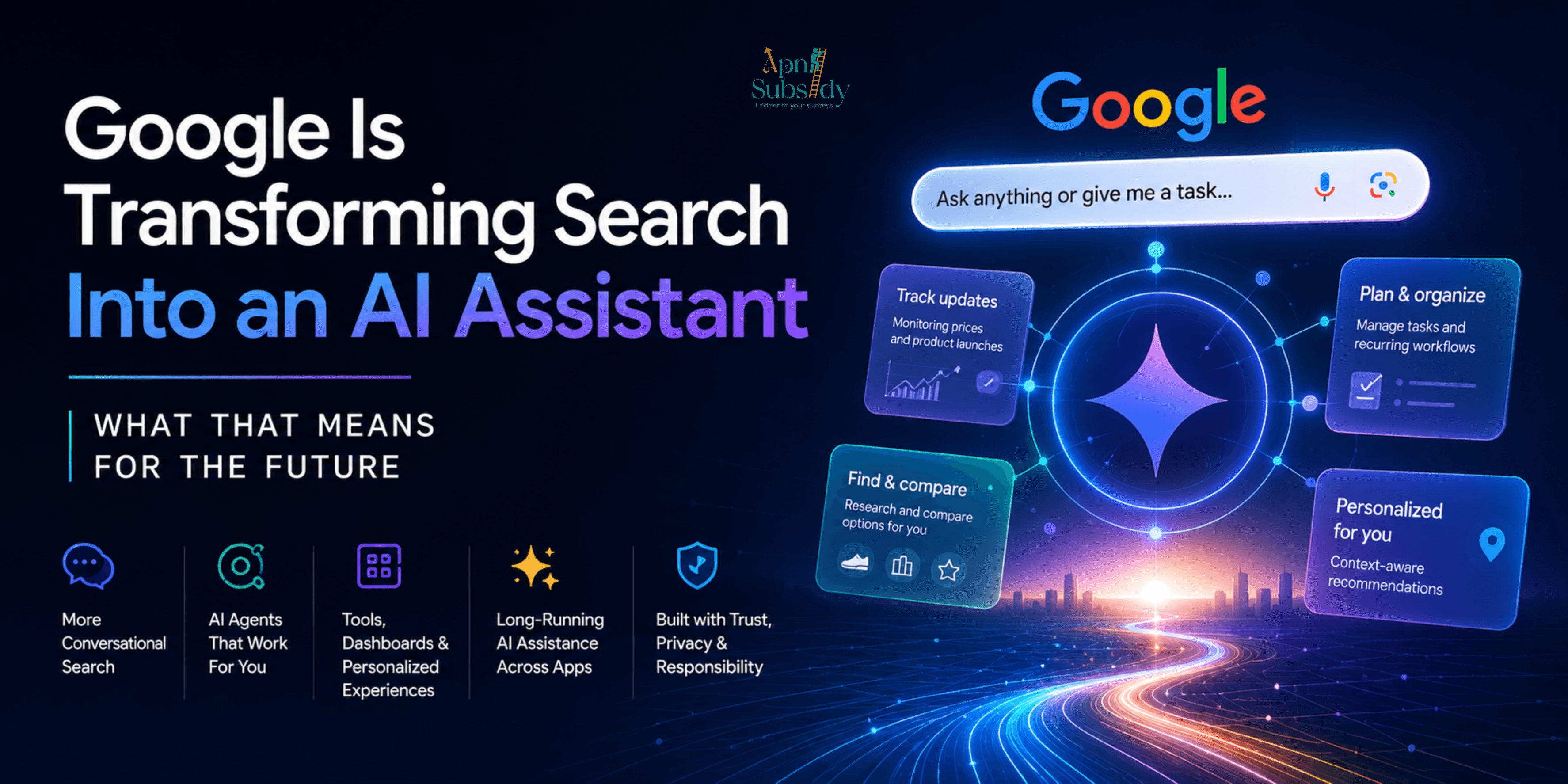
Google Is Transforming Search Into an AI Assistant.
Google Is Transforming Search Into an AI Assistant.
What That Means for the Future
For more than two decades, Google's search engine has worked in essentially the same way: users type a query, Google returns a list of links, and people decide where to go next. Over time, Google added features like featured snippets, knowledge panels, and AI-generated summaries, but the core experience remained largely unchanged.
Google's latest announcements suggest that this model is evolving into something fundamentally different. Instead of simply helping users find information, Search is increasingly being designed to help users complete tasks, monitor information, and take action.
Whether this represents a major leap forward or introduces new challenges remains to be seen, but it is one of the most significant shifts in Google's search strategy in years.
Search Is Becoming More Conversational
Powered by Google's latest Gemini models, Search is moving beyond traditional keyword-based queries.
Instead of typing fragmented searches such as "Nike sneaker collabs 2026," users can now make more detailed requests such as:
"Keep track of my favorite athletes and notify me when they launch new shoe collaborations."
The goal is not to eliminate searching altogether, but to reduce repetitive searches and help users reach desired outcomes more efficiently.
This reflects a broader industry trend: moving from information retrieval toward goal-oriented assistance.
Search Is Gaining Agent-Like Capabilities
One of Google's most notable announcements involves the introduction of AI-powered task management features within Search.
These systems can monitor topics, track updates, and surface relevant information over time without requiring users to repeatedly check for changes themselves.
Potential use cases include:
Tracking product launches
Monitoring industry developments
Following real estate listings
Keeping up with competitors
Watching for price changes
The shift is subtle but important.
Traditionally, users searched for information each time they needed it. Increasingly, AI systems may handle some of that monitoring work in the background and report back when something important changes.
Search Is Expanding Beyond Answers
Google also demonstrated how Search could generate simple tools, dashboards, and personalized experiences.
Examples include:
Fitness trackers
Personalized information dashboards
Location-aware recommendations
Task-specific planning tools
While these demonstrations show promising possibilities, real-world performance will ultimately determine their value. As with most AI-powered systems, users should expect occasional inaccuracies and continue verifying important information.
The broader direction, however, is clear: Search is evolving from a destination for information into a platform that helps users act on information.
Gemini Spark Brings Long-Running AI Assistance
Alongside Search updates, Google introduced Gemini Spark, a system designed to manage ongoing tasks across a user's digital environment.
According to Google, Spark can assist with activities such as:
Monitoring emails
Organizing to-do lists
Tracking documents
Summarizing information across Google services
Managing recurring workflows
Google has also indicated plans to expand support beyond its own ecosystem, potentially allowing Spark to interact with third-party applications.
The long-term vision appears to be an assistant that can work across multiple services rather than operating as a standalone chatbot.
AI Is Becoming More Persistent
One notable aspect of these announcements is that many of these systems can continue operating even when users are not actively interacting with them.
While background automation is not new, AI agents introduce a different level of autonomy. Instead of simply executing predefined rules, they may evaluate information, make decisions about relevance, and determine when to notify users.
This raises practical questions about trust, oversight, and how much autonomy people are comfortable giving to software systems.
Competition Is Accelerating Innovation
Google's announcements also reflect the rapidly evolving competitive landscape.
Companies such as OpenAI, Anthropic, and Meta have expanded AI capabilities beyond traditional chatbots into research, reasoning, automation, and task execution.
As users increasingly rely on AI systems for information gathering and decision support, Google faces pressure to evolve Search beyond its traditional role.
At the same time, Google's position remains unique. Few organizations combine:
Global-scale search infrastructure
Billions of users
Advanced AI research capabilities
Large cloud computing resources
This combination gives Google significant advantages as AI adoption continues to grow.
The AGI Discussion Continues
Google DeepMind continues to discuss Artificial General Intelligence (AGI) as a long-term research objective.
However, AGI remains a highly debated concept. There is no universally accepted definition, and researchers disagree on how it should be measured or when it might be achieved.
Current AI systems have made substantial progress in reasoning, coding, content creation, and task automation, but they still have important limitations in reliability, factual accuracy, and long-term planning.
For now, AGI remains an aspiration rather than an accomplished milestone.
The Challenge for Publishers and the Open Web
One of the most important questions raised by AI-powered search is its impact on publishers.
Historically, search engines served as a gateway to websites, sending traffic to news organizations, bloggers, businesses, and independent creators.
As AI-generated answers become more comprehensive, users may have fewer reasons to visit the original sources.
This creates a difficult balancing act.
Users benefit from faster answers and greater convenience, while publishers depend on traffic and visibility to sustain their work. How Google and other AI companies address this tension may shape the future of the open web.
Public Concerns Remain
Despite rapid progress, public concerns surrounding AI have not disappeared.
Common concerns include:
Privacy
Data security
Job displacement
Misinformation
Bias and fairness
Energy consumption
These concerns are not necessarily arguments against AI adoption, but they highlight the importance of responsible deployment and transparency.
As AI systems become more integrated into daily life, trust may become just as important as technical capability.
Where Search Is Headed Next
Google appears to be betting that the future of information access will combine searching, conversation, and AI-assisted task completion.
Rather than simply presenting information, Search is increasingly being designed to help users monitor, organize, and act on that information.
The result could be a more efficient and personalized experience. It could also introduce new dependencies, challenges, and questions about how much decision-making users are willing to delegate to AI systems.
What is clear is that Search is evolving beyond its traditional role. The familiar model of typing keywords and browsing links is unlikely to disappear overnight, but it is gradually being joined by a new model—one where AI helps manage not only what we know, but also what we do with that knowledge.
Tags
Work With Us
Need help identifying the right subsidy, preparing documentation, or maximizing claim value? Our team can guide you end to end.
Get in Touch