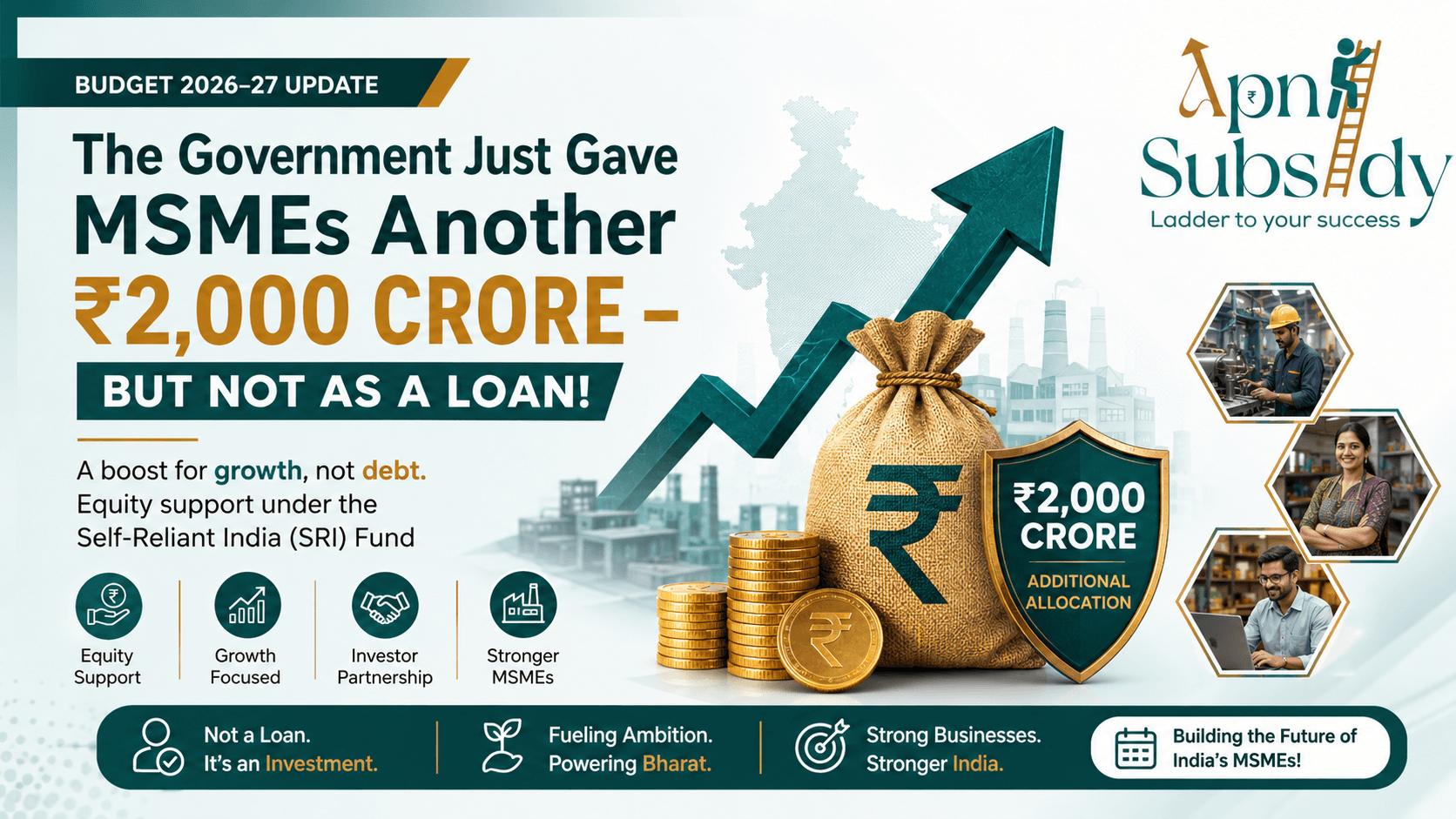
The Government Just Gave MSMEs Another ₹2,000 Crore – But Not as a Loan
The Government Just Gave MSMEs Another ₹2,000 Crore – But Not as a Loan
When most MSME owners hear about a new government announcement, the first assumption is usually the same: another loan scheme. But the Union Budget 2026–27 introduced something different.
The government has allocated an additional ₹2,000 crore to the Self-Reliant India (SRI) Fund—a fund that doesn't lend money to businesses. Instead, it invests in them.
This distinction is important because it changes who can benefit, how the funding works, and why it could be a better option than traditional business loans for certain MSMEs.
What is the Self-Reliant India (SRI) Fund?
The Self-Reliant India Fund (SRI Fund) was launched under the Aatmanirbhar Bharat initiative with a planned corpus of ₹50,000 crore.
The structure is unique:
The Government of India contributed ₹10,000 crore as the "Mother Fund."
The objective is to attract another ₹40,000 crore from private equity and venture capital investors.
Instead of investing directly in MSMEs, the government channels its capital through SIDBI-empanelled venture capital and private equity funds.
These funds then identify and invest in high-potential MSMEs using equity or quasi-equity financing.
This isn't a newly launched initiative. It is an established investment platform that has already been supporting businesses for several years.
As of November 2025, the SRI Fund ecosystem had supported 682 MSMEs, deploying investments worth approximately ₹15,442 crore. The additional ₹2,000 crore announced in Budget 2026–27 strengthens this existing funding mechanism rather than creating a new scheme.
Why This Matters for MSMEs
Most government financial support available to MSMEs is debt-based.
Schemes such as:
Emergency Credit Line Guarantee Scheme (ECLGS)
Credit Guarantee Fund Trust for Micro and Small Enterprises (CGTMSE)
Mutual Credit Guarantee Scheme for manufacturers and exporters
all work in a similar way.
Banks or NBFCs provide loans, while the government guarantees a portion of the risk if the borrower defaults.
These schemes improve access to finance, but the money remains a loan. Businesses are still required to repay it with interest according to a fixed schedule, regardless of market conditions or business performance.
The SRI Fund follows a completely different model.
Equity vs Loan: Understanding the Difference
When a venture capital fund invests through the SRI Fund ecosystem, it becomes a shareholder in the business.
Unlike banks, investors are not expecting fixed monthly repayments.
Instead, they expect the company's value to grow over time so that their investment becomes more valuable.
This can be particularly beneficial for businesses that are:
Expanding manufacturing capacity
Launching a new product line
Entering new markets
Investing heavily in technology
Scaling operations before revenue catches up
During such growth phases, cash flows are often uneven. In these situations, equity funding may provide more flexibility than debt financing.
However, equity also comes with a trade-off.
Business owners must be willing to give up a portion of ownership and, in many cases, share strategic decision-making with investors.
Can MSMEs Apply Directly?
One of the biggest misconceptions is that businesses can directly apply to the SRI Fund.
They cannot.
Unlike subsidy schemes or government portals, the SRI Fund does not accept applications from MSMEs.
Instead, businesses must approach one of the SIDBI-empanelled venture capital or private equity funds that receive capital through the SRI Fund.
These investment funds independently evaluate companies and decide where to invest.
Which Businesses Are Most Likely to Benefit?
The SRI Fund is not designed for every MSME.
It generally targets businesses that already demonstrate strong growth potential.
Typically, investment funds look for companies that have:
An established business model
Revenue traction
Clear expansion plans
Strong financial reporting
Good corporate governance
Scalability across markets
This makes the scheme more suitable for growing manufacturing and service businesses than for early-stage micro enterprises or businesses looking only for working capital.
For newer or survival-stage businesses, government-backed loan guarantee schemes may still be the more appropriate option.
What Does the New ₹2,000 Crore Allocation Mean?
The additional ₹2,000 crore announced in the Union Budget does not change how the SRI Fund operates.
Instead, it signals the government's continued commitment to expanding equity-based financing for MSMEs.
Rather than relying solely on loans, policymakers are strengthening alternative funding channels that help promising businesses grow without taking on excessive debt.
It also reflects a broader shift in India's MSME financing strategy—offering entrepreneurs multiple financial instruments based on their stage of growth and funding requirements.
Final Thoughts
The additional ₹2,000 crore allocated to the Self-Reliant India Fund is more than just another budget announcement.
It reinforces the idea that not every growing business needs another loan.
For MSMEs with ambitious expansion plans, strong financial discipline, and investor-ready operations, equity funding through the SRI Fund ecosystem could provide the growth capital needed without the pressure of fixed loan repayments.
The key is understanding that the opportunity doesn't lie in submitting an application to the government—it lies in connecting with the right SIDBI-empanelled venture capital or private equity fund that participates in the SRI Fund network.
As India's MSME ecosystem evolves, knowing when to choose debt and when to choose equity may become one of the most important financial decisions a business owner makes.
Tags
Work With Us
Need help identifying the right subsidy, preparing documentation, or maximizing claim value? Our team can guide you end to end.
Get in Touch