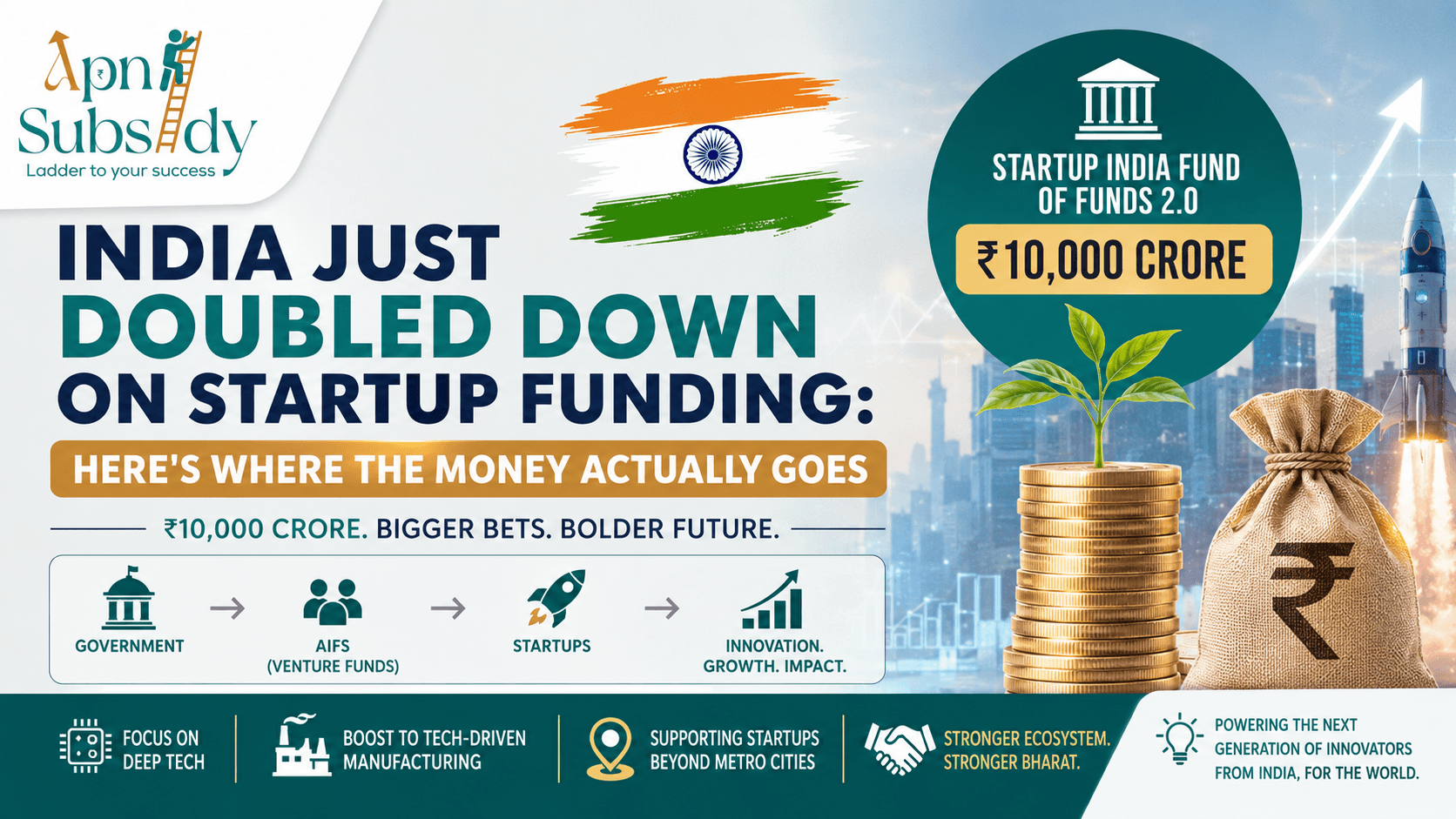
India Just Doubled Down on Startup Funding: Here's Where the Money Actually Goes
India Just Doubled Down on Startup Funding: Here's Where the Money Actually Goes
For nearly a decade, one government-backed fund quietly influenced how venture capital reached Indian startups. Now, the government has launched a second major fund—and this time, it's focused on the next generation of innovation.
The Startup India Fund of Funds (FoF) 2.0, with a corpus of ₹10,000 crore, is no longer just a policy announcement. After receiving Cabinet approval in February, the fund has officially begun operations, marking a significant step in India's long-term startup financing strategy.
But before founders start expecting direct government cheques, it's important to understand how this fund actually works—and why it could matter far beyond India's biggest startup hubs.
What Is Startup India Fund of Funds 2.0?
Unlike traditional grant programs, the government does not invest directly into startups.
Instead, the Small Industries Development Bank of India (SIDBI), acting as the implementation agency, channels government capital into SEBI-registered Alternative Investment Funds (AIFs). These professional venture capital funds then identify and invest in promising startups.
In simple terms:
Government → AIFs (Venture Capital Funds) → Startups
This structure allows experienced fund managers—not government officials—to make investment decisions while ensuring startups gain access to larger pools of private capital.
Building on the Success of the First Fund
This isn't India's first experiment with a Fund of Funds.
The original Startup India Fund of Funds, launched in 2016 with the same ₹10,000 crore corpus, has already delivered substantial results.
According to official figures, it has:
Invested through 145 Alternative Investment Funds
Catalyzed investments exceeding ₹25,500 crore
Supported more than 1,370 startups
Backed businesses across sectors including:
FinTech
AgriTech
Biotechnology
Space Technology
Manufacturing
Healthcare
During this period, India's startup ecosystem expanded dramatically—from fewer than 500 recognized startups to over 2 lakh DPIIT-recognized startups.
Fund of Funds 2.0 isn't replacing the original scheme. Instead, it's adding another ₹10,000 crore to fuel the ecosystem's next phase of growth.
What's Different About FoF 2.0?
While the first fund broadly strengthened India's startup ecosystem, the second version has a much more focused strategy.
1. Greater Focus on Deep Tech
FoF 2.0 prioritizes startups working in areas such as:
Artificial Intelligence
Semiconductors
Robotics
Advanced Manufacturing
Defence Technology
Space Technology
Climate Technology
Biotechnology
These businesses often require years of research and development before becoming profitable, making them less attractive to traditional venture investors seeking quicker returns.
2. Support for Tech-Driven Manufacturing
India wants to become a global manufacturing hub.
To support this goal, the fund is expected to back startups building:
Industrial automation
Electronics manufacturing
Precision engineering
Advanced materials
Hardware innovation
These sectors generally require larger capital investments than software startups and benefit from patient, long-term funding.
3. Helping Startups Beyond the Metro Cities
India's startup ecosystem has traditionally been concentrated in:
Bengaluru
Delhi NCR
Mumbai
FoF 2.0 aims to encourage venture capital to flow into founders based in Tier-2 and Tier-3 cities, where innovative businesses often struggle to attract investors despite strong market potential.
Startup Recognition Rules Have Also Changed
The funding initiative comes alongside important changes to India's startup recognition framework.
The government has already:
Increased the turnover limit for standard startup recognition from ₹100 crore to ₹200 crore
Introduced a dedicated Deep Tech Startup category with:
Turnover eligibility up to ₹300 crore
Recognition valid for 20 years, compared to the standard recognition period
Together, these reforms indicate a clear policy direction: support startups working on complex, capital-intensive technologies for a longer period.
What Does This Mean for MSMEs?
For MSMEs and manufacturing businesses, the biggest question isn't whether the scheme exists—it's whether they can benefit from it.
The answer is: eventually, yes—but not immediately.
Although FoF 2.0 has begun implementation, investment capital still needs to move through several stages:
Government allocates capital
AIFs receive commitments
Venture funds complete fundraising
Investment teams evaluate startups
Capital finally reaches founders
This process typically takes several months.
Businesses expecting immediate funding may need to be patient, as deployment is likely to happen over quarters rather than weeks.
What Businesses Can Do Right Now
Even if investment deployment takes time, there are immediate steps founders should consider.
Check Your Startup Eligibility
If your company previously crossed the old ₹100 crore turnover limit, you may now qualify under the revised ₹200 crore threshold.
Deep tech businesses may also qualify under the newly introduced category with higher eligibility limits.
Obtaining DPIIT Startup Recognition can unlock benefits beyond Fund of Funds 2.0, including:
Tax incentives
Easier access to government schemes
Intellectual property support
Faster regulatory approvals
Improved investor confidence
Reviewing your eligibility today could position your business to benefit from future funding opportunities.
The Bigger Picture
India's first Fund of Funds helped build the country's startup ecosystem over the past decade.
Now, with another ₹10,000 crore committed, the government's focus is shifting from simply creating more startups to supporting businesses tackling deeper technological challenges, advanced manufacturing, and innovation emerging from smaller cities.
Whether FoF 2.0 becomes as transformative as its predecessor will depend on how effectively capital reaches venture funds—and ultimately, the entrepreneurs building India's next generation of companies.
One thing, however, is already clear: the government isn't just trying to create more startups anymore. It's investing in making India's startup ecosystem more resilient, technology-driven, and globally competitive.
Tags
Work With Us
Need help identifying the right subsidy, preparing documentation, or maximizing claim value? Our team can guide you end to end.
Get in Touch