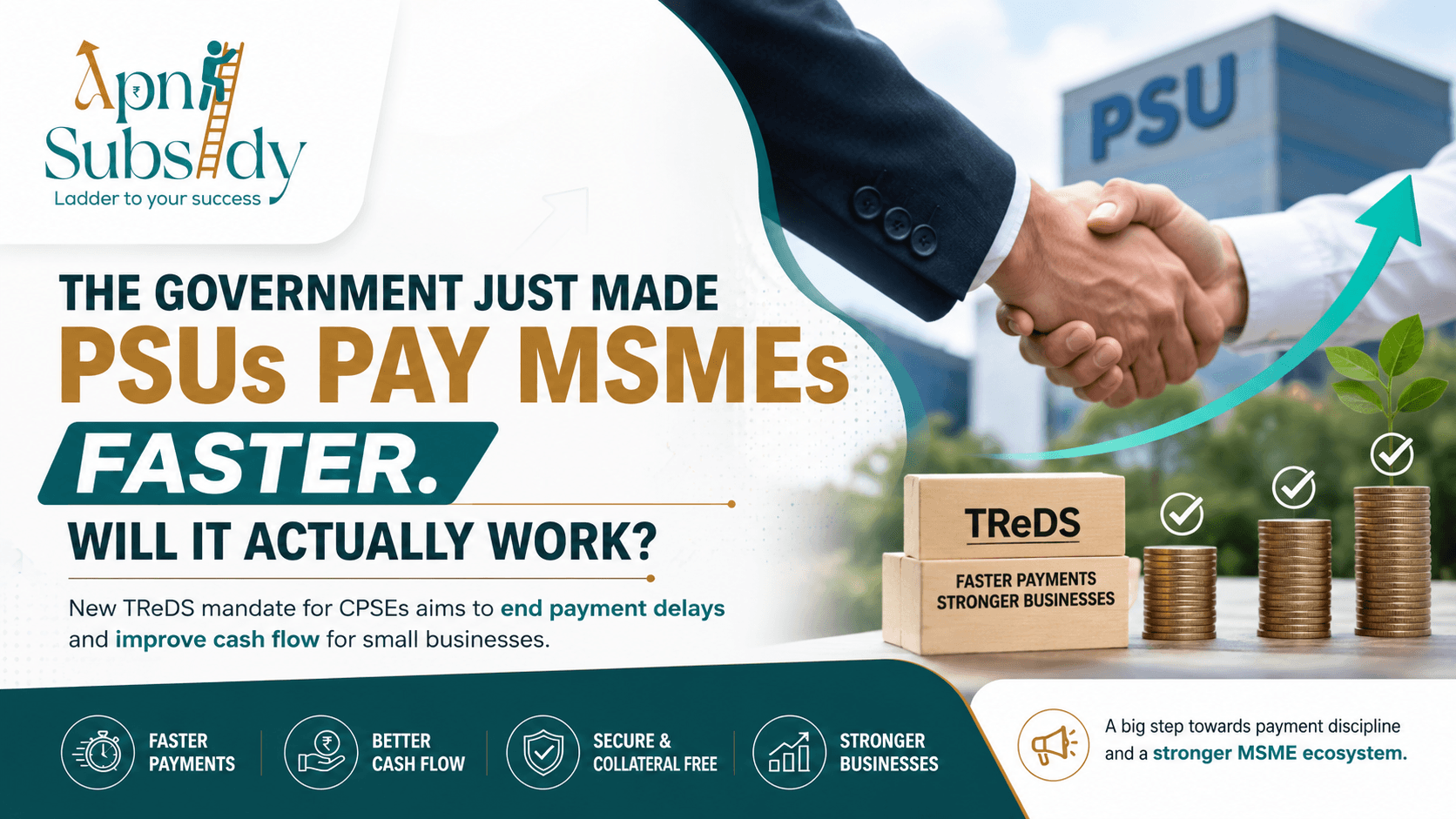
The Government Just Made PSUs Pay MSMEs Faster. Will It Actually Work?
The Government Just Made PSUs Pay MSMEs Faster. Will It Actually Work?
For years, delayed payments have been one of the biggest frustrations for India's Micro, Small, and Medium Enterprises (MSMEs). A small manufacturer supplying components to a public sector steel plant or a service provider working with a government-owned bank often had to wait months to receive payments that were contractually due within weeks.
The financial strain created by these delays has affected cash flow, business expansion, and even day-to-day operations for countless small businesses.
Now, the government is attempting to change that.
On June 30, the Ministry of MSME issued new guidelines making it mandatory for every operating Central Public Sector Enterprise (CPSE) to process payments to MSME suppliers through the Trade Receivables Discounting System (TReDS). While the announcement itself wasn't unexpected—it had already been proposed by Finance Minister Nirmala Sitharaman during the Union Budget 2026–27—the latest notification transforms that proposal into an enforceable compliance requirement.
The question now is simple:
Will this finally solve India's long-standing MSME payment problem?
What Exactly Has Changed?
Under the new guidelines, every invoice raised by an MSME against a Central Public Sector Enterprise must now be processed through an RBI-regulated TReDS platform instead of remaining stuck in traditional payment approval systems.
Here's how the new process works:
An MSME supplies goods or services to a CPSE.
The CPSE verifies and approves the invoice.
Once approved, the invoice is uploaded to a TReDS platform.
Banks and NBFCs compete to finance that invoice by offering discounted rates.
The MSME receives payment almost immediately instead of waiting for the official payment due date.
Unlike traditional loans, this financing requires no collateral because the approved invoice itself serves as security.
For small businesses that constantly struggle with working capital, this could significantly improve cash flow.
The Biggest Difference Isn't TReDS—It's Enforcement
TReDS isn't new.
The platform has existed since 2017, but participation—particularly among government buyers—has remained inconsistent.
The latest notification changes that by introducing something previous guidelines lacked:
Accountability.
Every CPSE is now required to:
Route eligible MSME invoices through TReDS.
Report invoice routing and settlement data in an RBI-prescribed format.
Have statutory auditors certify TReDS registration and compliance during annual audits.
This means participation is no longer voluntary or symbolic.
Government-owned companies will now leave an audit trail that regulators, auditors, policymakers, and researchers can verify.
That significantly raises the cost of non-compliance.
Why This Matters for MSMEs
India's MSME sector forms the backbone of the country's economy.
Today, more than 8.7 crore enterprises are registered on the Udyam Portal, collectively employing over 38 crore people.
Yet delayed payments remain one of the most common complaints across industries.
Late payments create a chain reaction:
Working capital gets locked.
Salaries become difficult to manage.
Inventory purchases slow down.
Growth plans are postponed.
Businesses often take expensive loans simply to survive while waiting for payments.
The government hopes mandatory TReDS adoption can break this cycle.
The platform's own growth suggests the model works when buyers actually participate.
Invoice discounting through TReDS has expanded from roughly ₹40,000 crore in FY22 to nearly ₹3.47 lakh crore in FY26, demonstrating increasing confidence in the system.
Industry Leaders Welcome the Move—With One Important Caveat
Industry associations have largely welcomed the notification, but few believe it solves the entire payment delay problem.
Anil Bharadwaj, Secretary General of the Federation of Indian Micro and Small & Medium Enterprises (FISME), pointed out that many Central PSUs were already relatively disciplined in making payments.
According to him, the larger problems often arise elsewhere:
Government ministries
State Public Sector Enterprises
Electricity distribution companies
Other government agencies not covered by the current mandate
His recommendation is straightforward:
Extend mandatory TReDS adoption to these entities and encourage wider participation from large private corporates as well.
The Indian Industries Association (IIA) echoed a similar view, describing the reform as a positive step but only one part of the broader solution needed to improve payment discipline across India's business ecosystem.
Will This Actually Work?
The answer depends less on technology and more on enforcement.
India has launched many well-intentioned schemes over the years that struggled because compliance remained optional.
This reform is different.
By requiring statutory auditors to certify compliance, the government has created a mechanism that is much harder to ignore.
A CPSE can no longer simply claim to support TReDS.
It must demonstrate compliance during its annual audit.
That shift in accountability may ultimately prove more important than the platform itself.
What Should MSMEs Do Now?
If your business supplies goods or services to a Central Public Sector Enterprise, now is the time to take advantage of the new framework.
You should:
Verify whether your CPSE buyer has registered on a TReDS platform.
Ensure eligible invoices are routed through TReDS.
Use invoice discounting to improve working capital instead of waiting for conventional payment cycles.
Stay updated on evolving MSME compliance requirements.
Businesses that actively adopt the new system could experience faster cash flow and reduced dependence on costly short-term borrowing.
Final Thoughts
Mandatory TReDS adoption for Central Public Sector Enterprises represents one of the government's most significant recent efforts to address delayed MSME payments.
The policy won't eliminate every payment bottleneck overnight, especially since many state-owned entities and private companies remain outside its scope.
However, by combining mandatory participation with audit-backed accountability, the government has taken a meaningful step toward improving payment discipline.
If implemented effectively, the reform could help thousands of MSMEs spend less time chasing invoices and more time growing their businesses.
Need Help Navigating the New MSME Rules?
Whether you're supplying to government buyers, registering under Udyam, exploring subsidy opportunities, or understanding evolving MSME compliance requirements, Apni Subsidy can help simplify the process and guide your business every step of the way.
Tags
Work With Us
Need help identifying the right subsidy, preparing documentation, or maximizing claim value? Our team can guide you end to end.
Get in Touch