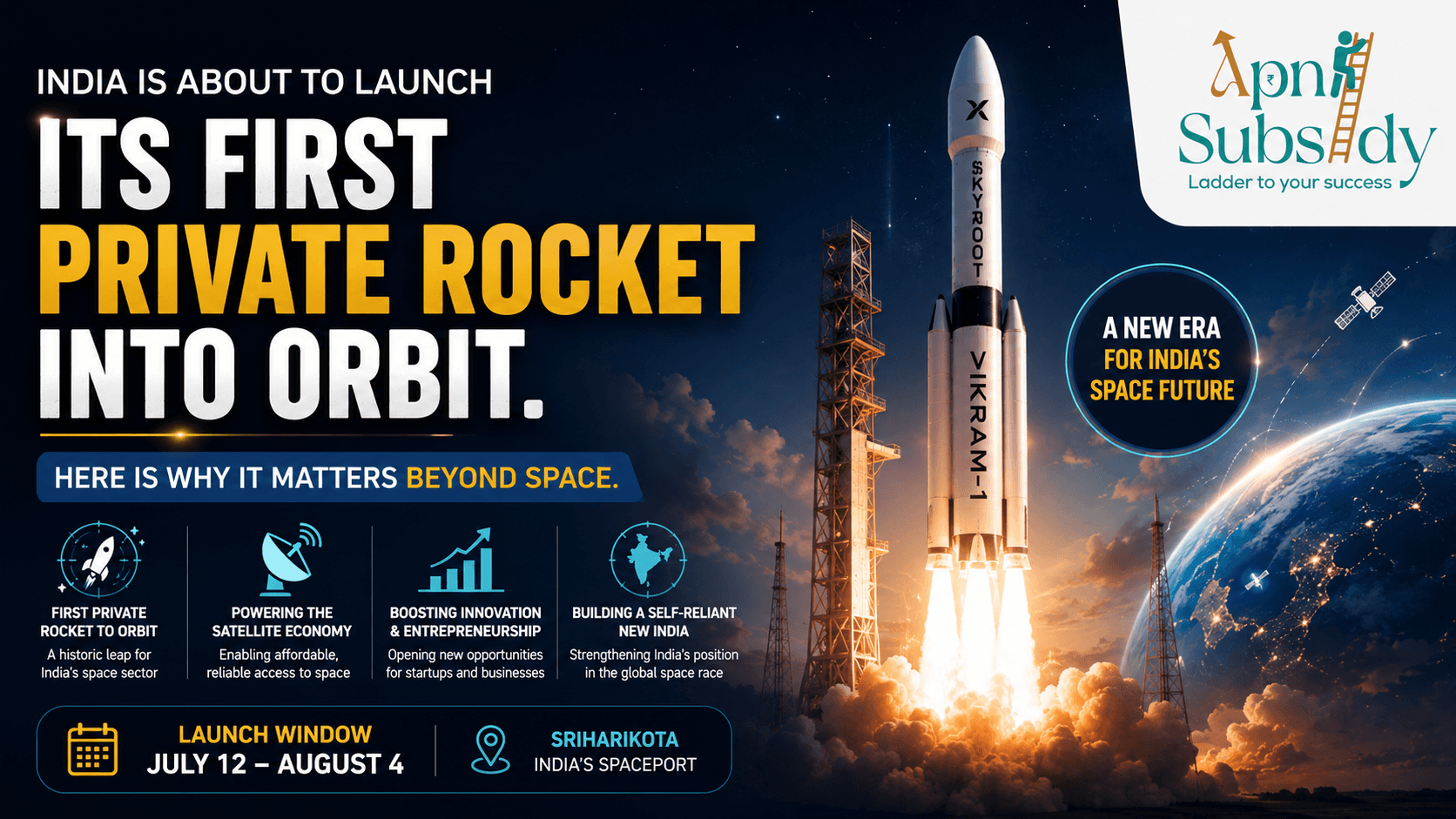
India Is About to Launch Its First Private Rocket Into Orbit. Here's Why It Matters Beyond Space.
India Is About to Launch Its First Private Rocket Into Orbit. Here's Why It Matters Beyond Space.
Sometime between July 12 and August 4, a rocket will rise from the Satish Dhawan Space Centre in Sriharikota and attempt something India has never seen before.
This mission will not be led by ISRO.
Instead, it will be launched by Skyroot Aerospace, a Hyderabad-based startup founded just eight years ago by two former ISRO engineers. If successful, Vikram-1 will become the first privately built Indian rocket to place a satellite into orbit, marking a milestone not only for India's space ambitions but also for its startup ecosystem.
This is more than a space mission. It is a story about entrepreneurship, policy reform, technological innovation, and the growing confidence in India's private sector.
From ISRO Engineers to Space Entrepreneurs
Skyroot Aerospace was founded in 2018 by Pawan Kumar Chandana and Naga Bharath Daka, both former ISRO scientists.
Their vision was simple but ambitious: build affordable launch vehicles specifically designed for the rapidly growing small-satellite market.
At the time, however, there was one major obstacle.
India's space sector was effectively closed to private launch companies. ISRO controlled launch infrastructure, testing facilities, and orbital missions, leaving startups with little opportunity to build commercial launch businesses.
Everything changed in 2020, when the Indian government opened the space sector to private participation.
Skyroot became one of the first startups to seize that opportunity.
Vikram-S Proved the Concept. Vikram-1 Aims to Make History.
In November 2022, Skyroot launched Vikram-S, becoming the first private Indian company to send a rocket into space.
Although it was a suborbital mission, meaning it did not place a satellite into orbit, the launch demonstrated that an Indian startup could successfully design, manufacture, and fly a rocket.
Now comes the next challenge.
Vikram-1 is an orbital launch vehicle capable of carrying satellites into Low Earth Orbit, where the majority of today's commercial satellite missions operate.
If successful, it will represent a historic first for India's private space industry.
Built for the Modern Space Economy
Vikram-1 has been designed specifically for today's commercial satellite market rather than traditional government missions.
The rocket stands roughly seven storeys tall and incorporates several advanced manufacturing technologies.
Among its key features are:
Carbon-composite structure that is lighter and stronger than conventional aluminium designs
3D-printed rocket engines that significantly reduce manufacturing time and cost
Payload capacity of approximately 350 kilograms to an altitude of around 450 kilometres
These capabilities make it well suited for launching Earth observation satellites, communication satellites, scientific payloads, and other small spacecraft that are increasingly in demand worldwide.
Investor Confidence Is Growing
The upcoming launch follows a major financial milestone for the company.
In May 2026, Skyroot raised $60 million from GIC, Singapore's sovereign wealth fund, along with Sherpalo Ventures.
The investment pushed Skyroot's valuation beyond $1 billion, making it India's first space-tech unicorn.
For investors, this was more than backing a rocket company.
It reflected confidence that India's commercial space sector is becoming a globally competitive industry capable of generating long-term business opportunities.
Why the Small Satellite Market Matters
The demand for launching small satellites has grown rapidly over the past decade.
Governments, universities, research institutions, and private companies now deploy hundreds of satellites each year for applications such as:
Weather forecasting
GPS navigation
Remote sensing
Agricultural monitoring
Disaster management
Broadband connectivity
Environmental observation
India now has more than 400 registered space startups, many of which design satellites but depend on foreign launch providers to reach orbit.
Most currently rely on overseas launch services, particularly SpaceX's Rideshare Programme, which often involves longer waiting periods, limited flexibility, and dependence on international launch schedules.
A successful Indian private launch vehicle would give domestic satellite companies a home-grown alternative.
Skyroot's "Cab to Space" Model
Unlike traditional rideshare missions, where multiple customers share a single launch, Skyroot is positioning itself as a provider of dedicated launches.
The company refers to this concept as "Cab to Space."
Instead of waiting for a rocket carrying dozens of unrelated payloads, customers can book an entire launch dedicated to placing their satellite into its required orbit.
For satellite operators requiring precise orbital placement, this flexibility can be more valuable than simply choosing the lowest launch price.
A Critical Moment for India's Space Industry
The timing of Vikram-1's launch is particularly significant.
In the months leading up to this mission, ISRO experienced two consecutive launch failures involving its Small Satellite Launch Vehicle (SSLV).
While ISRO remains one of the world's most respected space agencies with decades of successful missions, these setbacks reinforce an important reality.
Launching rockets is extraordinarily difficult.
They also highlight why a healthy commercial space ecosystem benefits from having multiple reliable launch providers rather than depending on a single organization.
Skyroot Isn't Alone
India's commercial space race now includes several promising startups.
Among them is Agnikul Cosmos, the Chennai-based company that recently conducted India's second private rocket launch using its own privately developed launchpad at Sriharikota.
The company also flew one of the world's first fully 3D-printed rocket engines in an operational launch.
Like Skyroot, Agnikul is building commercial launch services rather than experimental demonstrations, with paying customers already waiting for future missions.
Together, these companies signal that India's private space industry is moving beyond prototypes toward sustainable commercial operations.
Why This Matters Beyond Space
The significance of Vikram-1 extends well beyond rockets and satellites.
It demonstrates how policy reforms can unlock entirely new industries.
Before 2020, building a private orbital launch company in India was effectively impossible because the legal and regulatory framework did not exist.
Today, startups can design launch vehicles, access testing infrastructure, attract global investment, and compete in an international market worth billions of dollars.
Skyroot's journey reflects that transformation.
Eight years ago, it was a small team working from a Hyderabad incubator.
Today, it stands on the verge of attempting India's first privately operated orbital launch from the country's premier spaceport.
That evolution illustrates what becomes possible when innovation is matched by supportive policy.
Looking Ahead
The launch window for Vikram-1 opens between July 12 and August 4.
Success is far from guaranteed-orbital launches remain among the most complex engineering challenges in the world.
But regardless of the outcome, the mission represents a defining moment for India's startup ecosystem.
It is proof that Indian entrepreneurs are no longer limited to building apps, software platforms, or consumer businesses. They are now building rockets capable of competing in one of the world's most advanced industries.
Whether Vikram-1 reaches orbit on its first attempt or not, one thing is already clear:
India's private space era has officially begun.
Tags
Work With Us
Need help identifying the right subsidy, preparing documentation, or maximizing claim value? Our team can guide you end to end.
Get in Touch