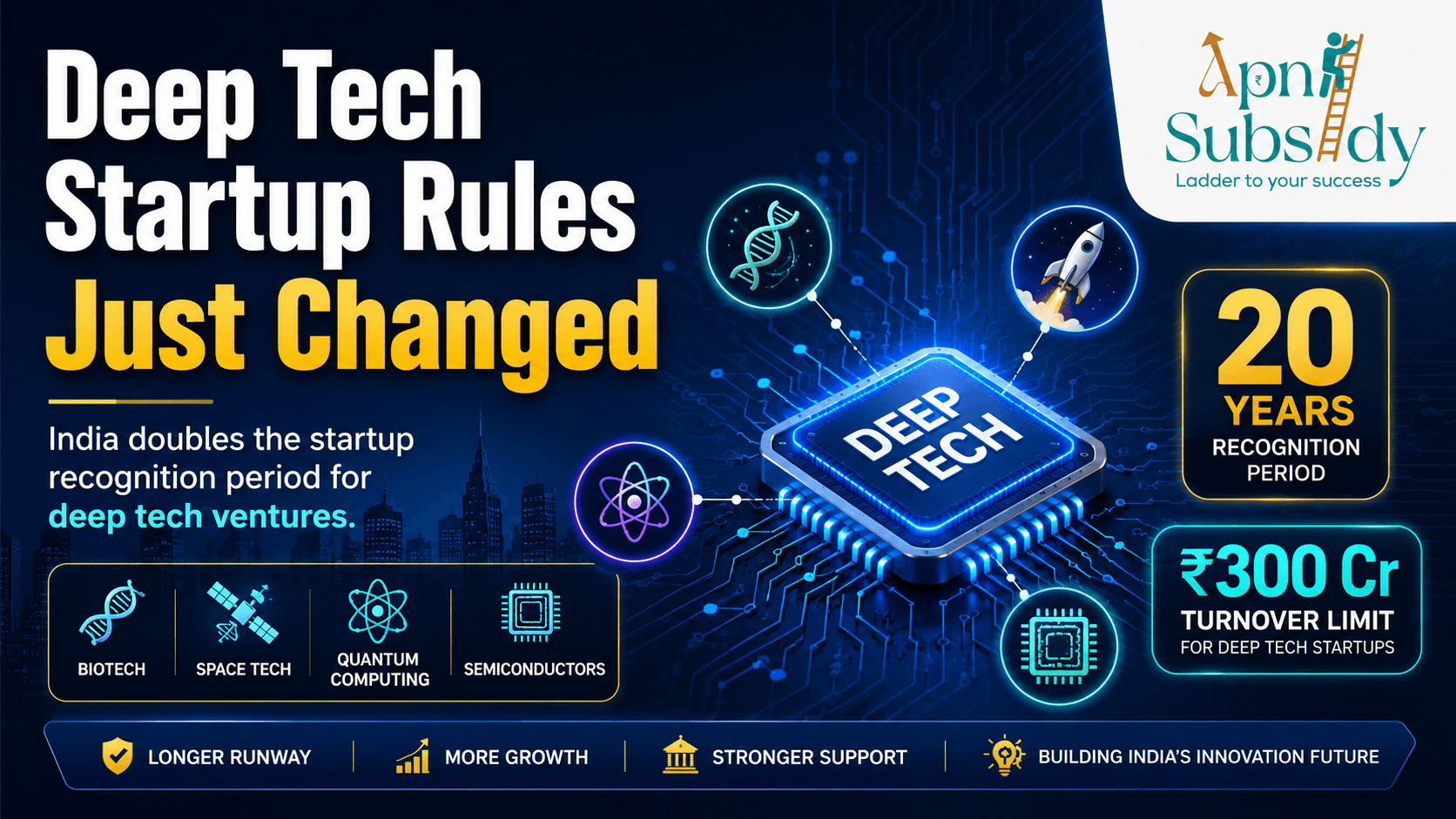
Deep Tech Startup Rules Just Changed. Here's Why It Matters.
Deep Tech Startup Rules Just Changed. Here's Why It Matters.
For years, India's deep tech founders have argued that the country's startup policies were designed for fast-growing digital businesses–not companies building technologies that can take a decade or more to reach the market.
The government has now responded.
A Gazette notification issued by the Department for Promotion of Industry and Internal Trade (DPIIT) on February 4 introduces one of the most significant changes to Startup India since the initiative was launched in 2016. The new rules give deep tech startups something they have consistently asked for: more time.
The Problem With the Old Rules
Until now, every DPIIT-recognized startup followed the same timeline.
A company would lose its startup status after 10 years or once its annual turnover crossed ₹100 crore, whichever came first.
For startups building consumer apps, SaaS products, fintech platforms, or e-commerce businesses, this framework was generally reasonable. Many of these companies generate commercial revenue within a few years.
Deep tech companies, however, operate on an entirely different timeline.
Businesses developing semiconductor technologies, advanced materials, biotechnology, quantum computing, aerospace systems, or new pharmaceuticals often spend years conducting research, building prototypes, filing patents, and completing testing before selling their first commercial product.
Many founders found themselves losing startup benefits precisely when their technologies were finally approaching commercialization.
That meant losing access to incentives such as the Section 80-IAC tax exemption, government support programs, and eligibility under the Fund of Funds for Startups-even though their businesses were only beginning to enter the market.
A New Category for Deep Tech
The notification formally creates a dedicated Deep Tech Startup category, something that did not previously exist under Startup India.
To qualify, companies must demonstrate that they are developing genuine scientific or engineering innovations rather than incremental software improvements. Applicants are expected to provide evidence of:
Significant investment in research and development
Ownership of intellectual property
A credible commercialization strategy
Scientific or engineering innovation with meaningful technological advancement
Recognition is not automatic. Companies must apply through the DPIIT portal, where each application is reviewed individually before approval.
What Has Changed?
The biggest change is the extension of the recognition period.
Qualified deep tech startups can now retain their startup status for 20 years, double the previous limit of 10 years.
The turnover ceiling has also increased significantly.
Instead of losing recognition after crossing ₹100 crore, deep tech startups can now continue receiving startup benefits until they reach ₹300 crore in annual turnover.
Regular startups have also received some relief.
While their recognition period remains capped at 10 years, their turnover limit has increased from ₹100 crore to ₹200 crore.
For many founders, these changes provide a much longer runway before government support expires.
Stricter Rules on Fund Usage
The notification also introduces tighter conditions regarding how recognized startups can use their capital.
Companies can no longer use startup-related benefits while investing in residential property, luxury purchases, or speculative financial investments.
The objective is to ensure that government-backed incentives continue supporting innovation and business growth rather than non-business assets.
Cooperative Societies Can Now Register
Another important—but less discussed—change expands eligibility beyond traditional private companies.
For the first time, Multi-State Cooperative Societies and State Cooperative Societies can register as startups under the Startup India framework.
This could prove especially relevant for sectors such as agriculture, dairy, handicrafts, and rural entrepreneurship, where cooperative business models are common.
States like Rajasthan, with large cooperative networks in dairy production and handicrafts, may particularly benefit from this expanded definition.
Why the Government Is Doing This
The policy change reflects a broader concern about India's deep tech ecosystem.
Despite having one of the world's largest engineering talent pools, deep tech startups still represent only a small share of India's startup landscape.
As of 2024, only around 10% of DPIIT-recognized startups operated in deep tech sectors such as artificial intelligence, biotechnology, quantum computing, advanced materials, and other research-intensive industries.
The government has repeatedly stated that this number is too low if India aims to build long-term technological self-reliance.
Budget allocations reinforce that priority.
The Union Budget earmarked ₹20,000 crore for research and development during FY 2026–27 as part of the larger ₹1 lakh crore Research, Development and Innovation initiative, alongside plans for a dedicated Deep Tech Fund of Funds.
Together, these measures signal a stronger policy focus on high-impact scientific innovation.
Investors See a Positive Signal
Many investors have welcomed the new framework.
One long-standing concern among venture capital firms was that startup recognition often expired just as deep tech companies became commercially viable.
Unlike software startups, deep tech investments frequently require patient capital over 12 to 15 years before generating meaningful returns.
Extending the recognition period reduces that mismatch and may encourage greater long-term investment into Indian deep tech ventures.
While the policy does not eliminate investment risk, it makes the ecosystem more aligned with the realities of scientific innovation.
Is This Enough?
The notification removes an important policy obstacle, but it does not solve every challenge facing deep tech founders.
Longer recognition periods and higher turnover limits certainly help companies retain tax benefits and government support for a greater portion of their lifecycle.
However, successful commercialization still depends on factors that extend well beyond startup recognition.
Access to patient capital, world-class research infrastructure, testing facilities, manufacturing capabilities, regulatory support, and government procurement opportunities remain equally important.
In other words, this reform gives deep tech startups more time—but time alone will not build the next generation of Indian semiconductor companies, biotech innovators, or space technology leaders.
Whether these changes become a true turning point or simply a useful administrative improvement will become clearer over the next few years as funding trends, commercialization rates, and startup growth begin to reflect the impact of the new policy.
For now, however, India's deep tech ecosystem has received something it has long been asking for: a framework that better matches the pace of breakthrough innovation.
Tags
Work With Us
Need help identifying the right subsidy, preparing documentation, or maximizing claim value? Our team can guide you end to end.
Get in Touch