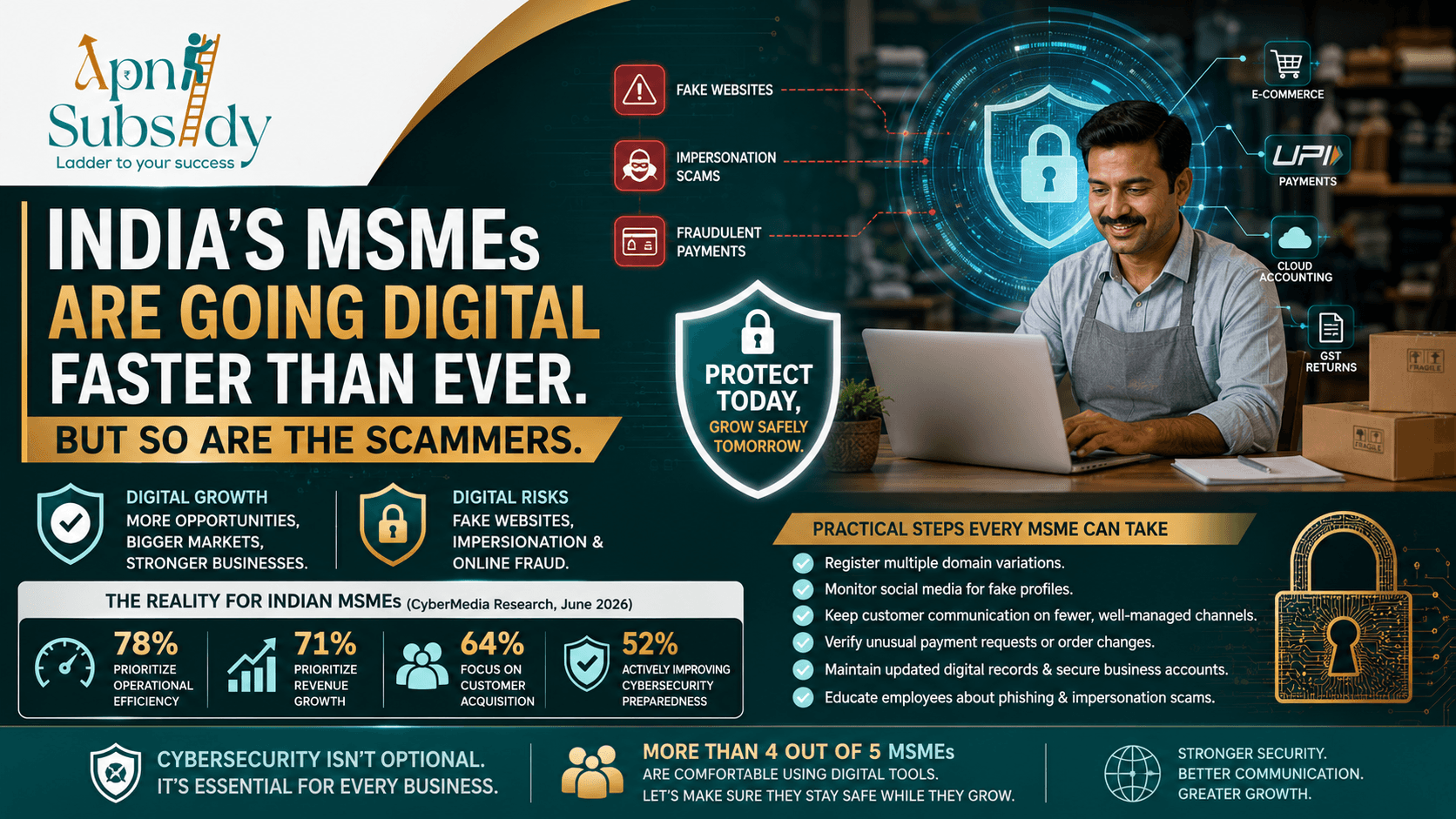
India's MSMEs Are Going Digital Faster Than Ever. But So Are the Scammers.
India's MSMEs Are Going Digital Faster Than Ever. But So Are the Scammers.
Over the past decade, India's MSME sector has undergone a remarkable digital transformation.
From accepting UPI payments and filing GST returns online to selling through e-commerce marketplaces and managing finances with cloud-based accounting software, millions of small businesses have embraced technology to improve efficiency and reach new customers.
The shift has delivered undeniable benefits. Transactions are faster, records are easier to manage, and businesses have access to markets that once seemed out of reach.
But as India's small businesses become more visible online, they are also becoming more attractive targets for cybercriminals.
The biggest threat today isn't always a hacked computer or a ransomware attack. Sometimes, it's something far quieter-and far more difficult to detect.
The Cyber Threat Most Small Businesses Never See Coming
According to Sanjay Katkar, Joint Managing Director at Quick Heal, many attacks against small businesses don't begin by breaking into company systems.
Instead, they happen outside the business itself.
Cybercriminals create fake websites that closely resemble legitimate businesses, register lookalike domain names to mislead customers, or operate fraudulent social media accounts impersonating trusted brands.
These scams often remain unnoticed for weeks or even months.
Customers unknowingly place orders through fake websites, transfer payments to fraudulent accounts, or lose confidence in a business after interacting with an impersonator. By the time the real business owner discovers the issue, both revenue and reputation may already have suffered.
Unlike ransomware or data breaches, these attacks rarely trigger obvious warning signs. They quietly damage customer trust while operating in plain sight.
Why MSMEs Are More Vulnerable
Large corporations typically have dedicated cybersecurity teams monitoring their online presence around the clock.
Most MSMEs don't.
For many small businesses, the owner is simultaneously managing procurement, inventory, customer service, compliance, finance, and marketing. Monitoring fake domains and impersonation accounts simply isn't part of the daily routine.
Cybercriminals understand this gap.
They know that smaller businesses often lack the resources to regularly monitor their digital presence, making them easier targets for brand impersonation and online fraud.
Communication Gaps Can Create Security Risks
Cybersecurity isn't only about protecting computers.
It's also about protecting customer communication.
As Harsha Solanki of Infobip has highlighted, many MSMEs communicate with customers across multiple platforms-WhatsApp, email, phone calls, and social media-without maintaining a unified record of those conversations.
This creates operational confusion.
A customer may receive different responses depending on which platform they use, while employees may have incomplete information about previous discussions.
More importantly, fragmented communication creates opportunities for fraud.
Without a single, trackable conversation history, suspicious payment requests or unusual customer interactions are easier to miss, making scams harder to identify before damage occurs.
AI Is Changing the Landscape
Artificial Intelligence is rapidly becoming part of everyday business operations, but its benefits depend heavily on how digitally prepared a business already is.
A CyberMedia Research study conducted in June 2026 found that:
78% of Indian MSMEs consider operational efficiency their highest business priority.
71% prioritize revenue growth.
64% focus on customer acquisition.
52% say they are actively improving their cybersecurity preparedness.
The findings suggest encouraging progress, but they also highlight an important reality.
Nearly half of India's MSMEs have yet to make cybersecurity a formal priority, even as their digital presence continues to expand.
AI Alone Cannot Solve Weak Digital Foundations
Artificial intelligence has enormous potential to automate operations, improve customer service, and strengthen security.
However, AI is not a shortcut for businesses that lack organized digital systems.
Companies with structured customer data, centralized communication, and properly managed digital infrastructure can adopt AI tools relatively quickly.
Businesses still relying on scattered spreadsheets, personal mobile numbers, and disconnected communication channels face a much greater challenge.
Without clean, organized data, even the most advanced AI tools cannot deliver reliable security or meaningful business insights.
In many cases, strengthening digital foundations should come before investing heavily in AI solutions.
Practical Steps Every MSME Can Take
Improving cybersecurity doesn't always require expensive enterprise software or dedicated security teams.
Several practical measures can significantly reduce risk:
Register multiple variations of your business domain before fraudsters do.
Regularly monitor social media platforms for fake business profiles.
Keep customer communication on fewer, well-managed channels.
Verify payment requests or order changes that differ from a customer's normal purchasing pattern.
Maintain updated digital records and secure access to business accounts.
Educate employees about phishing attempts and impersonation scams.
These simple precautions often prevent the majority of common cyber threats faced by small businesses.
Digital Growth Brings Greater Responsibility
India's MSMEs are becoming increasingly formalized.
Digital records now play a larger role in loan approvals, credit assessments, government schemes, and business expansion opportunities.
That progress is encouraging.
However, greater digital visibility also makes businesses more attractive targets for fraudsters seeking financial information, customer databases, or brand credibility to exploit.
Recent industry research indicates that more than four out of five MSMEs are now comfortable using digital tools in their daily operations.
That growing confidence is a positive sign-but confidence must be matched with vigilance.
Final Thoughts
India's digital economy has opened remarkable opportunities for MSMEs to grow faster, serve more customers, and compete in larger markets than ever before.
Yet every new digital opportunity also introduces new risks.
Cybersecurity is no longer a concern reserved for large corporations. It has become a business necessity for enterprises of every size.
For India's MSMEs, the next stage of digital transformation isn't just about adopting more technology-it's about ensuring that every digital step forward is backed by stronger security, better communication, and greater awareness.
Because in today's business environment, protecting customer trust is just as important as earning it.
Tags
Work With Us
Need help identifying the right subsidy, preparing documentation, or maximizing claim value? Our team can guide you end to end.
Get in Touch