Rajasthan Just Rewrote Its Industrial Approval Timelines. Here's What Actually Changed
Rajasthan Just Rewrote Its Industrial Approval Timelines. Here's What Actually Changed
Every government policy announcement comes with big numbers. Investment promises, funding packages, and ambitious targets often dominate the headlines. But for entrepreneurs, especially MSME owners, the question is much simpler:
Will it actually become easier to start and grow a business?
That question became particularly relevant on June 27, when Rajasthan celebrated its first official International MSME Day. During the event, Chief Minister Bhajan Lal Sharma unveiled the Rajasthan Industrial Development Policy along with a financial package for MSMEs, startups, and the handicraft sector.
The announcement included eye-catching figures-a package worth more than ₹13 crore and claims of ₹8 lakh crore in active industrial Memorandums of Understanding (MoUs). While those numbers naturally attracted attention, they don't necessarily tell the full story.
The Headline Numbers Need Context
Large investment announcements often generate excitement, but it's important to understand what they actually represent.
MoUs are expressions of intent, not confirmed investments. They indicate that companies are interested in investing, but they don't guarantee factories will be built, jobs will be created, or projects will ultimately move forward.
The ₹8 lakh crore figure therefore reflects potential investment rather than completed industrial development. As with similar announcements made by many states, the real measure of success will be how many of these commitments eventually translate into operational businesses.
For entrepreneurs deciding where to invest, these headline figures matter far less than practical improvements in the ease of doing business.
Faster Approvals Could Be the Biggest Change
Among all the announcements, one reform stands out because it directly affects businesses on the ground.
The Rajasthan government has significantly reduced approval timelines.
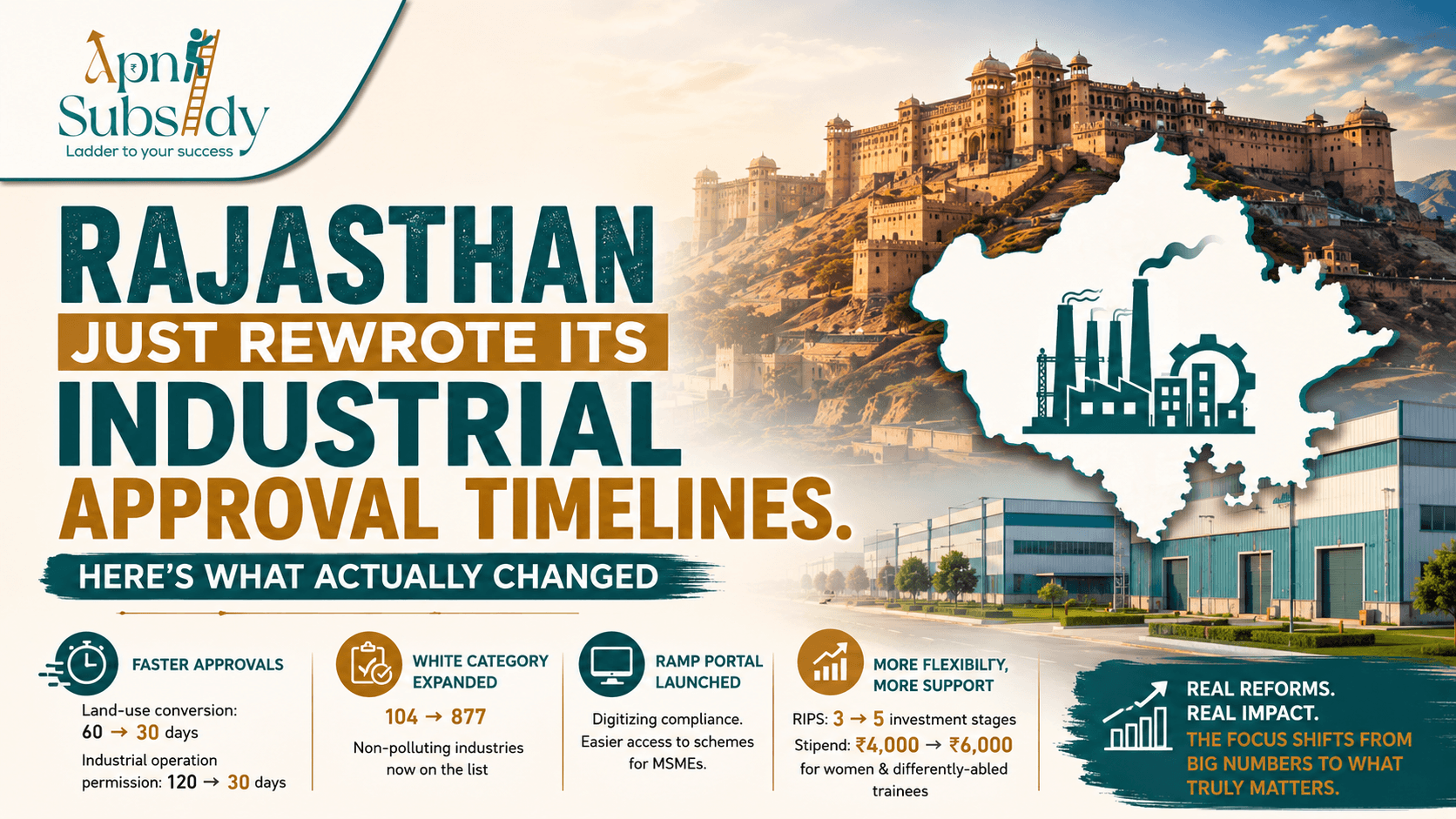
Urban land-use conversion approvals have been reduced from 60 days to 30 days.
Industrial operation permissions, which previously took up to 120 days, are now targeted to be completed within 30 days.
If these timelines are consistently achieved, businesses could save several months before beginning operations.
For manufacturers comparing Rajasthan with neighboring states, quicker approvals can reduce project costs, improve cash flow, and make investment decisions much easier.
Of course, the success of this reform will depend on whether departments consistently meet these timelines in practice rather than simply announcing new targets.
A Much Larger White Category List
Another significant but less-publicized reform is the expansion of Rajasthan's White Category industries.
The White Category includes businesses considered non-polluting, allowing them to operate without undergoing extensive environmental clearance procedures.
Previously, the list included 104 industries.
It has now expanded to 877 industries.
That represents one of the largest regulatory changes announced under the new policy.
For hundreds of businesses, this could eliminate lengthy approval processes altogether, allowing projects to begin much faster.
Unlike headline investment figures, this change has a direct operational impact for eligible enterprises.
The New RAMP Portal
The government also launched the RAMP (Raising and Accelerating MSME Performance) Portal, developed with assistance from the World Bank.
The portal aims to simplify compliance procedures while making government schemes easier for MSMEs to access.
On paper, that sounds promising.
However, the effectiveness of any digital portal depends on adoption and execution rather than launch announcements.
India has already seen platforms with strong intentions struggle to deliver their expected impact. The central government's SAMADHAAN portal, created to address delayed MSME payments, has demonstrated that simply creating an online platform doesn't automatically solve administrative challenges.
Whether RAMP becomes a genuinely useful tool or another underutilized portal will become clear only after businesses begin using it.
Not Every Reform Benefits Everyone
Some policy changes deserve a closer look.
The Rajasthan Investment Promotion Scheme (RIPS) now reduces the capital subsidy period from 10 years to 7 years.
Although presented as a policy reform, shorter subsidy support isn't automatically advantageous for businesses receiving those incentives. Whether this change improves overall efficiency or reduces long-term support remains open to interpretation.
On the positive side, RIPS now allows investments to be made across five phases instead of three.
This provides greater flexibility for businesses that cannot deploy all their capital at once and makes the scheme more practical for growing enterprises.
Meanwhile, monthly stipends for women and differently-abled trainees enrolled in electronics and semiconductor skill development programs have increased from ₹4,000 to ₹6,000, providing a direct and measurable benefit.
Rajasthan's MSME Ranking
During the announcement, the Chief Minister stated that Rajasthan now has more than 33 lakh registered MSMEs, making it the fourth-largest MSME base in India.
While the registration figure is significant, the ranking itself was presented during the official speech rather than through an independently published national comparison. As with many government claims, it is worth viewing this as a statistic that should be independently verified.
The Bigger Picture
The most meaningful takeaway from Rajasthan's new industrial policy isn't the investment headline or the funding announcement.
It's the practical reforms that businesses will experience day to day.
Shorter approval timelines, a dramatically expanded White Category list, greater flexibility under RIPS, and the launch of the RAMP Portal all have the potential to improve the state's business environment.
The real test, however, begins after the announcements end.
If approvals genuinely arrive within 30 days, if the expanded White Category reduces unnecessary compliance, and if the RAMP Portal becomes a platform businesses actually use, Rajasthan's reforms could significantly improve the ease of doing business for MSMEs.
Until then, the focus should remain less on ambitious investment promises and more on whether these administrative reforms deliver measurable results where they matter most-in the day-to-day experience of entrepreneurs.
Tags
Work With Us
Need help identifying the right subsidy, preparing documentation, or maximizing claim value? Our team can guide you end to end.
Get in Touch