Haryana's 60 MSME Incentives: Subsidies, Exports & Startup Support
Haryana Just Rolled Out 60 MSME Incentives in One Policy. Here's What's Actually in It.
Haryana has introduced a new Progressive MSME and Export Promotion Policy, bringing together 60 initiatives covering investment, exports, startups, insurance, digital commerce, environmental compliance and industrial infrastructure.
The policy came into effect on July 29 and was formally launched by Chief Minister Nayab Singh Saini in Karnal.
The 60 initiatives also mark 60 years since Haryana's formation. But beyond the anniversary theme, the policy represents a broad attempt to strengthen the state's MSME and manufacturing ecosystem.
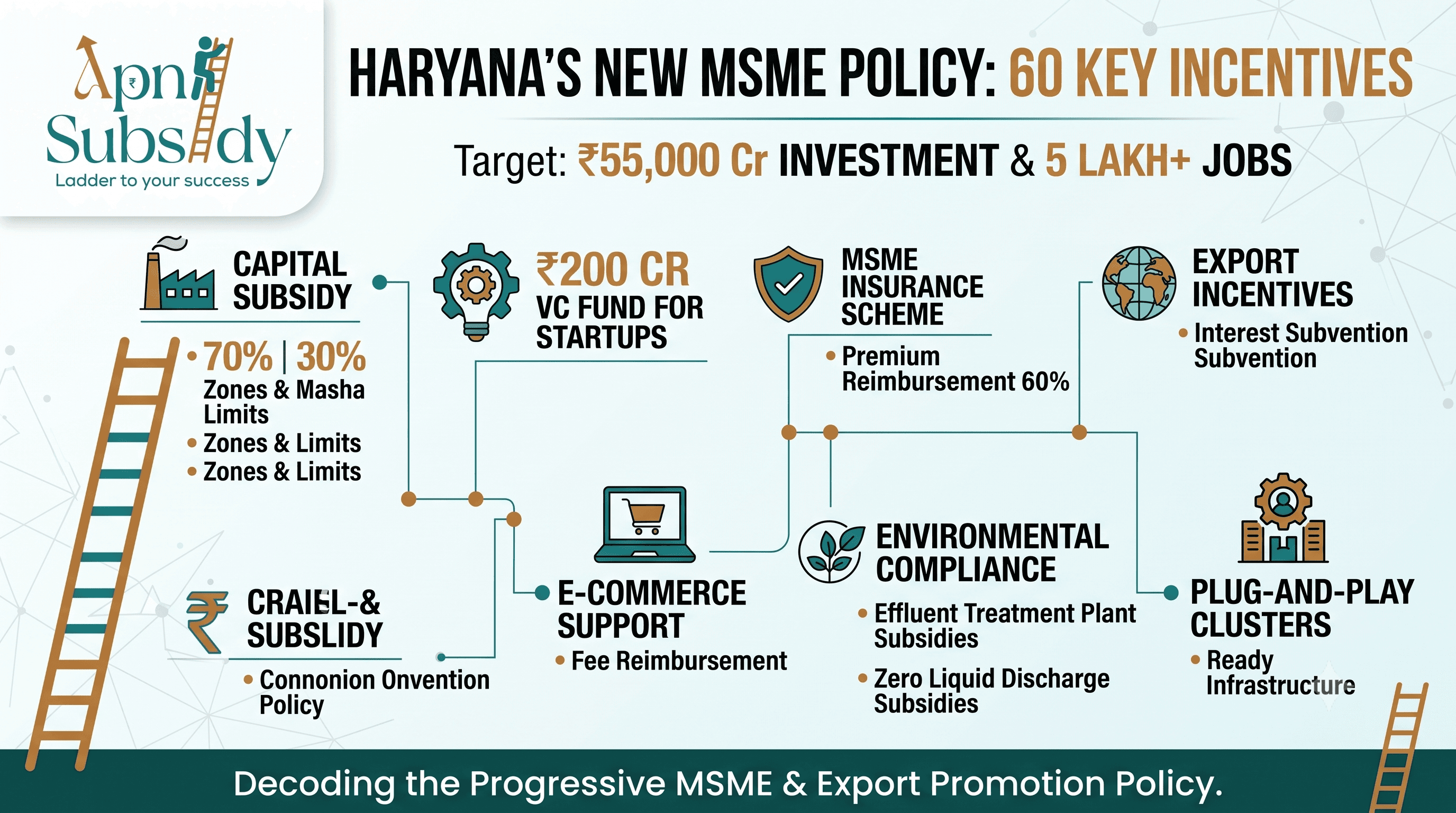
Over the next five years, Haryana aims to attract ₹55,000 crore in manufacturing investment, create more than 5 lakh jobs, and double the state's exports.
Capital Subsidy Gets a New Structure
One of the most important parts of the policy is its capital investment subsidy.
Haryana has replaced its earlier A, B, C and D area classification system with four new zones. The subsidy available to an eligible business now depends on the zone in which the unit is established.
Capital subsidy rates range from 15% to 30% of the project cost.
In designated Sub-Prime and Prime or Focus Areas, eligible projects can receive a subsidy of up to 30%, subject to a maximum of ₹35 lakh for most projects.
For larger manufacturing investments supported through the newly created Haryana Udyam Vikas Mission, capital subsidy can go up to ₹4 crore.
This means the policy is designed not only for small workshops and traditional MSMEs but also for larger manufacturing projects.
₹200 Crore Venture Capital Fund for Startups
Capital subsidies are useful for businesses investing in machinery, buildings and physical infrastructure. But technology-driven startups often have a different capital requirement.
To address this, Haryana has created a ₹200 crore venture capital fund focused on innovation-driven startups and emerging MSMEs.
The fund is intended to support businesses where the primary value lies in areas such as technology, products, innovation or processes rather than physical machinery.
This gives Haryana's MSME policy an additional financing route beyond conventional subsidies and bank loans.
MSME Insurance Support
Another unusual component is the Haryana MSME Insurance Scheme.
Under the scheme, eligible businesses can receive reimbursement of 33% of their insurance premium, subject to a maximum of ₹5 lakh per year for three years.
The objective is to encourage more small manufacturers to obtain adequate insurance coverage instead of treating insurance as an avoidable operating expense.
For businesses exposed to machinery, property, inventory and other operational risks, this could reduce the cost of maintaining appropriate insurance protection.
Export Incentives for MSMEs
The policy also puts significant emphasis on exports.
Eligible MSMEs can receive a 3% interest subvention on pre-shipment and post-shipment export credit obtained from scheduled commercial banks.
The benefit is capped at ₹10 lakh per unit per year for three years.
Haryana has also introduced the Mukhya Mantri Pratham Niryatak Protsahan Yojana, aimed at encouraging businesses that are entering international markets for the first time.
The objective is to help more Haryana-based MSMEs make the transition from domestic sales to exports.
Support for E-Commerce Businesses
The policy also recognises that many MSMEs now depend on online marketplaces to reach customers.
Eligible MSMEs selling through e-commerce platforms can receive reimbursement of 75% of platform-related fees, including registration, shipping and subscription costs.
The reimbursement can be up to ₹1 lakh per year for five years.
For MSE exporters, the annual limit increases to ₹2 lakh.
This is significant because the support is linked directly to the digital selling costs businesses actually incur rather than only supporting physical infrastructure.
Incentives for Environmental Compliance
Environmental compliance is another major part of the policy.
Manufacturing units establishing Effluent Treatment Plants (ETPs) in designated Sub-Prime and Prime or Focus Areas can receive reimbursement of 25% of the total cost, subject to a maximum of ₹1 crore.
Businesses investing in Zero Liquid Discharge (ZLD) systems can receive 25% of eligible costs, with support going up to ₹5 crore.
For water-intensive industries, these incentives could make investments in treatment and water-management infrastructure more financially viable.
Plug-and-Play Industrial Clusters
Haryana also plans to develop modern industrial clusters using a plug-and-play model.
These clusters will be developed over a minimum area of five acres and are intended to provide businesses with ready infrastructure instead of requiring entrepreneurs to develop everything from raw industrial land.
For new manufacturing units and expanding businesses, ready infrastructure can reduce both the time and initial cost involved in setting up operations.
What the Policy Means for MSMEs
Haryana's new policy covers a wide range of business needs—from initial investment and startup funding to exports, e-commerce, insurance and environmental compliance.
Its geographical advantage also plays a role. Haryana's proximity to Delhi-NCR, existing manufacturing corridors and established industrial ecosystems give the state a strong base for attracting new investment.
The government's targets of ₹55,000 crore in manufacturing investment and more than 5 lakh jobs over five years are ambitious.
The bigger test, however, will be implementation—particularly how quickly businesses can access and claim benefits under a policy containing 60 separate initiatives.
For MSMEs considering Haryana as a manufacturing or export destination, the policy is nevertheless significant because it supports multiple stages of the business lifecycle rather than focusing on just one type of incentive.