PM Vishwakarma Turns 3: 30 Lakh Artisans Registered, But What Comes Next?
PM Vishwakarma Turns Three. The Real Story Is in the Drop-Off, Not the Headline Number
Three years after Prime Minister Narendra Modi launched PM Vishwakarma, the government is marking the scheme's third anniversary on September 17 in Kolkata.
The headline number is impressive: 30 lakh artisans and craftspeople have registered, reaching the scheme's original target well ahead of its five-year timeline.
But registration is only the first step.
Follow the numbers through training, toolkit distribution and credit access, and a different picture emerges. The number of artisans receiving support becomes progressively smaller at each stage.
That drop-off provides a more useful way to understand what PM Vishwakarma has achieved so far—and where its next challenge lies.
What Is PM Vishwakarma?
PM Vishwakarma is designed to support traditional artisans and craftspeople through three broad pillars, described by the government as the three S's:
Samman – Recognition through an official ID card and certificate
Samarthya – Skill development and access to modern tools
Samriddhi – Financial support and market access
The scheme is a Central Sector Scheme, meaning it is fully funded by the Union government.
It has an approved outlay of ₹13,000 crore for 2023-24 to 2027-28 and covers 18 traditional trades, including carpentry, blacksmithing, goldsmithing, pottery, stone carving and basket making.
From 30 Lakh Registrations to 6.19 Lakh Loans
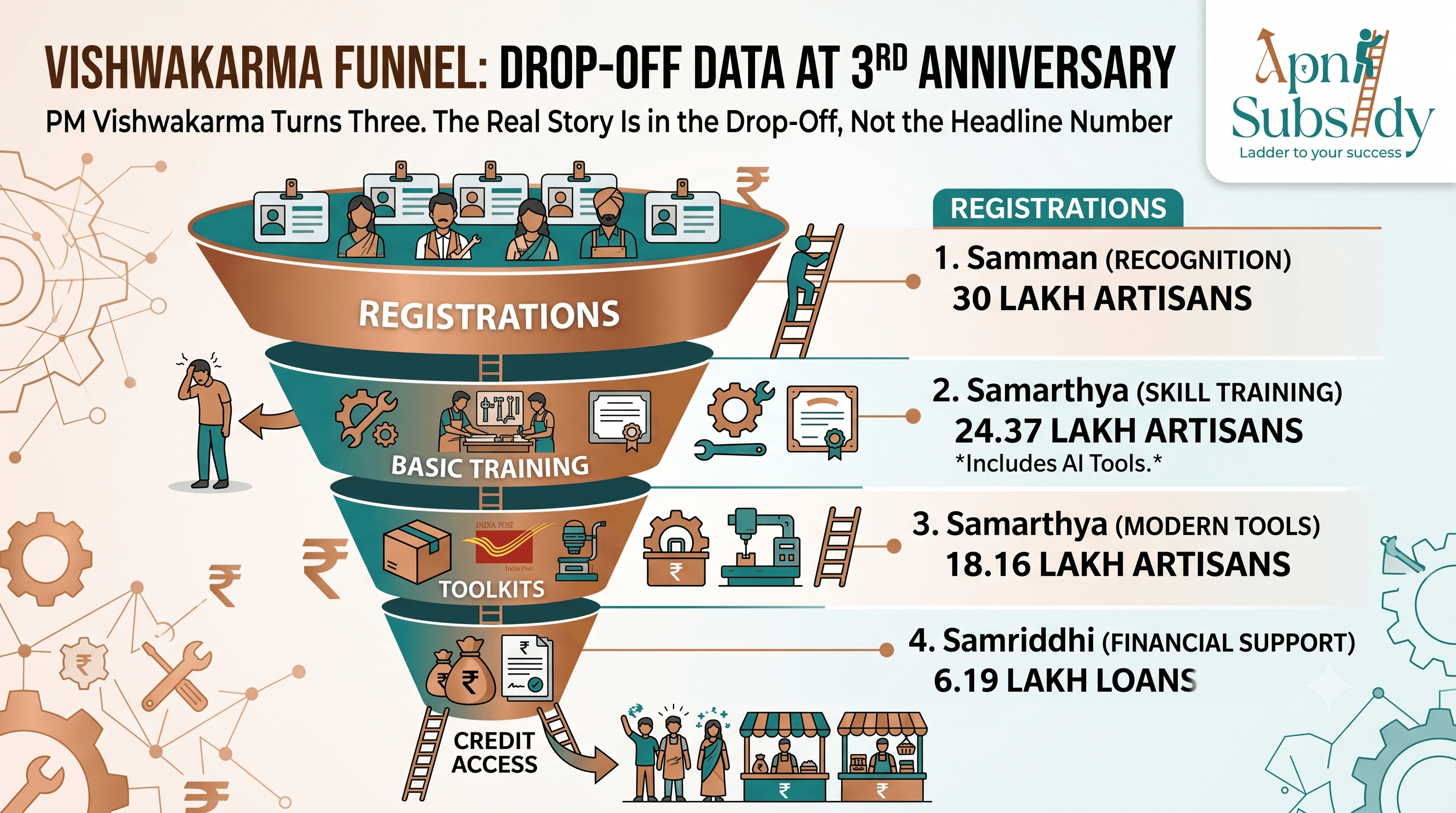
The most revealing numbers emerge when the scheme is viewed as a funnel.
Of the 30 lakh registered beneficiaries, around 24.37 lakh have completed basic skill training.
The basic training programme runs for approximately five to seven days, with participants receiving a stipend of ₹500 per day.
The next stage is access to modern tools.
Around 18.16 lakh artisans have received modern toolkits, delivered directly to their doorstep through India Post. The toolkit incentive is worth up to ₹15,000.
The credit stage is where the number falls considerably.
Around 6.19 lakh loans have been sanctioned, with a combined value of approximately ₹5,316 crore.
These loans are available at a concessional 5% interest rate.
In other words, only around one in five registered artisans has reached the stage where the scheme has provided credit support that can potentially be used to expand or upgrade the business.
Why the Drop-Off Matters
The declining numbers don't necessarily mean the scheme itself is failing.
Registration is naturally easier than completing training, receiving a toolkit and taking a business loan.
Not every artisan who registers will immediately need credit, and different beneficiaries may require different types of support.
However, the scale of the difference is significant.
There is roughly a five-to-one gap between registrations and sanctioned loans.
That raises an important question: how much of PM Vishwakarma's headline success represents artisans moving through the full support system, and how much reflects successful registration and initial onboarding?
For the scheme's next phase, converting more registered beneficiaries into active users of its training, toolkit, credit and market-access components could be an important measure of progress.
AI Training Brings a New Dimension
Another number from the scheme's progress data points toward an interesting shift.
More than 12,000 artisans have received training in AI tools for areas including:
Branding
Product design
Packaging
Marketing
For a programme focused on traditional trades, this represents a move beyond simply improving craftsmanship.
An artisan may be highly skilled at making a product but still struggle with branding, online marketing, packaging or reaching customers outside their local market.
AI tools can potentially help address some of those gaps and make traditional products more competitive in modern markets.
West Bengal Highlights the Uneven Rollout
The location of the third-anniversary event is also noteworthy.
West Bengal joined PM Vishwakarma in May this year, almost three years after the scheme was launched nationally.
As of the anniversary, around 3,000 artisans in the state had completed the full three-stage verification process, with skill training for those beneficiaries still underway.
This highlights another challenge for a national scheme: overall numbers can look strong while implementation and participation vary considerably from one state to another.
For West Bengal, the anniversary could therefore mark the beginning of a faster expansion of the programme among its large artisan community.
What the Three-Year Data Means for Artisans
For an artisan considering PM Vishwakarma, the first step is registration.
But registration is not where the scheme's biggest potential benefits end.
The more meaningful support comes through skill training, modern toolkits, concessional credit and market-related assistance.
The three-year numbers suggest that a large majority of registered beneficiaries have not yet reached the credit stage.
That makes the next phase of PM Vishwakarma particularly important.
The scheme has already demonstrated that it can bring millions of traditional artisans into a formal support framework.
The bigger question now is whether more of those artisans can move beyond registration and actually use the tools, skills, financing and market support needed to increase production, reach new customers and build more sustainable businesses.
For traditional artisans, the real value of PM Vishwakarma may ultimately be determined not by how many people register, but by how many successfully move through the entire support pipeline.