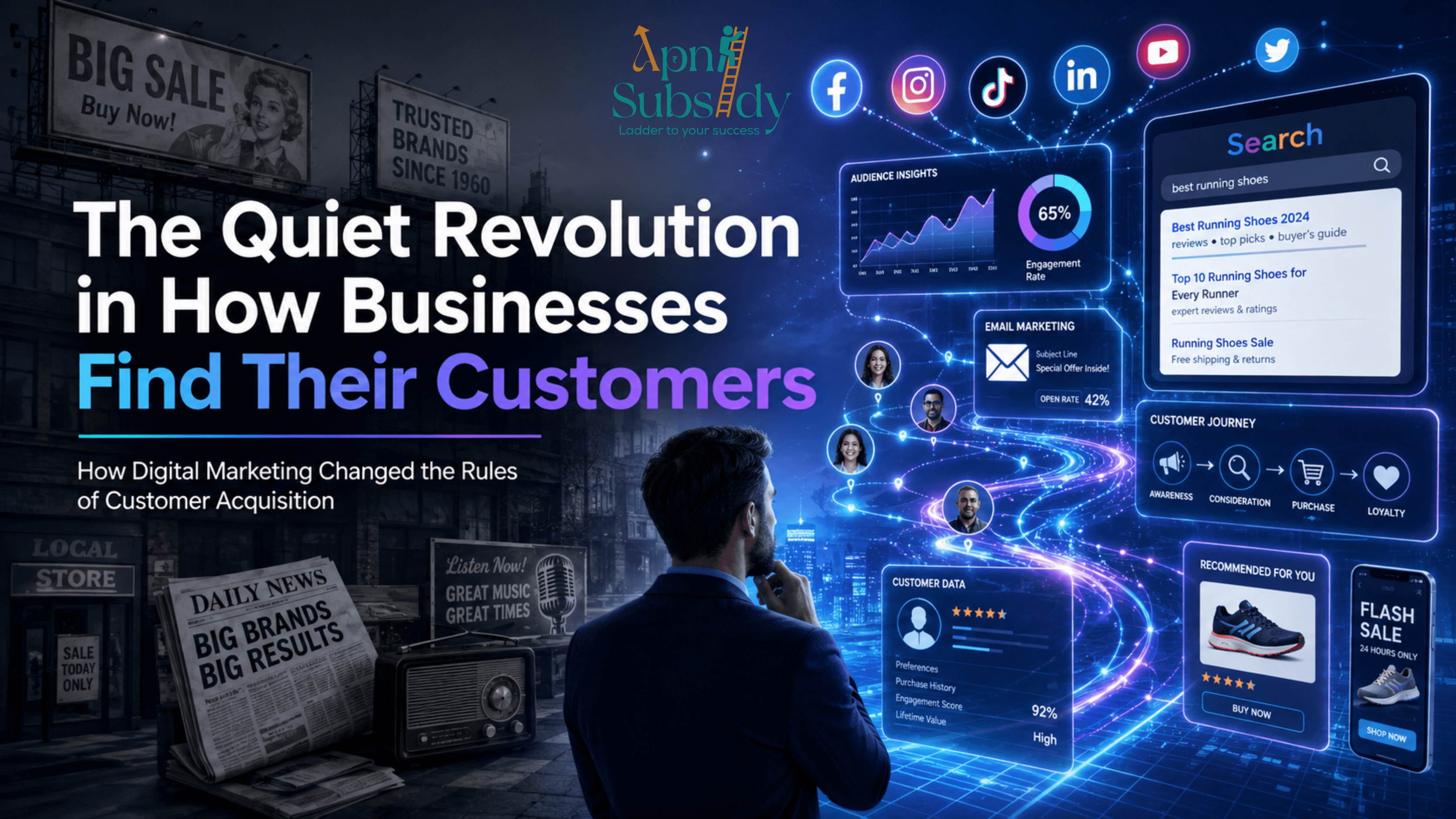
The Quiet Revolution in How Businesses Find Their Customers
The Quiet Revolution in How Businesses Find Their Customers
From Billboards to Browser Tabs
Take a walk through any mid-sized city today and you might notice something surprising. Many businesses that once relied heavily on billboards, newspaper advertisements, and radio spots have significantly reduced their offline marketing efforts. Their advertising budgets have shifted online—not because digital marketing is trendy, but because that's where their customers went first.
Digital marketing didn't simply introduce a new way to advertise. It fundamentally changed how businesses connect with consumers and, more importantly, how consumers discover, evaluate, and purchase products and services.
The End of Guesswork
Consider a small furniture company in 2005. Its marketing options were limited: newspaper ads, local radio campaigns, and perhaps a basic website. Measuring results was difficult. The owner could only hope that customers who walked into the store had seen the advertisement.
Today, that same furniture company operates in a completely different environment. It can track customer behavior in real time—from the moment someone clicks on an advertisement to the exact products they browse. If a potential customer abandons their shopping cart, automated emails and targeted advertisements can encourage them to return and complete the purchase.
Every interaction becomes measurable. Every campaign can be optimized. And perhaps most importantly, sophisticated marketing tools are no longer reserved for large corporations. Small businesses can now access capabilities that were unimaginable two decades ago.
Why Search Marketing Changed Everything
One of the biggest transformations has come through search advertising.
In the past, local businesses competed for visibility through directory listings and traditional advertising channels. Today, success often depends on understanding what potential customers search for online.
Whether it's a plumber in Jaipur or a law firm in Chicago, businesses now compete for attention based on their ability to appear when customers actively seek solutions.
The scale of this shift is evident in the numbers. Google's advertising business generated over $237 billion in revenue in 2023, highlighting the enormous value companies place on search marketing. Businesses invest heavily because they can directly measure results and calculate return on investment.
Social Media: From Broadcasting to Conversation
While search marketing helps businesses capture demand, social media helps them build relationships.
Traditional advertising was largely one-way communication. Businesses spoke, and customers listened. Social media changed that dynamic.
Today's successful brands engage in ongoing conversations with their audiences. A bakery sharing behind-the-scenes videos of freshly made croissants or a clothing brand showcasing its design process can create stronger emotional connections than traditional advertisements ever could.
Consumers increasingly follow brands because they want updates, insights, and content they find valuable. Social media has blurred the line between marketing and community building, making authenticity a powerful competitive advantage.
The Rise of Personalization
Perhaps the most significant evolution in digital marketing is personalization.
Not long ago, email marketing involved sending the same message to thousands of subscribers. Today, businesses can tailor communications based on customer behavior, interests, and purchasing history.
A customer who recently purchased running shoes may receive recommendations for athletic accessories. Someone who frequently browses coffee equipment may be offered a special discount on espresso machines.
This level of personalization isn't just convenient—it drives measurable results. Studies have shown that personalized marketing campaigns often generate significantly higher returns than generic, one-size-fits-all approaches.
As consumer expectations continue to rise, businesses are investing heavily in technologies that allow them to deliver increasingly relevant experiences.
The Privacy Challenge
However, the growth of personalized marketing comes with an important challenge: privacy.
The more targeted an advertising strategy becomes, the more data it typically requires. This creates tension between effective marketing and growing consumer concerns about data collection.
A notable example occurred in 2021 when Apple's iOS 14 update gave users the option to limit cross-app tracking. The change disrupted advertising performance across the digital marketing industry and highlighted how dependent many businesses had become on third-party data.
The lesson was clear: businesses that rely entirely on platform-owned data are vulnerable. Those with strong email lists, loyal audiences, direct customer relationships, and valuable content assets are often better positioned to adapt to changing privacy regulations.
Why Content Marketing Matters More Than Ever
As digital marketing continues to evolve, content marketing has emerged as one of the most sustainable strategies.
Instead of interrupting consumers with advertisements, content marketing attracts people who are already searching for answers, solutions, or information.
A helpful blog post, educational video, or practical guide can establish trust before a purchase decision is ever made. Customers arrive with genuine interest rather than passive exposure to an advertisement.
This approach often leads to stronger relationships, higher-quality leads, and better long-term results.
Understanding Customers, Not Just Demographics
The biggest lesson from the digital marketing revolution is that successful businesses understand their customers at a deeper level than ever before.
It's no longer enough to identify a broad target demographic. Businesses must understand specific customer needs, behaviors, motivations, and decision-making processes.
The most successful companies use digital marketing not merely as a promotional tool but as a way to learn about and serve their customers more effectively.
Conclusion
Digital marketing has transformed business growth by replacing broad assumptions with measurable insights, personalized experiences, and direct customer engagement. From search engines and social media to email automation and content marketing, businesses now have unprecedented opportunities to reach the right audience at the right time.
Yet the true power of digital marketing lies not in technology itself, but in understanding customers. Companies that use digital tools to build meaningful relationships and solve real problems continue to thrive. Those that view digital marketing simply as a louder advertising channel often find themselves competing for attention in an increasingly crowded marketplace.
In today's digital economy, success belongs to the businesses that listen as much as they speak.
Tags
Work With Us
Need help identifying the right subsidy, preparing documentation, or maximizing claim value? Our team can guide you end to end.
Get in Touch