AI Is Thirsty: The Water Bill Your AI Strategy Isn't Counting
AI Is Thirsty: The Water Bill Your AI Strategy Isn't Counting
Most executives scaling AI in 2025 have modeled compute costs, latency, and model performance. Few have calculated how many liters of water their AI roadmap will consume by 2028. That gap is becoming a liability.
The environmental conversation around AI has been dominated by carbon. Water is the quieter story. And unlike carbon, where offsets offer some corporate cover, water is local. You cannot offset a depleted aquifer in Arizona with a wetland restoration project in Scotland.
Why AI Drinks So Much
The heat problem is structural. Modern GPU clusters now push power densities exceeding 200 kilowatts per rack, up from 25–40 kilowatts just two years ago. Conventional air cooling cannot keep pace, so most facilities rely on evaporative cooling towers that pull fresh water from local supplies and lose it to the atmosphere permanently.
The secondary consumption layer gets less attention. Water use is growing not primarily from cooling, but from power generation and hardware manufacturing. The electricity grid feeding a data center needs water at the generation source. The chip fabrication plant that built the hardware needed water too. Neither shows up in a facility's operational footprint.
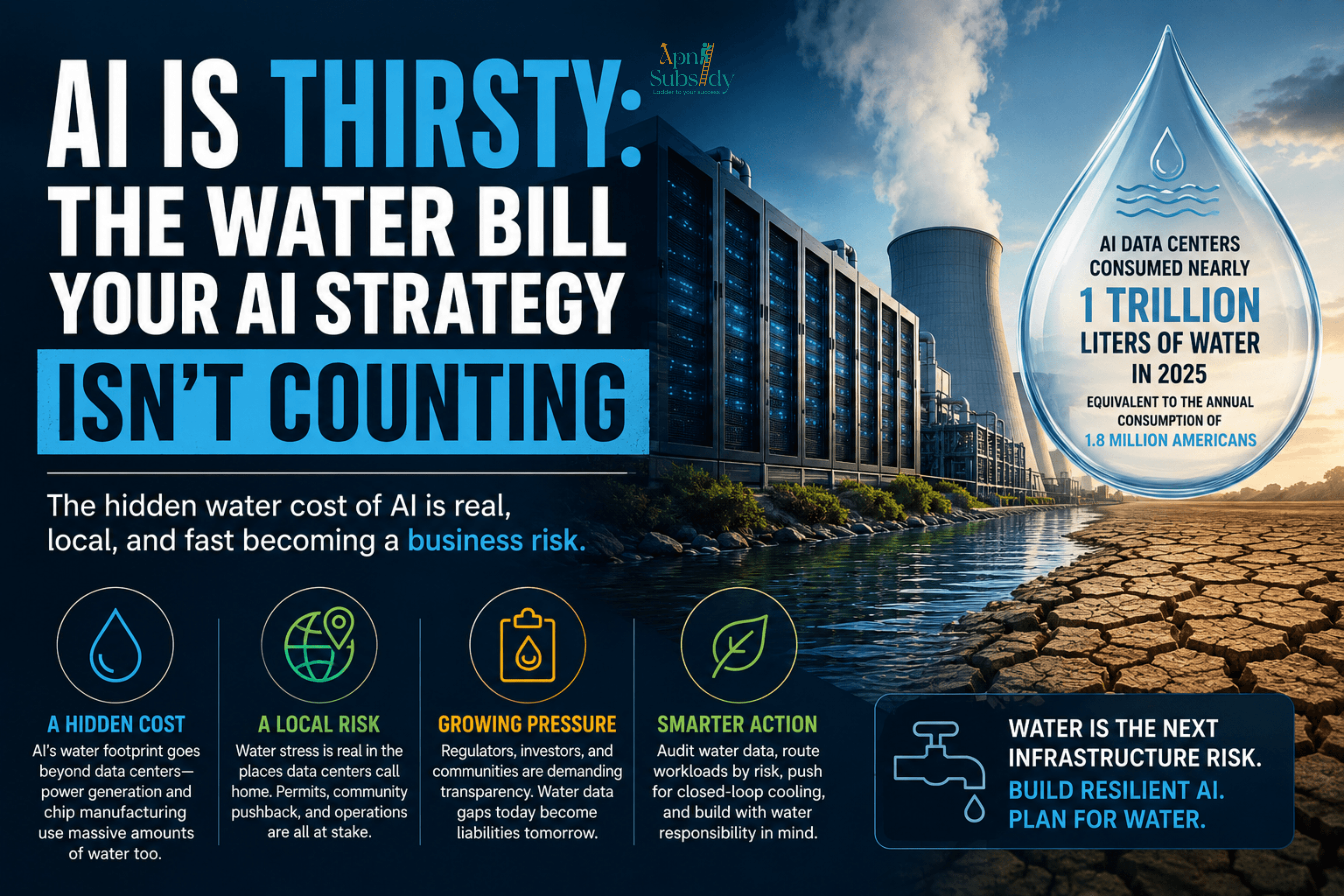
AI data centers consumed nearly 1 trillion liters of water globally in 2025, equivalent to the annual consumption of 1.8 million Americans. By 2030, AI data centers could drain between 731 and 1,125 million cubic meters of water, equivalent to the annual household usage of 6 to 10 million Americans.
The Risk Is Local, Not Abstract
These numbers map to specific counties and specific water systems.
A single Meta data center in Newton County, Georgia consumes 500,000 gallons of water per day, roughly 10% of the entire county's supply. One facility in Iowa consumed a billion gallons in 2024, enough to cover the state's residential needs for five days.
About 30% of data centers currently under construction are in regions where water scarcity is expected to intensify through 2050. Many of the states competing hardest for hyperscale investment — Texas, Arizona, Nevada — are already in long-term water stress. Companies building there are banking on water availability that the climate trajectory does not guarantee.
Three Business Risks Executives Are Underweighting
Regulatory exposure. The EU's Corporate Sustainability Reporting Directive now requires water used by systems to be reported and audited, and this applies to non-EU companies with significant EU operations. California requires Scope 1, 2, and 3 emissions disclosure for large companies in the state. Singapore and the UAE are tying data center expansion to strict sustainability conditions. Voluntary disclosure is becoming mandatory reporting. Companies without water data in their infrastructure planning will face gaps they cannot quickly close.
Permitting friction. Communities that welcomed data centers as economic development are reassessing the trade-off. Research has found no clear evidence that data centers stimulate local growth in tech employment, and local governments in water-stressed regions are beginning to slow or block approvals. Permitting timelines that were 12 months are now 24.
Investor scrutiny. Sustainalytics' ESG Risk Ratings now evaluate companies across water exposure, management quality, and disclosure quality. Water gaps register in ratings, and eventually in cost of capital. Amazon still does not disclose its data center water consumption. That absence is now a data point investors read as risk.
What to Do About It
Audit your cloud provider's water performance by facility, not by global average. Ask for Water Usage Effectiveness data at the regional level. Some providers publish it; most do not. Make it a procurement requirement.
Route workloads by water risk. Training runs and batch inference do not need to run in water-stressed geographies. Facilities in the Pacific Northwest or Scandinavia offer water-surplus, low-carbon options. Most enterprises have never mapped workload placement this way.
Push for closed-loop cooling in new contracts. Microsoft committed at Build 2025 that all new data center designs will use zero-waste water cooling systems. Liquid cooling reduces cooling energy consumption by 56–95% and cuts Power Usage Effectiveness by 40%. These solutions exist at commercial scale. If you have procurement leverage, require them.
Run smaller models where the use case allows. A model sized appropriately for its task consumes less compute per inference, which means less heat and less water. Model efficiency is water efficiency.
The companies that treat water as a footnote in their AI infrastructure planning are repeating the mistake the industry made with carbon fifteen years ago: discovering the liability after it has accumulated. Carbon can be offset. A depleted aquifer cannot.
The infrastructure decisions made in 2025 and 2026 will define AI's water footprint at scale. CTOs and CSOs who embed water alongside energy in every infrastructure decision will have built a more resilient operation. That is not a sustainability argument. It is a risk management one.
Tags
Work With Us
Need help identifying the right subsidy, preparing documentation, or maximizing claim value? Our team can guide you end to end.