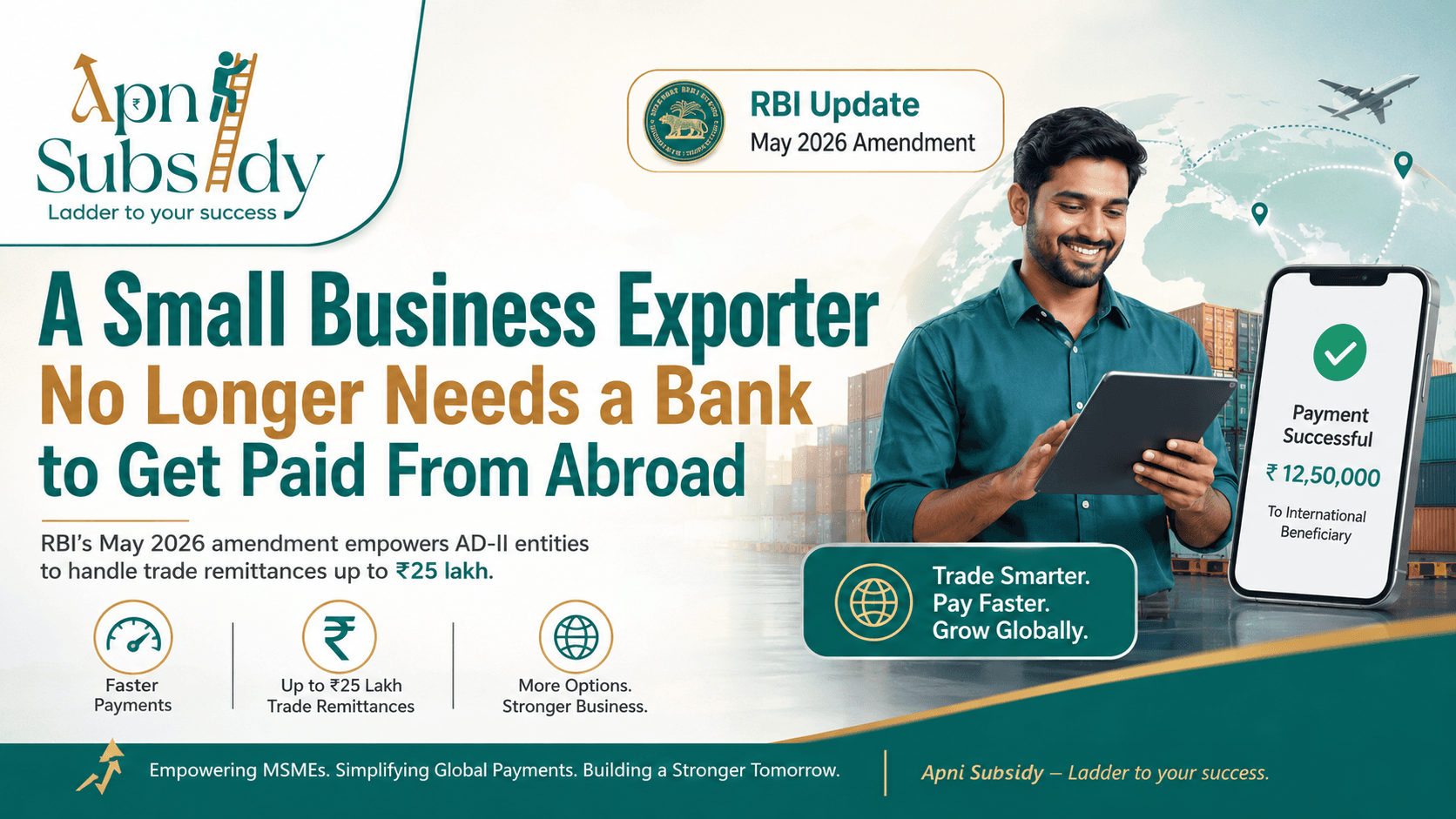
A Small Business Exporter No Longer Needs a Bank to Get Paid From Abroad
A Small Business Exporter No Longer Needs a Bank to Get Paid From Abroad
For years, Indian exporters—especially Micro, Small, and Medium Enterprises (MSMEs)—had only one practical option for receiving payments from overseas customers: go through a bank.
Whether it was export proceeds, import payments, or other trade-related foreign exchange transactions, businesses relied on banks or banking-linked institutions to process international payments.
That has now begun to change.
In May 2026, the Reserve Bank of India (RBI) amended its foreign exchange regulations to allow Authorised Dealer Category-II (AD-II) entities to handle trade remittances of up to ₹25 lakh. Shortly afterward, on 21 July 2026, EbixCash World Money became the first AD-II entity to receive a licence under this expanded framework, marking an important milestone in India's cross-border payments ecosystem.
For MSME exporters and importers, this could mean faster, more accessible, and more competitive international payment services.
What Changed?
The RBI's latest revision expands the role of AD-II entities, allowing them to process:
Trade remittances up to ₹25 lakh
Family maintenance remittances
Certain foreign exchange transactions that were previously limited to banks
Until now, trade remittances were almost exclusively handled by Authorised Dealer Category-I (AD-I) banks, making banks the default gateway for international business payments.
The revised rules create a new alternative for businesses handling smaller cross-border transactions.
Understanding AD-I and AD-II Entities
To understand the significance of this change, it's helpful to know how the RBI classifies foreign exchange service providers.
AD-I Entities
Authorised Dealer Category-I institutions are primarily commercial banks.
They are permitted to handle the complete range of foreign exchange activities, including:
Export payments
Import payments
International trade finance
Foreign currency transactions
Cross-border remittances
AD-II Entities
AD-II entities traditionally operated in a much narrower space.
Their services generally included:
Currency exchange
Travel forex
Student remittances
Personal remittances
Retail foreign exchange services
Trade remittances were outside their scope.
The RBI's May 2026 amendment changes that by allowing eligible AD-II entities to process trade-related foreign exchange transactions within the prescribed limit.
Why This Matters for MSMEs
Many MSMEs face practical challenges while dealing with international payments.
These include:
Limited access to specialised banking branches
Lengthy documentation requirements
Longer processing times
Dependence on existing banking relationships
Businesses located in smaller cities and industrial clusters often experience these issues more acutely.
By allowing licensed AD-II entities to process trade remittances, the RBI introduces greater flexibility into the system.
Instead of relying exclusively on banks, eligible businesses can now choose alternative authorised service providers for qualifying transactions.
EbixCash Becomes the First Licensed AD-II Player
Following the RBI's revised framework, EbixCash World Money became the first AD-II entity to receive a licence covering this expanded scope.
The licence is also notable because it is perpetual, replacing the renewal-based licensing model that previously governed this category.
EbixCash already operates one of India's largest AD-II networks, including:
More than 100 branches
Presence across over 70 cities
Operations at more than 20 international airports
Its existing infrastructure positions it to offer international payment services to a wider range of MSMEs without requiring businesses to establish a full banking relationship solely for trade remittances.
The Technology Behind Faster Cross-Border Payments
Another important aspect of this development is EbixCash's approval to maintain Nostro Accounts.
A Nostro account allows an institution to hold funds in foreign currency with overseas banks, enabling more direct settlement of international transactions.
Traditionally, this capability was associated primarily with banks.
Combined with its position as a Principal Member of Visa and Mastercard and its multi-currency payment infrastructure, EbixCash is equipped to facilitate cross-border transactions with fewer intermediaries.
This has the potential to improve processing efficiency and simplify payment flows for eligible businesses.
There Is Still a ₹25 Lakh Limit
While the change expands payment options, it does not eliminate banks from the process.
The RBI has capped trade remittances through AD-II entities at ₹25 lakh per transaction.
Larger exporters with higher-value international transactions will still need to rely on traditional banking channels for much of their foreign trade activity.
However, many MSMEs operate comfortably within this threshold, making the revised framework highly relevant for smaller exporters and importers.
What Could Happen Next?
The biggest question now is whether other AD-II entities will receive similar approvals.
If additional licensed players enter the market, MSMEs could benefit from:
Greater competition
Faster processing times
Better customer service
More accessible foreign exchange solutions
Reduced dependence on traditional banking channels
Competition may also encourage banks to improve their own trade remittance services by simplifying documentation and accelerating processing.
Final Thoughts
The RBI's decision to allow AD-II entities to process trade remittances represents an important shift in India's foreign exchange ecosystem.
While banks will continue to play a central role in international trade finance, MSMEs now have an additional option for managing smaller cross-border transactions.
For exporters and importers dealing with payments of up to ₹25 lakh, the new framework could make international trade more accessible, more competitive, and easier to manage.
As more authorised players enter this space, India's small businesses may benefit from faster payment services, increased choice, and a more flexible cross-border payment infrastructure.