GOBARdhan Scheme: A ₹23,731 Crore Push to Turn Waste into CBG
A New ₹23,731 Crore Scheme Wants MSMEs to Turn Farm Waste Into Fuel
Setting up a plant that turns cattle dung and crop residue into compressed biogas has never been an easy business for a small player to enter. It requires significant upfront capital, there has been uncertainty around who will buy the gas once it is produced, and pricing has fluctuated enough to make lenders cautious about financing such projects.
The Union Cabinet's approval of GOBARdhan on August 6, a National Circular Bioenergy Scheme with an outlay of ₹23,731 crore running from the current financial year through 2035-36, is designed to address these three challenges. Importantly, the framework creates support that can be relevant to MSMEs and rural entrepreneurs rather than being limited to large energy companies.
What Is GOBARdhan?
The scheme's full name, Galvanizing Organic Bio-Agro Resources Dhan, reflects its core idea: convert waste already generated in large quantities across India into useful energy.
The scheme focuses on feedstocks such as:
Agricultural residue
Cattle dung
Press mud
Municipal organic waste
These materials can be processed into Compressed Biogas (CBG), with organic manure generated as a byproduct.
The economic case goes beyond waste management. India currently imports a significant portion of its natural gas requirements, making domestically produced CBG an attractive alternative. The government wants domestic CBG production to increase substantially under the new framework, which means the sector will need many more producers, including MSMEs and rural businesses.
The First Problem: Who Will Buy the Gas?
For a small entrepreneur, producing CBG is only half the business. The bigger question is what happens after the gas comes out of the plant.
GOBARdhan addresses this through an Assured CBG Offtake framework.
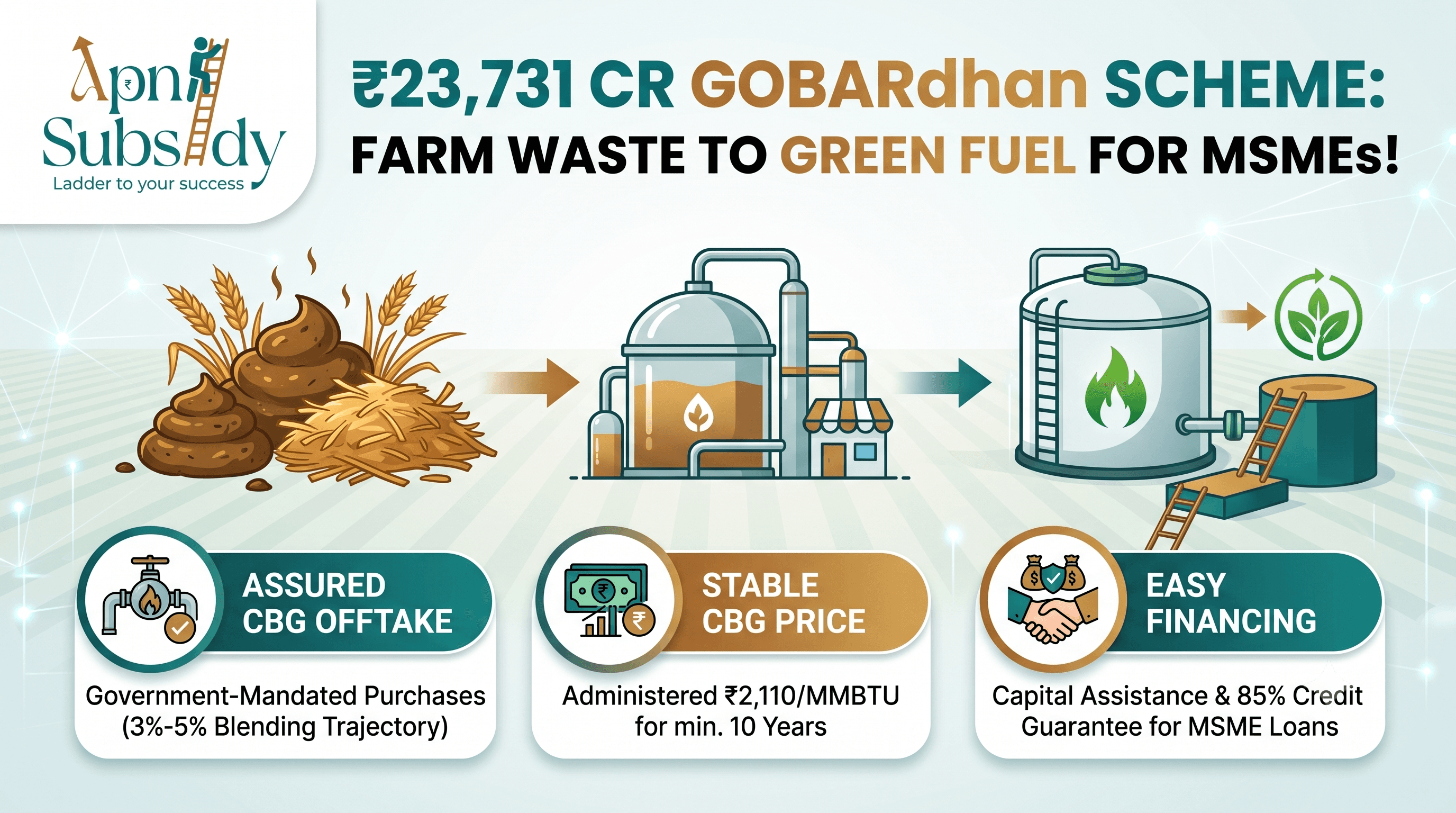
Under the framework, City Gas Distribution entities are required to procure CBG according to a notified obligation trajectory. The blending obligation starts at 3% in the current financial year, rises to 4% the following year, and reaches 5% from 2028-29 onwards.
That creates a stronger demand signal for producers.
For an MSME approaching a bank for project finance, having a defined potential buyer base can make a major difference. A business plan becomes easier to evaluate when there is greater visibility over future demand.
The Second Problem: Price Uncertainty
Demand alone does not make a project financially viable. An entrepreneur also needs some visibility on revenue.
GOBARdhan provides a stable administered CBG price of ₹2,110 per Metric Million British Thermal Unit, with the government framework providing a minimum ten-year horizon.
For a developer considering a new CBG plant, this kind of pricing visibility can make long-term financial planning easier.
Instead of building the entire business model around uncertain future gas prices, an entrepreneur has a defined framework against which project revenues can be estimated.
The Third Problem: Financing
This may be the most important part for MSMEs.
Greenfield CBG projects are eligible for capital assistance of up to ₹2 crore per tonne per day of installed capacity.
The scheme also includes a dedicated credit guarantee mechanism for MSME-based CBG projects, providing guarantee coverage of up to 85% on eligible loans.
That matters because financing has traditionally been one of the biggest hurdles for smaller businesses entering emerging energy infrastructure.
A lender financing a new biogas project has to consider construction risk, operational risk, feedstock availability and future cash flows. A substantial credit guarantee can reduce the lender's exposure and potentially make financing more accessible.
For an MSME, that could be the difference between having a viable project report and actually being able to raise the capital required to build the plant.
GOBARdhan Builds on Existing Schemes
The government is not starting from scratch.
GOBARdhan brings together and builds on earlier initiatives, including:
SATAT
Market Development Assistance Scheme
Biomass Aggregation Machinery Scheme
Development of Pipeline Infrastructure Scheme
The objective is to create a more coordinated framework instead of requiring prospective producers to navigate several separate programmes.
That consolidation is important for smaller entrepreneurs who may not have dedicated teams to track multiple government schemes, eligibility conditions and application processes.
Who Could Benefit?
The opportunity is particularly relevant to businesses that already have access to organic waste or agricultural feedstock.
Potential participants could include:
Farmer producer organisations
Farmer cooperatives
Rural entrepreneurs
Feedstock aggregators
Waste-management businesses
MSMEs developing CBG plants
Businesses operating around agricultural clusters
The availability of feedstock will remain a critical factor. A plant cannot operate economically without a reliable and affordable supply of organic material, so entrepreneurs should evaluate local waste availability and logistics before treating the scheme as a guaranteed business opportunity.
What MSMEs Should Watch
GOBARdhan changes three important variables for a potential CBG project: who will buy the gas, how the revenue framework works, and how much financing support is available.
But government support does not automatically make every CBG project profitable. Feedstock collection, transportation, plant efficiency, land, technology, operations and local market conditions will still determine the actual economics.
The real test will be whether the ₹23,731 crore framework produces a broad base of MSME- and rural entrepreneur-led CBG projects, rather than concentrating most of the opportunity among large energy companies.
For an MSME that has previously considered turning agricultural or organic waste into a business but could not make the numbers work, GOBARdhan is a development worth watching closely. It does not remove every risk, but it directly addresses three of the biggest ones: demand, price visibility and access to finance.