RBI Ends FCNR(B) Swap Facility Early: What It Means for Banks and Liquidity
RBI Ends the FCNR(B) Swap Facility a Month Early: What Changed and Why
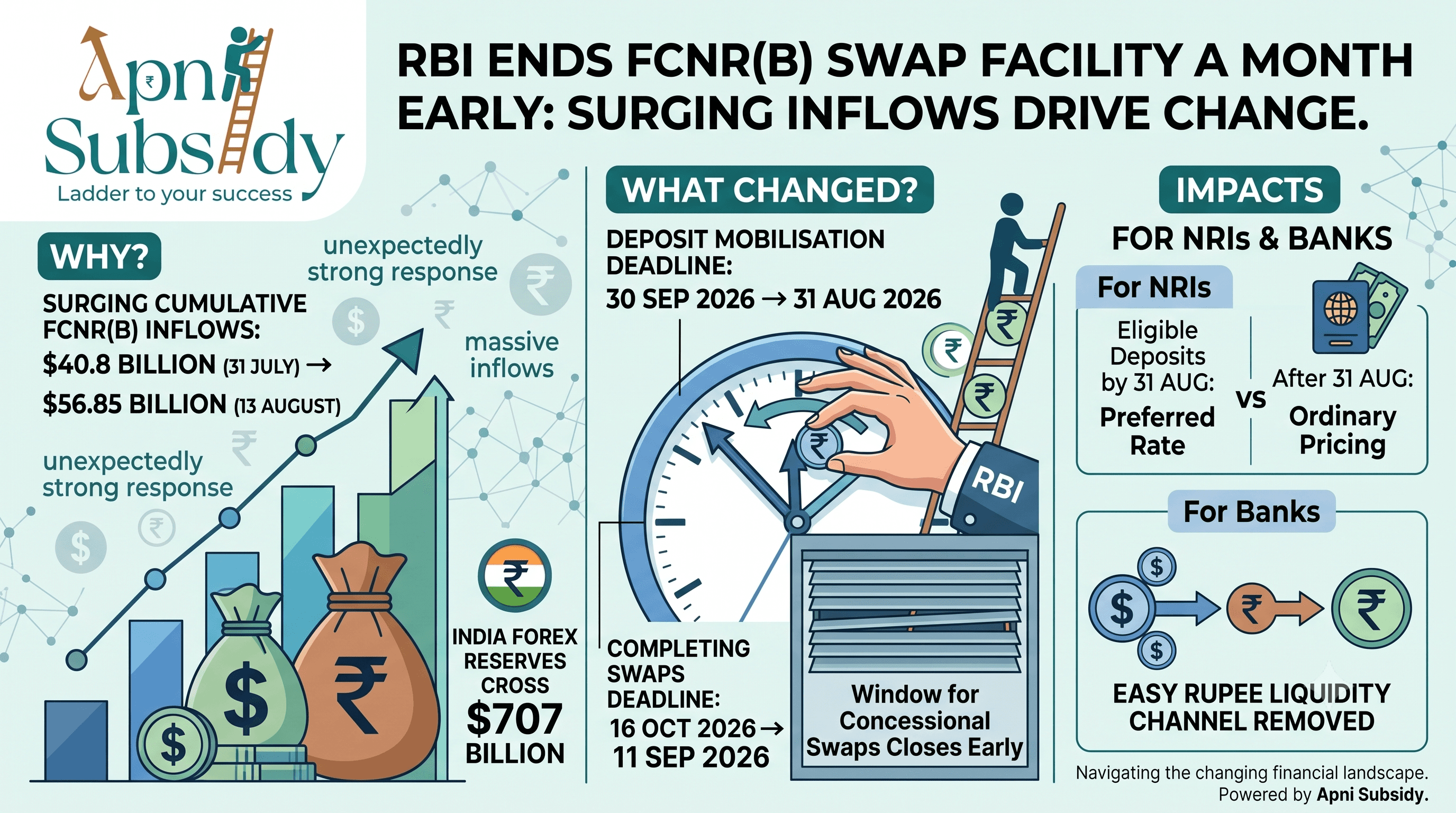
The Reserve Bank of India (RBI) has unexpectedly brought its special FCNR(B) swap facility to an early close, moving the deadline for banks to mobilise fresh deposits from 30 September to 31 August 2026.
The corresponding deadline for completing the swaps has also been moved forward, from 16 October to 11 September 2026.
The decision came only days after the RBI Governor had indicated that there was no proposal to end the facility ahead of schedule.
So, why did the central bank change course so quickly?
The answer lies largely in the unexpectedly strong inflow of foreign currency into Indian banks.
What Was the FCNR(B) Swap Facility?
The RBI introduced the special USD-INR swap arrangement on 8 June 2026 to encourage Indian banks to attract more Foreign Currency Non-Resident (FCNR(B)) deposits from Non-Resident Indians (NRIs).
The facility also covered related foreign borrowing channels, including:
External Commercial Borrowings (ECBs)
Overseas Foreign Currency Borrowings (OFCBs)
Under the arrangement, banks could raise eligible foreign currency deposits, typically with a three-to-five-year maturity, and then swap the foreign currency with the RBI for Indian rupees at a concessional rate.
This effectively reduced the currency and hedging costs associated with attracting foreign currency deposits.
For banks, that created an incentive to compete more aggressively for NRI deposits.
And the response was much stronger than expected.
FCNR(B) Inflows Surged
The numbers provide the clearest explanation for the RBI's decision.
By 31 July 2026, cumulative inflows under the broader facility had reached approximately $40.8 billion, with FCNR(B) deposits accounting for around $36.7 billion.
Just two weeks later, by 13 August, the total had increased dramatically to approximately $56.85 billion, while FCNR(B) deposits alone had reached around $52.3 billion.
The rapid acceleration suggested that the facility was attracting foreign currency at a pace significantly higher than initially anticipated.
At the same time, India's foreign exchange reserves were also rising sharply.
During the week ending 7 August, India's reserves increased by approximately $14.1 billion, crossing the $707 billion mark for the first time.
With foreign currency inflows already strong, the RBI had less reason to continue encouraging additional inflows through a special concessional facility.
Why Does the Swap Affect Rupee Liquidity?
The FCNR(B) swap mechanism has implications beyond foreign exchange reserves.
When banks bring in foreign currency through eligible deposits and swap it with the RBI, the RBI provides them with Indian rupees in exchange.
That means the facility also injects rupee liquidity into the banking system.
The large inflows therefore became an important source of additional liquidity for banks.
Analysts have also linked the additional liquidity to increased demand for government securities.
By ending the facility earlier than planned, the RBI is effectively removing one channel through which additional rupee liquidity was entering the financial system.
This becomes particularly relevant as the central bank manages both its foreign exchange reserves and domestic liquidity conditions.
Why Did Bank Stocks React?
The early closure was also reflected in the stock market.
On 18 August, shares of major banks including HDFC Bank, ICICI Bank, Kotak Mahindra Bank, and State Bank of India (SBI) traded lower.
The market interpretation was not necessarily that the FCNR(B) facility had failed.
In fact, the opposite is closer to the numbers.
The facility had attracted foreign currency far more quickly than expected.
Instead, investors appeared to be focusing on what the early closure could mean for future bank funding and rupee liquidity conditions.
With one source of additional liquidity being removed, banks could face a somewhat different funding environment going forward.
What Actually Changes for NRIs?
The early closure does not affect every FCNR(B) deposit.
For NRIs considering a new deposit, the key date is 31 August 2026.
Eligible deposits opened before that date can still qualify for the concessional swap-backed arrangement, subject to the applicable conditions.
After the facility closes, new FCNR(B) deposits will no longer receive the benefit of this special swap arrangement and are expected to return to the ordinary pricing environment.
Existing deposits already covered under the facility are not being cancelled.
They continue according to their agreed terms for their full maturity period.
ECB and OFCB Facilities Continue
Another important distinction is that the RBI has not ended the entire broader foreign borrowing facility.
The separate arrangements covering External Commercial Borrowings (ECBs) and Overseas Foreign Currency Borrowings (OFCBs) continue until 31 December 2026.
Therefore, the early closure specifically concerns the FCNR(B) deposit mobilisation and corresponding swap window.
What Does This Mean for India's Credit Environment?
For businesses and investors tracking India's financial system, the bigger message is about liquidity management.
The FCNR(B) facility was introduced to encourage foreign currency inflows and strengthen banks' access to foreign currency funding.
It succeeded—perhaps too quickly.
The RBI's decision to close the facility early demonstrates that central banks can withdraw an incentive when the market response becomes stronger than necessary.
For businesses, including MSMEs that depend on bank credit and working capital, changes in banking-system liquidity can eventually influence funding conditions and the availability and pricing of credit.
Final Thoughts
The early closure of the FCNR(B) swap facility should not be interpreted simply as a failed government or RBI programme.
The data suggests the facility achieved its immediate objective of attracting foreign currency—and did so at a pace that prompted the RBI to reconsider the original timeline.
With India's foreign exchange reserves already at historically high levels and the banking system receiving substantial foreign currency inflows, the RBI has chosen to close this particular incentive earlier than planned.
For NRIs, the immediate takeaway is the 31 August deadline for fresh eligible deposits under the special arrangement.
For banks, investors, and businesses, the larger takeaway is that the RBI is actively managing the balance between foreign exchange accumulation and domestic rupee liquidity.