ECLGS 5.0 Closed Early: What It Means for MSMEs
ECLGS 5.0 Ran Out Early. What Its Closure Means for MSMEs
India's latest emergency credit guarantee programme for MSMEs has reached an unexpectedly early end, creating a fresh financing challenge for small businesses just as demand for working capital begins to rise.
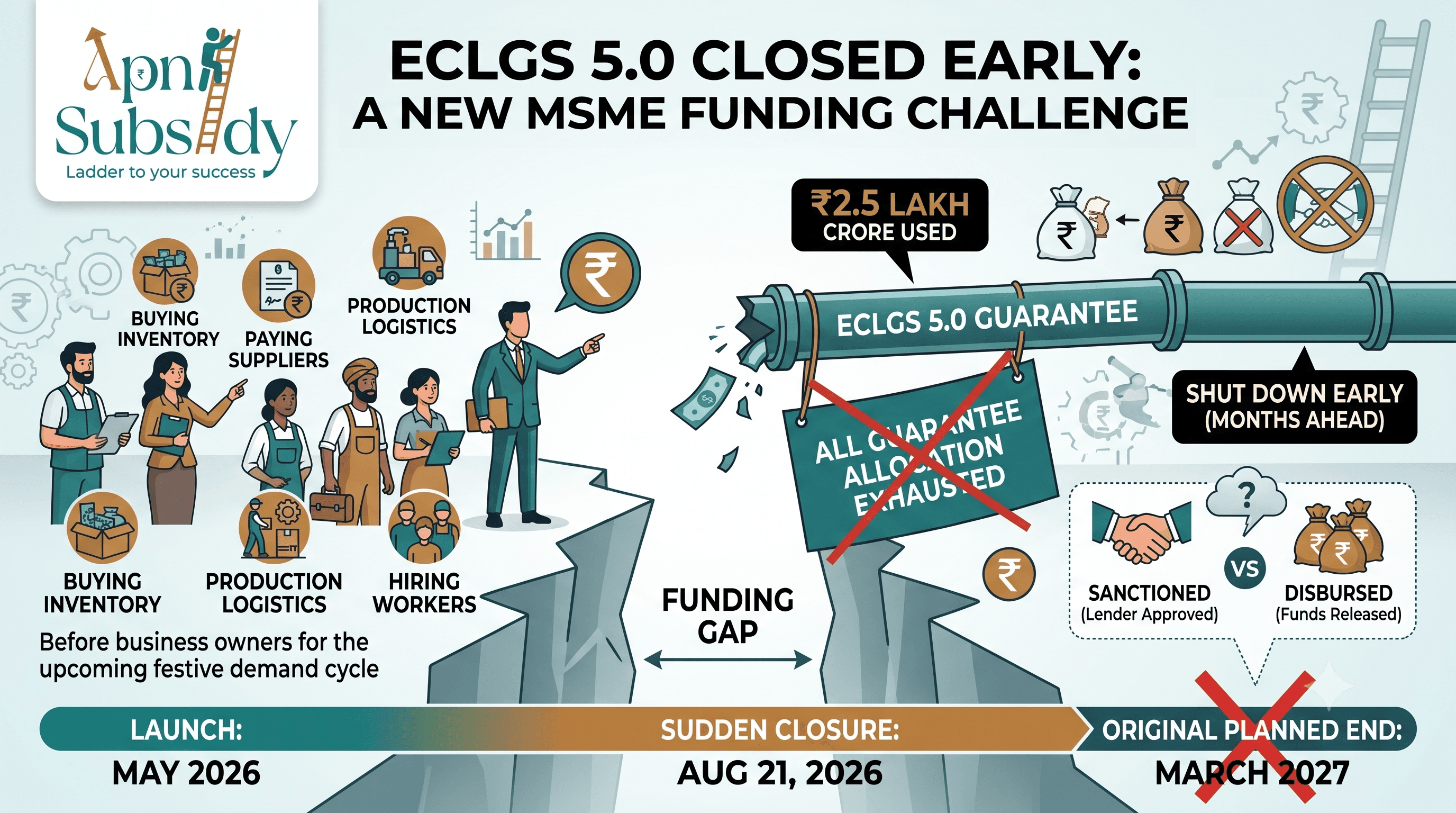
ECLGS 5.0, launched in May 2026, was designed to provide additional credit support to eligible businesses through government-backed guarantees. The scheme carried a total guarantee allocation of ₹2.5 lakh crore and was originally expected to remain operational until March 2027.
Instead, the entire guarantee allocation was exhausted and the scheme was shut down early, around August 21, 2026.
That leaves an unusual situation: demand for guaranteed MSME credit remains, but the guarantee capacity under the programme has already been used up.
What Was ECLGS 5.0?
The Emergency Credit Line Guarantee Scheme (ECLGS) was created to help businesses access additional bank credit during periods of financial stress.
Its core mechanism was relatively straightforward.
The government provided a credit guarantee to lenders, reducing the lender's risk when extending eligible credit to businesses. This was intended to encourage banks and other participating institutions to continue lending even when businesses faced uncertainty or weaker financial conditions.
ECLGS 5.0 represented another phase of that broader emergency-credit approach, with a substantial ₹2.5 lakh crore guarantee allocation.
The Scheme Closed Months Earlier Than Planned
The biggest development isn't simply that ECLGS 5.0 has ended.
It is how quickly the allocation was consumed.
The programme was originally scheduled to continue until March 2027, but its guarantee allocation was exhausted roughly seven months ahead of that deadline.
The early closure suggests that demand for the supported credit was significantly stronger than the remaining guarantee capacity could accommodate.
For MSMEs, the timing is particularly important because many businesses require additional working capital during periods of higher inventory purchases, seasonal demand and increased operating expenses.
What Happens to Sanctioned but Undisbursed Loans?
The early closure has created another practical issue for the banking system.
Some loans had already been sanctioned by lenders but had not yet been disbursed when the guarantee allocation was exhausted.
This creates uncertainty around how those sanctioned facilities will be handled when the underlying guarantee capacity has effectively been used up.
For an MSME that has received a loan sanction but is still waiting for the funds to reach its account, the distinction between sanctioned credit and actually disbursed credit becomes particularly important.
A sanction does not necessarily mean the business already has the working capital it needs.
Why the Timing Matters for MSMEs
The closure comes at a time when many Indian businesses are preparing for the festive-season demand cycle.
For manufacturers, traders and other small businesses, seasonal demand can require additional money for:
Purchasing inventory
Paying suppliers
Increasing production
Hiring temporary workers
Managing logistics
Financing receivables
When additional guaranteed credit becomes unavailable, businesses may have to rely on other forms of bank finance or alternative sources of working capital.
That can create a funding gap for enterprises that had expected ECLGS-backed credit to remain available.
How This Differs From the CGSE Situation
Another credit guarantee programme, the Credit Guarantee Scheme for Entrepreneurs (CGSE), had an application window that was scheduled to close by March 31, 2026, or once ₹20,000 crore in guarantees had been issued, whichever came first.
There is no evidence of an extension in the information reviewed.
That makes CGSE more relevant as a retrospective policy story rather than as a scheme MSMEs can currently assume is open for applications.
ECLGS 5.0, by contrast, represents a much more immediate development because its early closure has implications for credit that businesses and banks were dealing with in the current financial year.
The Bigger MSME Credit Question
The early exhaustion of ECLGS 5.0 raises a broader question about the demand for government-backed MSME credit.
If guarantee capacity is consumed well before the scheduled end of a programme, policymakers and lenders have to consider whether businesses still need additional credit support after the allocation is exhausted.
At the same time, guarantees are only one part of the MSME financing ecosystem.
Businesses can also depend on conventional working-capital facilities, cash-credit limits, invoice financing and other forms of formal credit.
The challenge is ensuring that viable businesses don't lose access to financing simply because one guarantee programme has reached its allocation limit.
What MSMEs Should Watch Now
For businesses that were relying on ECLGS 5.0, the immediate priority is to understand the status of any sanctioned, pending or undisbursed facility with their lender.
Businesses should also distinguish between:
Loan sanctioned → the lender has approved the facility.
Loan disbursed → the funds have actually been released.
That distinction can matter significantly when working-capital requirements are time-sensitive.
The early closure of ECLGS 5.0 is therefore more than the end of another government credit programme.
It is a reminder that guaranteed credit has a finite capacity, while MSME demand for working capital can continue long after that capacity has been exhausted.
For India's small businesses heading into a period of higher seasonal demand, the question now is not simply how much credit the banking system has sanctioned—but how much of that credit can actually reach businesses when they need it.