DGFT Opens Source from India Platform to Startups: New Export Opportunity
DGFT Opens “Source from India” Export Platform to Startups for the First Time
For a startup trying to sell outside India, finding overseas buyers can be almost as difficult as building the product itself. A company may have a viable product, a website, and export-ready capacity, but getting in front of the right international buyer is a different problem altogether.
That is where a new change from the Directorate General of Foreign Trade (DGFT) could make a practical difference.
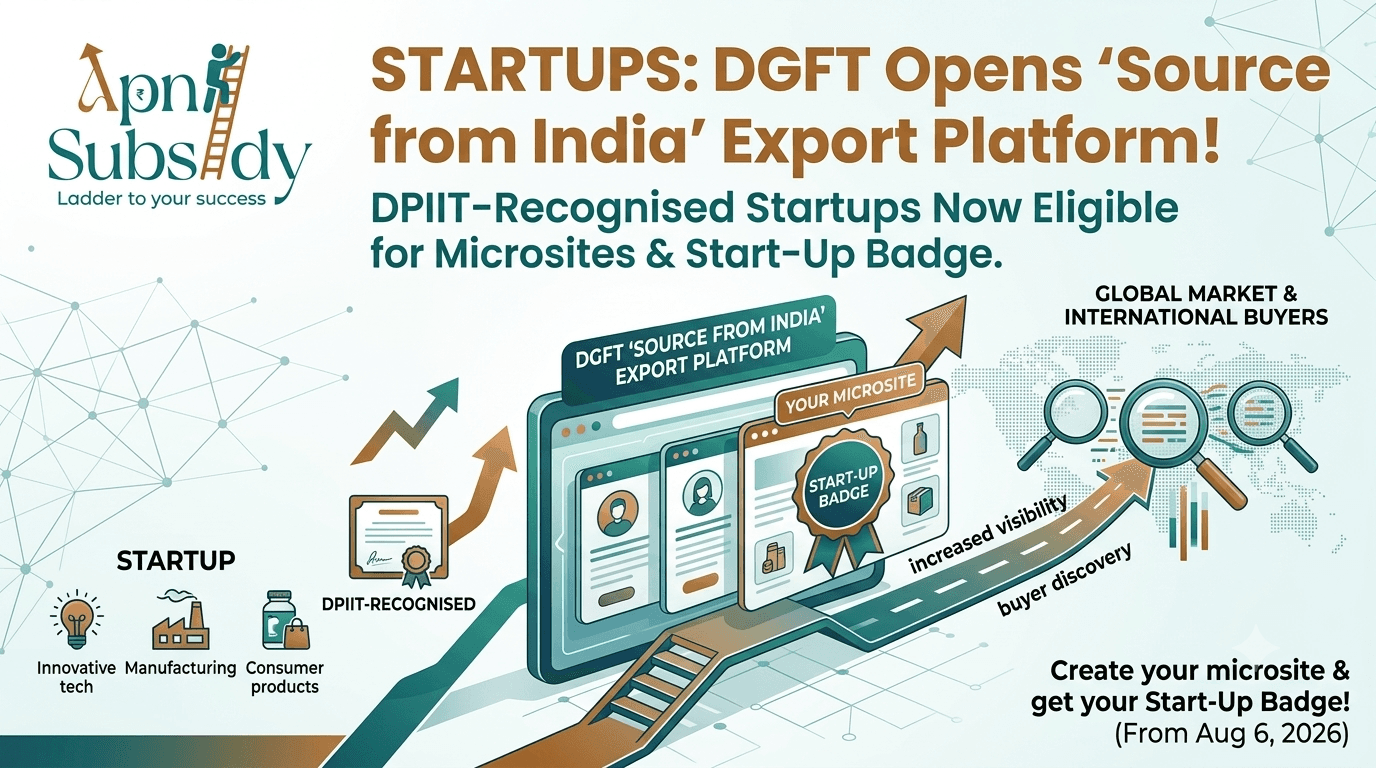
From 6 August 2026, DPIIT-recognised startups can access the government's “Source from India” platform, allowing eligible startups to create their own microsites and display a dedicated Start-Up Badge.
The change gives recognised startups a new government-backed channel for international visibility and buyer discovery.
What Is the “Source from India” Platform?
“Source from India” is a digital platform designed to connect Indian exporters with potential international buyers.
Instead of requiring every overseas buyer to discover individual Indian businesses independently, the platform acts as a central trade-discovery space where businesses can showcase their products and capabilities.
For exporters, visibility is an important part of entering a new market.
A business can have the right product and competitive pricing, but without access to potential buyers, those advantages may not translate into actual export orders.
The platform is therefore intended to reduce one part of that market-access problem.
What Has Changed for Startups?
The latest change specifically brings DPIIT-recognised startups into the platform.
Eligible startups can now create a microsite where they can present their business and products to potential international buyers.
They can also display a dedicated Start-Up Badge, making it easier for buyers browsing the platform to identify recognised startups.
Previously, access to this type of government-backed trade-discovery channel was more closely associated with established exporters.
Opening it to startups changes the equation for younger businesses that may have export-ready products but lack an established international sales network.
Why Does This Matter for Startups?
International expansion normally requires a startup to spend money and time on activities such as market research, buyer identification, trade events, digital marketing, and building overseas distribution relationships.
A government platform cannot replace all of those activities.
However, it can provide another route through which an international buyer can discover an Indian company.
That can be particularly useful for startups operating in areas such as manufacturing, technology-enabled products, specialised components, consumer products, and other sectors where the business is capable of serving international customers but has not yet built a large overseas network.
The DPIIT Recognition Matters
The benefit is not automatically available to every new company.
The change specifically applies to DPIIT-recognised startups.
DPIIT recognition is therefore an important eligibility factor for businesses wanting to take advantage of the new access.
For a startup already recognised by DPIIT, the opportunity is relatively straightforward: use the platform as an additional international discovery channel.
For an eligible startup that has not yet explored the platform, it is another government-backed export resource worth evaluating.
A Microsite Is Not the Same as an Export Order
There is an important limitation, though.
Getting listed on a government export platform does not guarantee international buyers or export contracts.
A microsite can improve visibility, but the startup still needs to demonstrate that it can meet buyer requirements.
That includes areas such as:
Product quality
Pricing
Export documentation
Certifications
Production capacity
Delivery timelines
International payment arrangements
After-sales support where applicable
In other words, the platform can help solve discovery, but it does not automatically solve the entire export process.
Why This Could Be Useful for Smaller Businesses
The change is particularly interesting because many startups are still operating with limited sales and marketing budgets.
An established exporter may already have overseas distributors, trade-fair relationships, international agents, and repeat buyers.
A young startup usually does not.
A government-backed platform can therefore provide an additional channel to build that initial international visibility without depending entirely on expensive private-sector lead-generation methods.
For startups looking beyond India's domestic market, that can be valuable.
The Bigger Export Opportunity
India's export strategy increasingly depends not only on large manufacturers but also on smaller businesses capable of selling specialised products to international markets.
Startups can play an important role in that ecosystem, particularly in technology, specialised manufacturing, innovation-led products, and emerging consumer categories.
Opening Source from India to DPIIT-recognised startups therefore fits into a broader push to make international markets more accessible to younger Indian companies.
Final Thoughts
The DGFT's decision to open the Source from India platform to DPIIT-recognised startups is not a direct subsidy or financing scheme.
Its value is different.
It gives eligible startups another government-supported route to showcase their products, improve international visibility, and potentially connect with overseas buyers.
For a startup preparing to export, the opportunity should be viewed as one piece of a larger international-market strategy.
The platform can help a business get discovered.
The next challenge is turning that discovery into a buyer—and eventually, a repeat export order.