Women Own 38% of India's MSMEs, But Their Businesses Generate Only 19% of Jobs
Women Own 38% of India's Registered MSMEs but Account for About 19% of Their Jobs
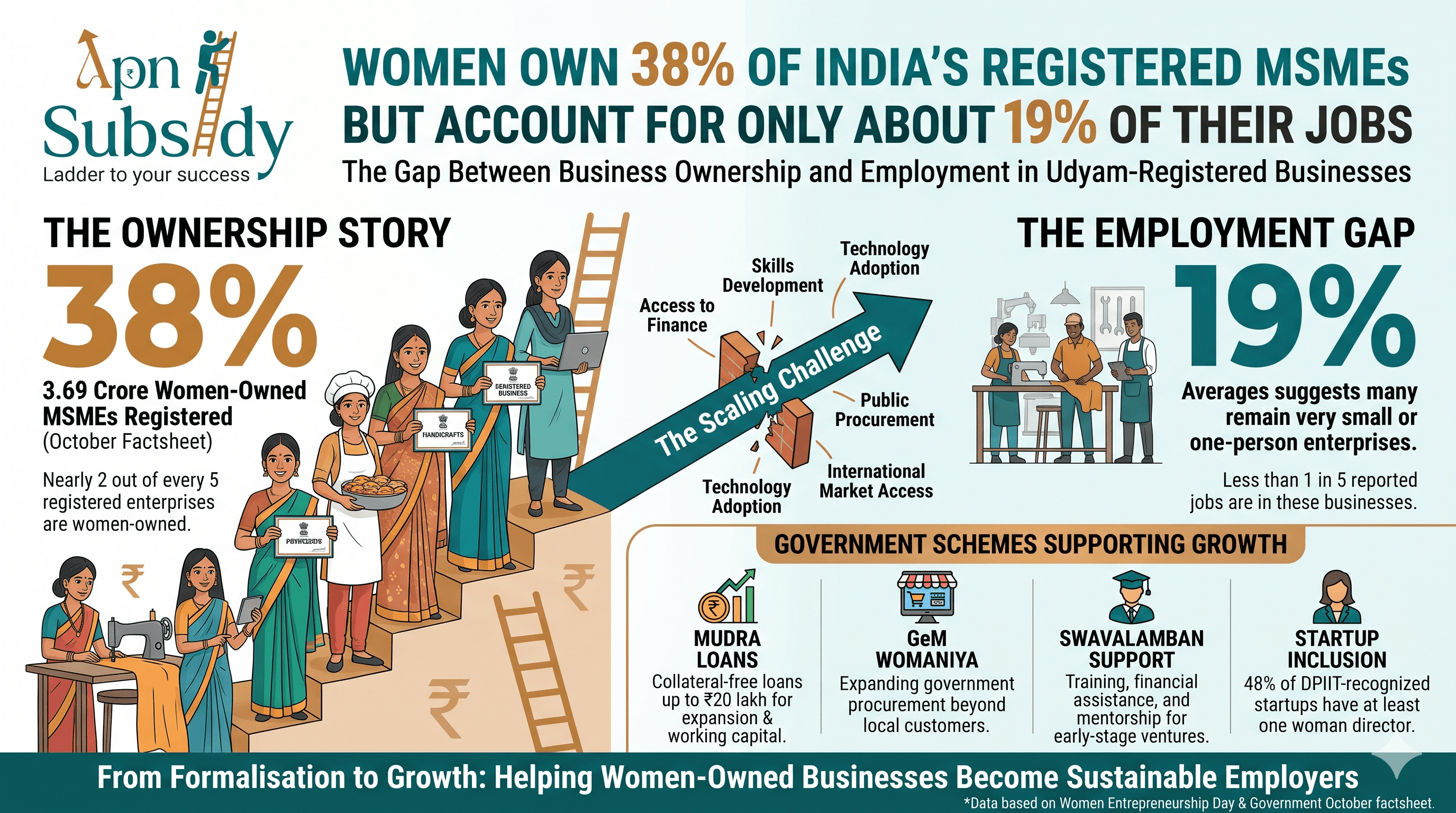
Women now own roughly 38% of India's registered MSMEs, but those enterprises account for only about 19% of employment among Udyam-registered businesses.
The numbers were highlighted around the Women Entrepreneurship Day event held in New Delhi on November 19, where MSME Secretary Bharat Khera pointed to the growing participation of women in India's formal MSME ecosystem.
According to the government's October factsheet, around 3.69 crore women-owned MSMEs are registered on the relevant platforms.
The scale is significant. But the employment figure reveals another side of the story: women own nearly two out of every five registered enterprises, while those businesses account for fewer than one in five reported jobs.
The Gap Between Business Ownership and Employment
The difference between the two figures is worth examining.
If women-owned businesses represent about 38% of registered enterprises but around 18.73% of reported employment, a simple calculation suggests that the average women-owned MSME employs roughly half as many people as the average registered MSME.
That is an arithmetic comparison based on the two published shares, not an employment figure reported by the government.
It nevertheless points toward a broader issue: many women-owned businesses appear to remain relatively small in terms of employment.
A significant number may be one-person or very small enterprises.
The Data Has Important Limitations
The numbers should not be interpreted as proof that women-owned businesses are inherently less capable of creating jobs.
There are several reasons the employment gap could exist.
Udyam employment data is self-reported by businesses, meaning it should be treated as an indicator rather than a precise headcount.
For example, a woman operating a tailoring, food-processing or handicraft business alone may have a registered enterprise but no employees to report.
Registration growth also matters.
The government's Yashasvini campaign, launched in June 2024 with the objective of moving toward gender parity in Udyam registrations by 2029, had facilitated more than 22 lakh women-owned MSME registrations as of July.
Some of this growth may therefore represent existing informal businesses entering the formal system rather than entirely new enterprises being created.
What Women-Owned MSMEs Need to Grow
At the Women Entrepreneurship Day event, the government's focus areas included:
Access to finance
Skills development
Technology adoption
Public procurement
International market access
These areas are important because registration alone does not make a business scalable.
A woman-owned enterprise that can access only small amounts of working capital and sells only within its local market may remain a micro business even after becoming formally registered.
The next challenge is therefore helping these businesses move from formalisation to growth.
Existing Schemes Already Target Some of These Barriers
Several government initiatives are designed to address the challenges faced by women entrepreneurs.
Mudra Loans
Under the Pradhan Mantri MUDRA Yojana, eligible micro and small enterprises engaged in non-farm income-generating activities can access collateral-free loans of up to ₹20 lakh, subject to applicable eligibility and lending conditions.
For women-owned micro businesses, access to formal credit can help finance equipment, inventory, expansion and working capital.
Government Procurement Through GeM
Public procurement is another potential growth channel.
Procurement from women-owned micro and small enterprises has exceeded the mandatory 3% procurement target.
The Womaniya initiative on the Government e-Marketplace (GeM) had registered more than 2.17 lakh women-owned enterprises as sellers by July, according to the figures referenced at the event.
For a small business capable of supplying products or services to government buyers, this can create a market beyond local customers.
Swavalamban Support
For women who are still at the idea or early-business stage, the Swavalamban Scheme provides support covering areas such as training, financial assistance, market guidance, legal support and mentorship.
The programme is designed to support women through the early stages of building an enterprise.
Women Are Also Increasingly Visible in Startups
The participation of women is not limited to traditional MSMEs.
More than 1.07 lakh DPIIT-recognised startups, representing around 48% of the total, have at least one woman director or partner.
However, this figure needs to be interpreted correctly.
It does not mean that women lead 48% of India's startups. It means that at least one woman is listed as a director or partner in these recognised startups.
Still, the number indicates substantial participation by women in India's formal startup ecosystem.
What Women Entrepreneurs Can Do Now
For women running small businesses, the policy ecosystem points toward a few practical steps.
First, ensure the business is formally registered under Udyam. Informal businesses can also explore the Udyam Assist Platform where applicable.
Businesses that can supply government buyers should consider registering as sellers on GeM, including through the Womaniya initiative where eligible.
Entrepreneurs seeking finance should also review the applicable MUDRA loan categories and eligibility requirements with their lending institution rather than assuming that the maximum loan amount automatically applies to every business.
These steps can create access to larger markets and formal finance.
The Next Challenge Is Growth, Not Just Registration
The 38% women-ownership figure is an important achievement in formalisation.
But the approximately 19% employment share raises a more important policy question: how many of these businesses can move beyond survival and become employers?
If the long-term objective is not merely registration parity but greater economic participation and employment creation, support will need to focus increasingly on business expansion, larger credit, market access, technology and hiring capacity.
Getting more women-owned businesses into the formal economy is the first step.
Helping those businesses grow into larger, sustainable employers is the harder—and potentially more valuable—next step.