Export Promotion Mission 2026: New Support for Small Exporters Explained
Small Exporters Can Now Claim Back Up to 95% of Airfare. The Export Mission Just Widened Its Doors.
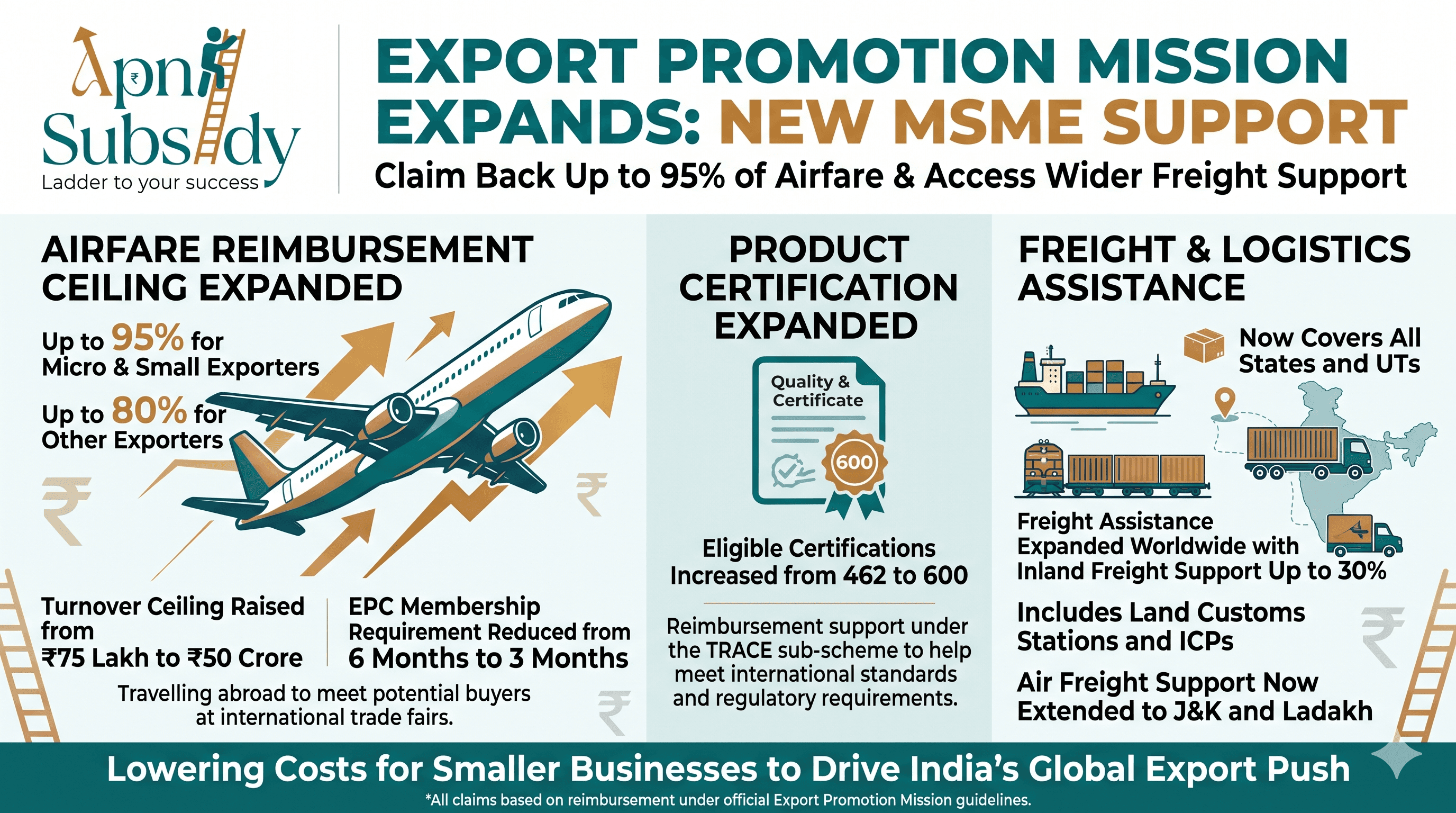
Small exporters travelling abroad to meet potential buyers at international trade fairs can now access significantly higher support for eligible airfare, while the turnover ceiling for qualifying exporters has been expanded from ₹75 lakh to ₹50 crore.
The changes are part of revised guidelines under the Export Promotion Mission, announced by the Ministry of Commerce and Industry on November 20.
The revised framework focuses on three major challenges faced by small exporters: finding international buyers, obtaining product certifications and moving goods efficiently to ports and other export hubs.
Export Promotion Mission Expands Support for MSMEs
The Export Promotion Mission was approved by the Cabinet Committee on Economic Affairs with an overall outlay of ₹25,060 crore through 2030-31.
Rather than introducing entirely new schemes, the revised guidelines expand eligibility and increase support under existing components of the Mission.
For MSMEs, this can be particularly important because accessing an existing support mechanism is often more useful than simply announcing another scheme.
Airfare Reimbursement Ceiling Raised to ₹50 Crore
One of the most significant changes is the expansion of airfare support.
Under the earlier framework, exporters with annual export turnover of up to ₹75 lakh in the previous financial year could claim eligible airfare expenses for participating in buyer-seller meets, international trade fairs and overseas trade delegations.
The turnover ceiling has now been increased to ₹50 crore.
This brings a much larger group of established small and medium exporters within the potential scope of the support.
Micro and small exporters can claim up to 95% of eligible airfare, while other eligible exporters can receive support of up to 80%.
The minimum Export Promotion Council membership requirement has also been reduced from six months to three months.
That means newer exporters joining an eligible council may be able to access support sooner, subject to the applicable conditions.
More Product Certifications Covered
International expansion often requires more than finding a buyer.
Depending on the destination market and product category, exporters may need quality, safety, technical or other regulatory certifications. For smaller businesses, these costs can become a major barrier to entering new markets.
Under the Trade Regulations, Accreditation and Compliance Enablement (TRACE) component of the Niryat Disha sub-scheme, eligible certification expenses can receive reimbursement support.
The number of certifications eligible for reimbursement has now increased from 462 to 600.
The broader list could help more exporters meet the certification requirements of overseas buyers and regulators.
Freight Support Now Covers Every State and Union Territory
Logistics is another area where the revised guidelines expand support.
Under the Logistics Interventions for Freight and Transport component, freight assistance was previously available across 13 states.
The revised framework expands coverage to all states and Union Territories.
Eligible MSME exporters can claim support of up to 30% of pre-tax inland freight costs, subject to a maximum of ₹20 lakh per Importer Exporter Code (IEC) per financial year.
The eligible locations now include Land Customs Stations and Integrated Check Posts, alongside existing logistics hubs.
Support also extends across road, rail and waterways, depending on the applicable conditions.
For exporters located away from major ports, particularly those operating from landlocked or border regions, the wider coverage could reduce part of the domestic logistics burden.
Air Freight Support Gets Wider Coverage
The revised guidelines also expand air freight assistance.
Earlier, air freight support was available only for exporters in the North Eastern Region.
The coverage has now been extended to Jammu & Kashmir and Ladakh.
The minimum distance requirement between the origin and destination has also been reduced from 200 kilometres to 100 kilometres.
The support is now available for all exportable goods, except products included in the prescribed negative list.
Why These Changes Matter for India’s Export Push
The changes come as India seeks to increase merchandise exports to $1 trillion by 2030-31.
MSMEs already account for a significant share of India’s exports, making their ability to access international markets an important part of the country’s broader export strategy.
Recent trade agreements with markets including Australia, the United Kingdom and the European Union could create additional opportunities for Indian exporters.
However, converting those opportunities into actual orders often depends on whether smaller businesses can meet foreign certification requirements, participate in international trade events and manage logistics costs.
The Support Still Has Practical Limitations
The revised guidelines offer greater support, but exporters should not assume that the government will cover costs upfront.
Most of these mechanisms operate through reimbursement, meaning businesses may still need to incur the eligible expense before claiming support.
That makes working capital an important consideration.
There is also a key information gap. The available announcement does not clearly specify the effective date for the revised rates or the complete claim procedure.
Exporters should therefore verify the latest official guidelines and consult their respective Export Promotion Council before making financial commitments based on the revised support.
The speed at which claims are processed and reimbursed will also determine the practical value of the scheme.
What Exporters Should Do Now
Exporters considering these benefits should take a few practical steps:
Confirm that the business has a valid Importer Exporter Code (IEC).
Check whether the business meets the three-month Export Promotion Council membership requirement.
Review whether the certifications required by the target market fall within the expanded list of 600 eligible certifications.
Identify whether planned freight routes qualify under the revised logistics provisions.
Check the latest official guidelines before incurring expenses that are expected to be reimbursed.
The revised Export Promotion Mission guidelines do not eliminate the challenges of exporting, but they can lower some of the costs that make international expansion difficult for smaller businesses.
For MSMEs looking to move beyond domestic markets, the real opportunity may now lie in combining these support measures with the right export market, product certification and logistics strategy.
Tags
Work With Us
Need help identifying the right subsidy, preparing documentation, or maximizing claim value? Our team can guide you end to end.