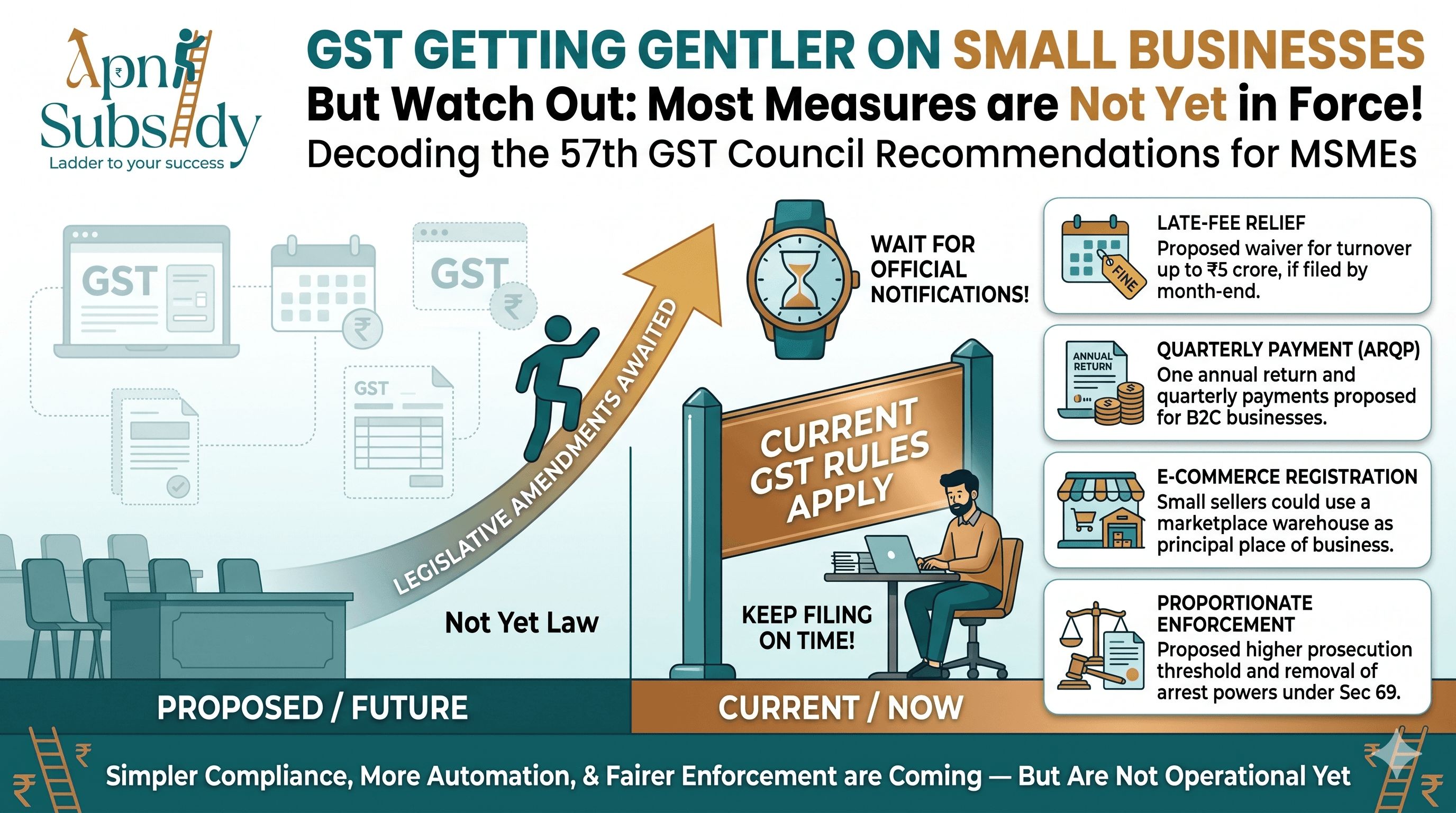
GST Reforms for MSMEs: New Relief Measures Explained
GST Is Getting Gentler on Small Businesses. Almost None of It Is in Force Yet.
For India’s small businesses, the latest GST changes are less about reducing tax rates and more about reducing compliance pressure.
At its 57th meeting held on October 8, the GST Council recommended several measures aimed at simplifying GST administration for small taxpayers. The proposals cover late fees, returns, e-commerce sellers, registration, refunds, penalties and prosecution.
But there is one important catch: most of these measures are recommendations and are not yet in force.
For MSME owners, understanding what has actually changed—and what has only been proposed—is crucial.
Late-Fee Relief for Small Taxpayers
One of the most noticeable recommendations concerns delayed GST returns.
The Council recommended waiving the late fee for delayed monthly or quarterly returns under Section 39(1) for taxpayers whose turnover in the previous financial year was up to ₹5 crore, provided the return is filed by the end of the month in which it was due.
However, two limitations are important.
First, the proposed waiver applies to the late fee, not unpaid-tax interest. Second, it does not extend the original filing due date.
In other words, a business cannot assume that the due date has been extended simply because a late-fee waiver has been recommended.
A New Quarterly Payment Option for B2C Businesses
The Council also approved in principle an Annual Return Quarterly Payment (ARQP) scheme for small businesses with turnover of up to ₹5 crore that make only business-to-consumer supplies to unregistered buyers.
Under the proposed framework, eligible businesses would potentially file one annual return while paying their GST liability every quarter.
For small retailers and other B2C-focused businesses, this could reduce recurring compliance work.
However, the proposal is not currently an operational filing option. Detailed rules and implementation requirements are still required before businesses can use it.
E-Commerce Sellers Could Get Simpler Registration
Another proposal could particularly benefit small online sellers.
At present, businesses selling goods through e-commerce platforms across multiple states can face additional GST registration and compliance requirements.
The Council proposed a new Rule 14B that would allow eligible small suppliers to treat an e-commerce platform's warehouse in a state as their principal place of business, with registration granted automatically subject to prescribed conditions.
The proposed relief would apply to small suppliers meeting specific requirements, including an input tax credit threshold of ₹2.5 lakh per month.
For home-based businesses and small sellers using marketplaces to reach customers across India, this could significantly reduce administrative complexity if implemented.
GST Enforcement Could Become More Proportionate
Some of the most significant recommendations concern GST enforcement.
The Council recommended:
Removing arrest powers under Section 69 of the CGST Act.
Increasing the prosecution threshold from ₹1 crore to ₹5 crore.
Narrowing certain offences under Section 132.
Reducing the general penalty to ₹10,000.
Introducing a ₹10,000 threshold below which a show-cause notice would not be issued.
For MSMEs, this could mean a more proportionate enforcement framework, particularly for smaller compliance issues.
The broader policy direction appears to be toward reserving the strongest enforcement mechanisms for cases involving more serious tax evasion and violations.
Registration and Refund Processes Could Become More Automated
The Council also recommended changes to GST registration and refund procedures.
These include:
Guided registration forms.
Automatic amendments.
Phased cancellation of registrations.
System-based processing of refunds.
Improvements in return and input-tax-credit reconciliation.
Changes to restrictions around input tax credit on certain items.
If implemented, greater automation could reduce the amount of manual intervention required from small businesses.
The Most Important Point: These Changes Are Not Yet Law
This is where MSME owners need to be careful.
A recommendation of the GST Council does not automatically change the law. The relevant legal amendments, notifications or circulars must be issued before businesses can rely on the proposed provisions.
As of now, most of the measures discussed above—including the late-fee waiver, prosecution threshold changes, Section 69 proposal, ₹10,000 notice threshold and refund-related changes—have not become operational merely because they were recommended.
Until the necessary legal changes take effect, existing GST rules continue to apply.
What MSMEs Should Do Now
For business owners, the practical approach is straightforward.
Keep filing GST returns on time and paying tax according to the existing rules. Do not assume that a proposed waiver or simplified filing mechanism is already available.
Businesses should also check whether their turnover falls within the proposed ₹5 crore threshold, as this is central to several of the small-taxpayer measures.
Most importantly, watch for the official notifications and legal amendments that will determine when each proposal actually becomes effective.
The Bigger Shift in GST Policy
The October GST Council meeting signals a broader shift.
Rather than focusing only on GST rates, the government is increasingly looking at how GST is administered—how businesses register, file returns, claim refunds and interact with the tax department.
For MSMEs, that distinction matters.
Lower compliance costs can be just as valuable as lower tax rates, particularly for businesses with limited administrative resources.
The direction of the reforms is clear: simpler compliance, more automation and potentially more proportionate enforcement.
What remains uncertain is the timeline.
Until the proposed measures are formally notified and brought into force, MSMEs should treat them as policy recommendations—not benefits they can claim today.
Tags
Work With Us
Need help identifying the right subsidy, preparing documentation, or maximizing claim value? Our team can guide you end to end.
Get in Touch