Government MSME Procurement Nearly Tripled, But One Key Target Was Missed
Government Buying From Small Businesses Nearly Tripled. One Sub-Target Still Missed It.
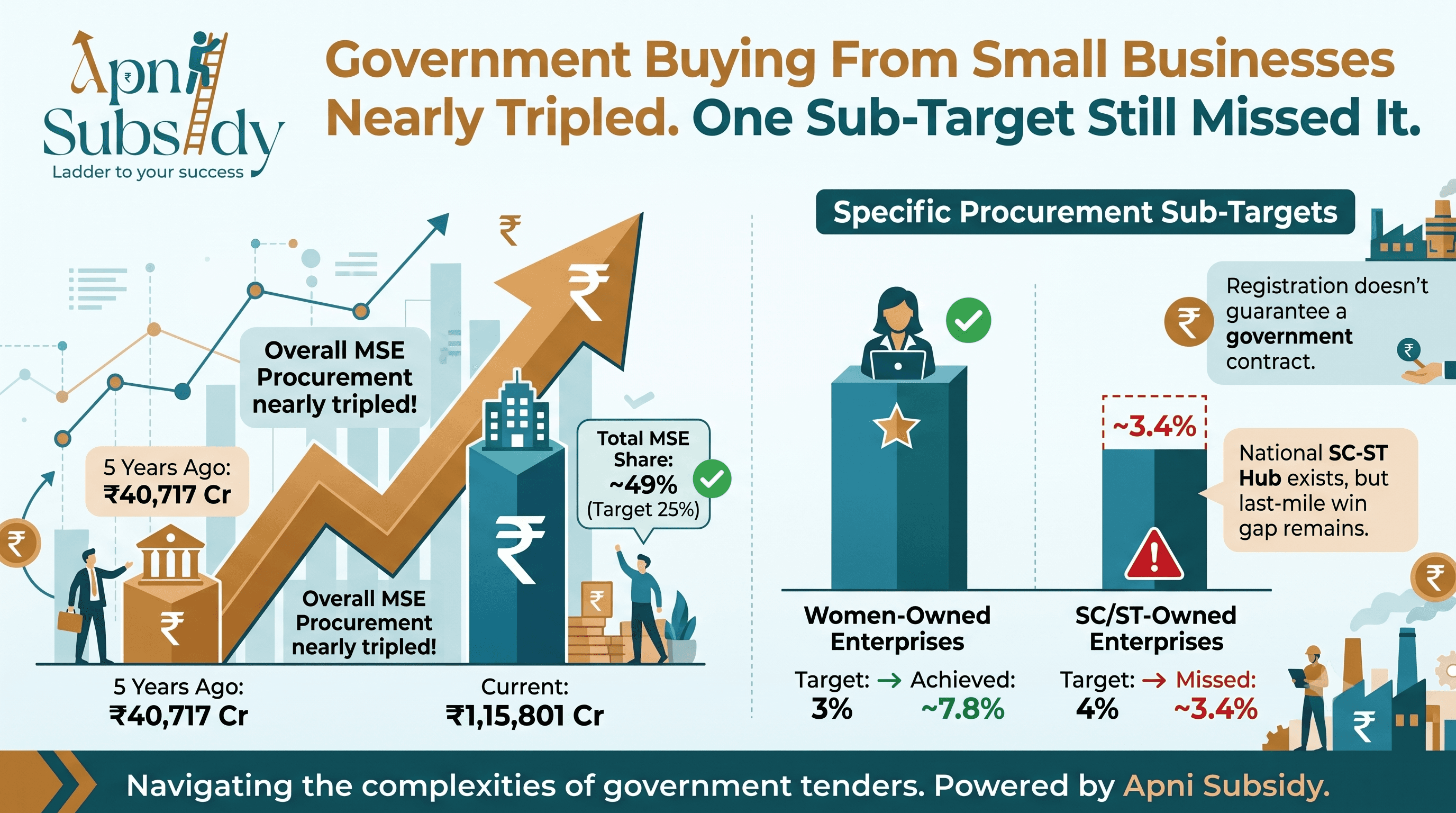
Government departments and public sector companies purchased ₹1,15,801 crore worth of goods and services from Micro and Small Enterprises (MSEs) in the financial year that just ended, according to the Ministry of MSME.
That is a significant increase from ₹40,717 crore five years earlier.
Against the government's mandated target of sourcing at least 25% of total procurement value from MSEs, the actual share crossed 49%. On the surface, that looks like a straightforward success story: government procurement from small businesses has not only met the target but nearly doubled it.
But the headline number hides a more complicated picture.
One of the specific procurement targets within that broader 25% mandate is still being missed.
What Is the 25% MSME Procurement Mandate?
Since 2012, every Central Government ministry, department, and public sector enterprise has been required to source at least 25% of its annual procurement from Micro and Small Enterprises.
The policy also includes two specific sub-targets:
4% of total procurement should come from SC/ST-owned enterprises.
3% of total procurement should come from women-owned enterprises.
These sub-targets exist because simply increasing overall MSME procurement does not necessarily guarantee equal access to government contracts.
Businesses with greater experience in government tenders, stronger financial resources, and established relationships can naturally find it easier to compete.
The additional targets are intended to make government procurement more accessible to businesses that have historically faced greater barriers.
Women-Owned Enterprises Have Surpassed Their Target
The latest figures show that government procurement from women-owned enterprises reached ₹9,059 crore.
That represents approximately 7.8% of total MSE procurement, well above the mandated 3% target.
In other words, procurement from women-owned enterprises was more than twice the minimum level required under the policy.
This suggests that women-led businesses have made significant progress in accessing government procurement opportunities.
SC/ST-Owned Enterprises Remain Below Target
The picture is different for SC/ST-owned enterprises.
Procurement from SC/ST-owned businesses stood at ₹3,984 crore, representing approximately 3.4% of total MSE procurement.
The mandated target is 4%.
That leaves a gap of roughly 0.6 percentage points.
The difference may appear small, but it is significant because the government has a dedicated programme specifically designed to help SC/ST entrepreneurs participate more effectively in government procurement.
What Is the National SC-ST Hub?
The National SC-ST Hub was launched in October 2016 and is implemented by the Ministry of MSME through the National Small Industries Corporation (NSIC).
Unlike general MSME schemes that focus primarily on finance or subsidies, the Hub has a more specific objective: helping SC/ST entrepreneurs become capable and competitive participants in government procurement.
Its support includes areas such as:
Technology upgradation
Capacity building
Mentoring
Market linkage
Support for participating in government tenders
The potential pool of businesses is also substantial.
More than 1.24 crore MSMEs registered on the Udyam portal are owned by SC/ST entrepreneurs.
Yet their procurement share remains below the 4% target.
That raises an important question: why has the growing number of eligible businesses not translated into a proportionate increase in government contracts?
Registration Does Not Guarantee a Government Contract
One possible explanation is that becoming eligible for government procurement is only the first step.
Winning a government tender can require considerable preparation.
A small business may need:
Experience with tender documentation
Sufficient working capital
Production and delivery capacity
Relevant certifications
Previous contract experience
Knowledge of government procurement procedures
For a first-generation entrepreneur or relatively young business, developing these capabilities can take considerable time.
A business can therefore be registered, eligible, and supported by a government programme while still struggling to win large procurement contracts.
The Bigger Procurement Story
Despite the gap in the SC/ST sub-target, the broader trend is significant.
Government procurement from MSEs has increased from ₹40,717 crore to ₹1,15,801 crore in five years.
That represents nearly a threefold increase and demonstrates how important government procurement has become as a potential market for India's small businesses.
But looking only at the overall 25% target can hide where participation remains uneven.
Women-owned enterprises have exceeded their target by a substantial margin, while SC/ST-owned enterprises remain below theirs.
This suggests that the next challenge is not simply increasing procurement from MSMEs.
It is improving access to procurement opportunities for businesses that remain underrepresented.
Final Thoughts
The latest procurement figures represent genuine progress for India's MSE sector.
The government has comfortably exceeded its overall 25% procurement target, while procurement from women-owned enterprises has also surpassed its specific target.
However, the SC/ST procurement target remains unmet despite the existence of the National SC-ST Hub, a programme specifically created to address many of the barriers faced by SC/ST entrepreneurs.
The lesson is straightforward: registration and eligibility are not enough.
For the policy to fully deliver on its promise, more businesses need to move from being eligible for government procurement to actually winning government contracts.
The next phase of MSME procurement policy will therefore be less about simply increasing the headline number and more about closing this last-mile gap.