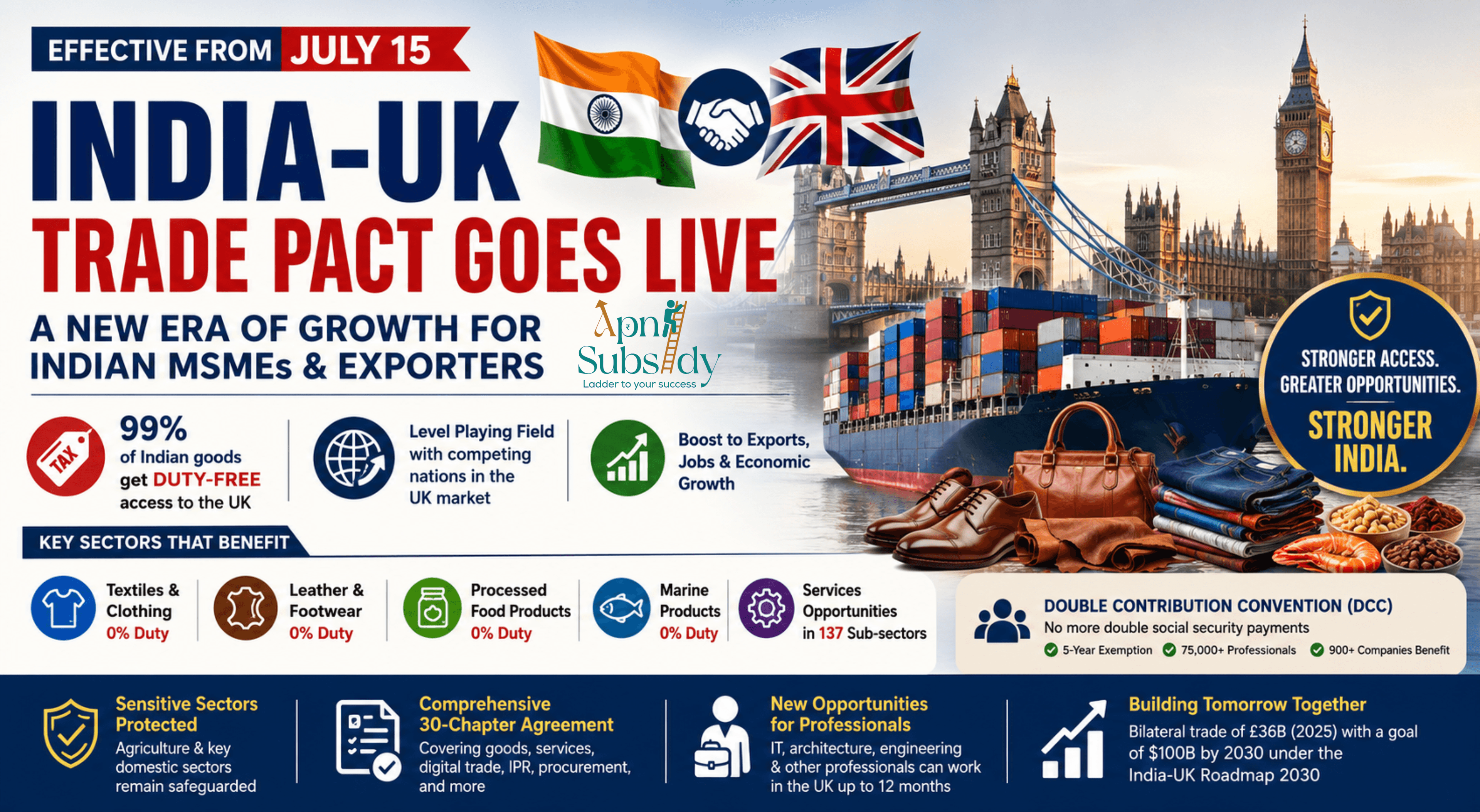
India-UK Trade Pact Goes Live on July 15: What It Actually Means for Indian MSMEs and Exporters
India-UK Trade Pact Goes Live on July 15: What It Actually Means for Indian MSMEs and Exporters
After nearly three years of negotiations and fourteen rounds of discussions, India and the United Kingdom are set to implement one of their most significant trade agreements to date.
On the sidelines of the G7 Summit in Evian, Prime Minister Narendra Modi confirmed that the India-UK Comprehensive Economic and Trade Agreement (CETA) will officially come into force on July 15, alongside the Double Contribution Convention (DCC), a social security agreement designed to reduce costs for Indian professionals working in the UK.
For India's exporters and MSMEs, this is more than a diplomatic milestone—it could reshape access to one of the world's largest consumer markets.
A Major Win: 99% of Indian Goods to Get Duty-Free Access
The biggest headline from the agreement is simple but powerful: 99% of Indian tariff lines will receive duty-free access to the UK market from day one.
According to Commerce Minister Piyush Goyal, the agreement removes long-standing tariff barriers that have limited India's competitiveness in Britain.
Several key sectors stand to benefit immediately:
Textiles and clothing: Existing tariffs of up to 12% eliminated.
Leather and footwear: Duties of up to 16% removed.
Processed food products: Tariffs reaching 70% abolished.
Marine products: Improved access through zero-duty treatment.
For years, countries such as Bangladesh, Cambodia, and Vietnam enjoyed preferential market access in the UK. With CETA taking effect, Indian exporters will finally compete on similar terms.
Why This Could Be a Game Changer for MSMEs
The biggest beneficiaries may not be India's largest corporations but its thousands of small and medium-sized manufacturers.
Take the leather and footwear sector as an example.
India exported approximately USD 494 million worth of leather and footwear products to the UK in 2024. Industry projections suggest that figure could exceed USD 1 billion within the next three years now that tariffs have been removed.
That growth could directly impact manufacturing hubs such as:
Tiruppur's garment industry
Agra's leather clusters
Rajasthan's traditional Mojari artisans
For these businesses, even small improvements in profit margins can determine whether they expand production, hire more workers, or reduce operations.
The Agreement Goes Beyond Merchandise Trade
Unlike many conventional trade deals, the India-UK CETA covers a broad range of sectors across 30 chapters, including:
Services
Digital trade
Financial services
Telecommunications
Intellectual property
Government procurement
Sustainability standards
Perhaps most importantly, the UK has opened 137 services sub-sectors for Indian participation.
This creates new opportunities for:
IT companies
Engineering consultancies
Architecture firms
Professional service providers
Legal and business advisory firms
The agreement also allows eligible independent professionals and contractual service suppliers in areas like IT and architecture to work in the UK for up to 12 months, subject to immigration regulations.
Double Contribution Convention: Cost Relief for Indian Professionals
While tariff reductions have dominated headlines, the accompanying Double Contribution Convention (DCC) could prove equally valuable.
Currently, Indian professionals temporarily posted to the UK often have to contribute to social security systems in both countries simultaneously.
The DCC removes this duplication.
Additionally, the exemption period has been extended from three years to five years, providing significant financial relief for businesses operating internationally.
The government estimates that:
More than 75,000 Indian professionals will benefit.
Over 900 Indian companies are expected to receive direct cost savings.
For mid-sized IT services firms that regularly deploy employees to UK projects, these savings could materially improve competitiveness.
Sensitive Sectors Remain Protected
The agreement is not a blanket opening of markets.
India has deliberately protected several sensitive agricultural sectors from import competition, including:
Dairy products
Cereals
Millets
Edible oils
Oilseeds
Various vegetable products
These exclusions reflect India's effort to balance export opportunities with domestic economic priorities.
Similarly, approximately 85% of India's steel exports will remain outside the scope of new UK steel measures coming into effect from July 1.
Looking Ahead
India and the UK recorded bilateral trade worth more than £36 billion in 2025.
Under the India-UK Roadmap 2030, both countries aim to increase this figure to $100 billion by the end of the decade.
The implementation of CETA and the Double Contribution Convention represents the most substantial structural step toward achieving that objective.
But the success of the agreement will not ultimately be measured by what is written in its legal text.
It will be measured by whether India's MSMEs, exporters, manufacturers, and service providers understand the opportunities available to them—and whether they can transform tariff-free market access into sustainable business growth and long-term international partnerships.
Tags
Work With Us
Need help identifying the right subsidy, preparing documentation, or maximizing claim value? Our team can guide you end to end.