India Wants Its Small Businesses to Sell Directly to the World. Here's the Plan.
India Wants Its Small Businesses to Sell Directly to the World. Here's the Plan.
For decades, exporting has been viewed as something only large companies could afford to do. While Indian MSMEs manufacture everything from premium textiles and handicrafts to engineering goods and consumer products, selling those products overseas has often been far more complicated than selling them at home.
The demand has always existed. The challenge has been everything that comes after-a maze of customs paperwork, shipping logistics, export financing, quality certifications, and delayed payments. For many small businesses, these hurdles have made international trade seem out of reach.
The Indian government now wants to change that.
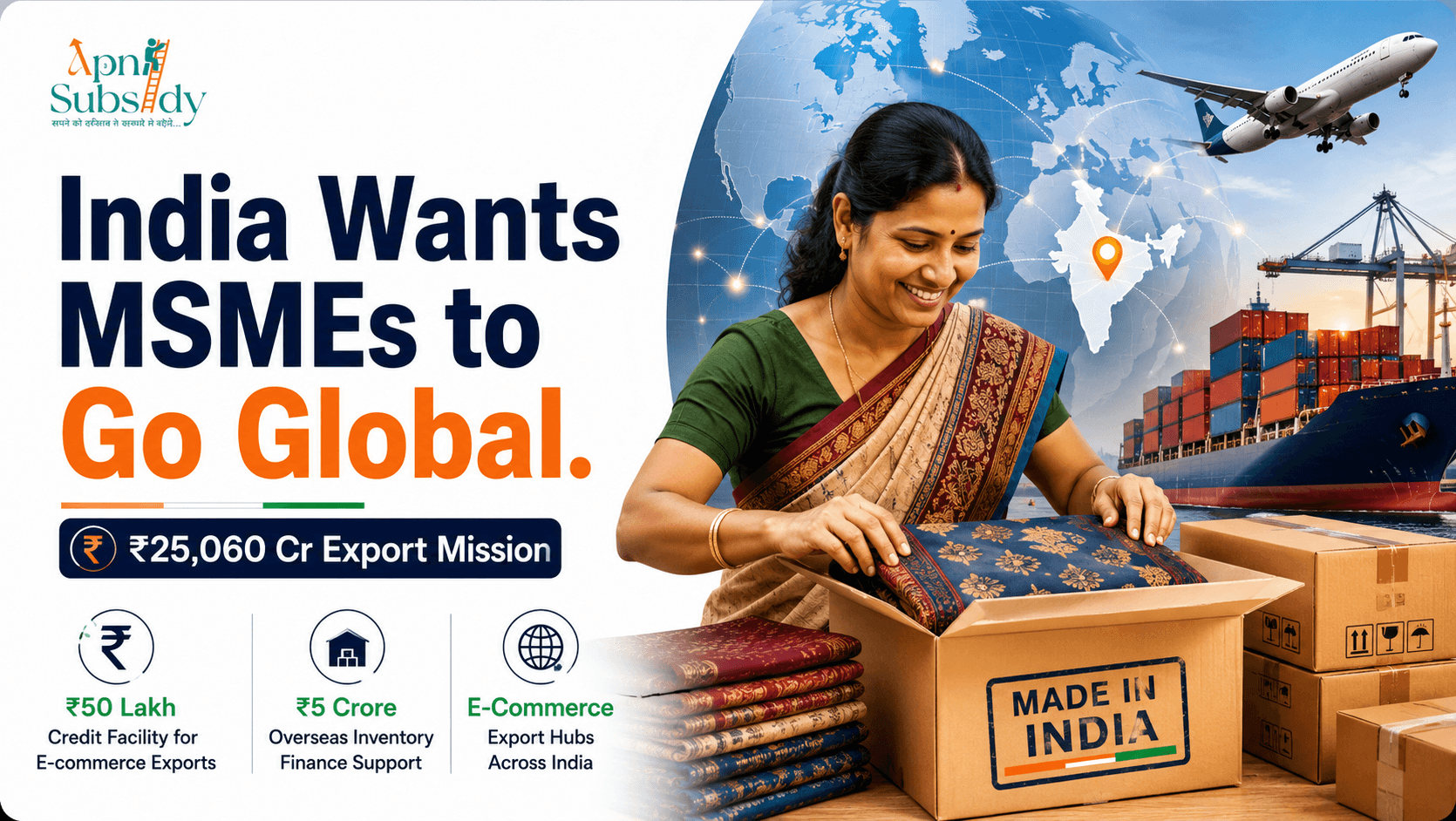
In the Union Budget 2025-26, the government announced the Export Promotion Mission, a six-year initiative backed by ₹25,060 crore. The programme aims to make exporting simpler, cheaper, and more accessible for India's micro, small, and medium enterprises (MSMEs), with a particular focus on cross-border e-commerce.
Why the Mission Matters
India has no shortage of products that can compete globally. From Varanasi's handloom weavers and Jaipur's handicraft makers to Coimbatore's engineering manufacturers, thousands of small businesses already produce goods that appeal to international buyers.
Yet India continues to lag behind countries like China in e-commerce exports.
According to government estimates, Chinese SMEs exported around $200 billion worth of goods through e-commerce in 2022, while India's cross-border e-commerce exports remain only a small fraction of that figure. The gap isn't necessarily about product quality-it is about infrastructure, financing, and making exports easier for small businesses.
Two Pillars of the Export Promotion Mission
The mission has been built around two key components.
The first, Niryat Protsahan, focuses on improving access to finance through export credit and government-backed lending.
The second, Niryat Disha, aims to simplify logistics, customs compliance, market intelligence, and other operational challenges that businesses face while exporting.
Together, these initiatives are designed to remove many of the barriers that discourage MSMEs from entering global markets.
Easier Access to Export Finance
One of the biggest challenges for small exporters has always been access to affordable credit.
To address this, the government has introduced the Direct E-Commerce Credit Facility, which offers eligible MSMEs financing of up to ₹50 lakh with a 90% government guarantee. By significantly reducing the lender's risk, the scheme is expected to make banks more willing to extend loans to smaller businesses.
The government has also launched the Overseas Inventory Credit Facility, offering financing of up to ₹5 crore with a 75% government guarantee and an annual interest subsidy of up to ₹15 lakh. This is intended to help exporters maintain inventory in overseas warehouses, enabling quicker deliveries and making Indian sellers more competitive on international e-commerce platforms.
Building Better Export Infrastructure
Finance alone cannot solve every export challenge.
The Export Promotion Mission also includes the creation of E-Commerce Export Hubs (ECEHs). These integrated facilities will provide warehousing, packaging, customs documentation, quality checks, and logistics support under one roof.
Instead of coordinating with multiple agencies, exporters will be able to complete much of the export process through a single streamlined system. The government is developing these hubs in partnership with logistics providers and major e-commerce platforms.
More Support for MSMEs
The mission was expanded further in February 2026, when Commerce Minister Piyush Goyal announced seven additional interventions.
Among them is support for export factoring, which allows exporters to receive payment against invoices without waiting for overseas buyers to settle them. The government will subsidise part of the factoring cost, helping improve cash flow for MSMEs.
Another initiative, the LIFT programme, reimburses up to 30% of freight expenses for eligible exporters located in geographically disadvantaged districts. Since businesses far from major ports often face higher transportation costs, the scheme aims to make exporting more financially viable for enterprises across the country.
The Bigger Picture
Perhaps the biggest shift introduced by the Export Promotion Mission is its overall approach.
Instead of treating exports as something businesses pursue only after becoming large, the government wants MSMEs to think globally from the beginning. By improving access to finance, simplifying compliance, reducing logistics costs, and strengthening export infrastructure, the mission seeks to lower the barriers that have historically kept small businesses out of international markets.
Of course, the success of the programme will depend on implementation. Many government schemes have struggled in the past due to limited awareness and complex application processes. Recognising this, the mission also includes outreach and capacity-building efforts to ensure that MSMEs-particularly those in Tier-2 and Tier-3 cities to understand and utilise the support available.
Final Thoughts
The Export Promotion Mission represents one of India's most ambitious efforts to help small businesses compete globally. With dedicated financing, integrated export hubs, freight support, and simplified export processes, the programme has the potential to make international trade far more accessible for MSMEs.
The framework is now in place. The funding has been committed. The real test will be how effectively these initiatives reach entrepreneurs on the ground-and whether more Indian businesses seize the opportunity to sell directly to customers around the world.
Tags
Work With Us
Need help identifying the right subsidy, preparing documentation, or maximizing claim value? Our team can guide you end to end.
Get in Touch