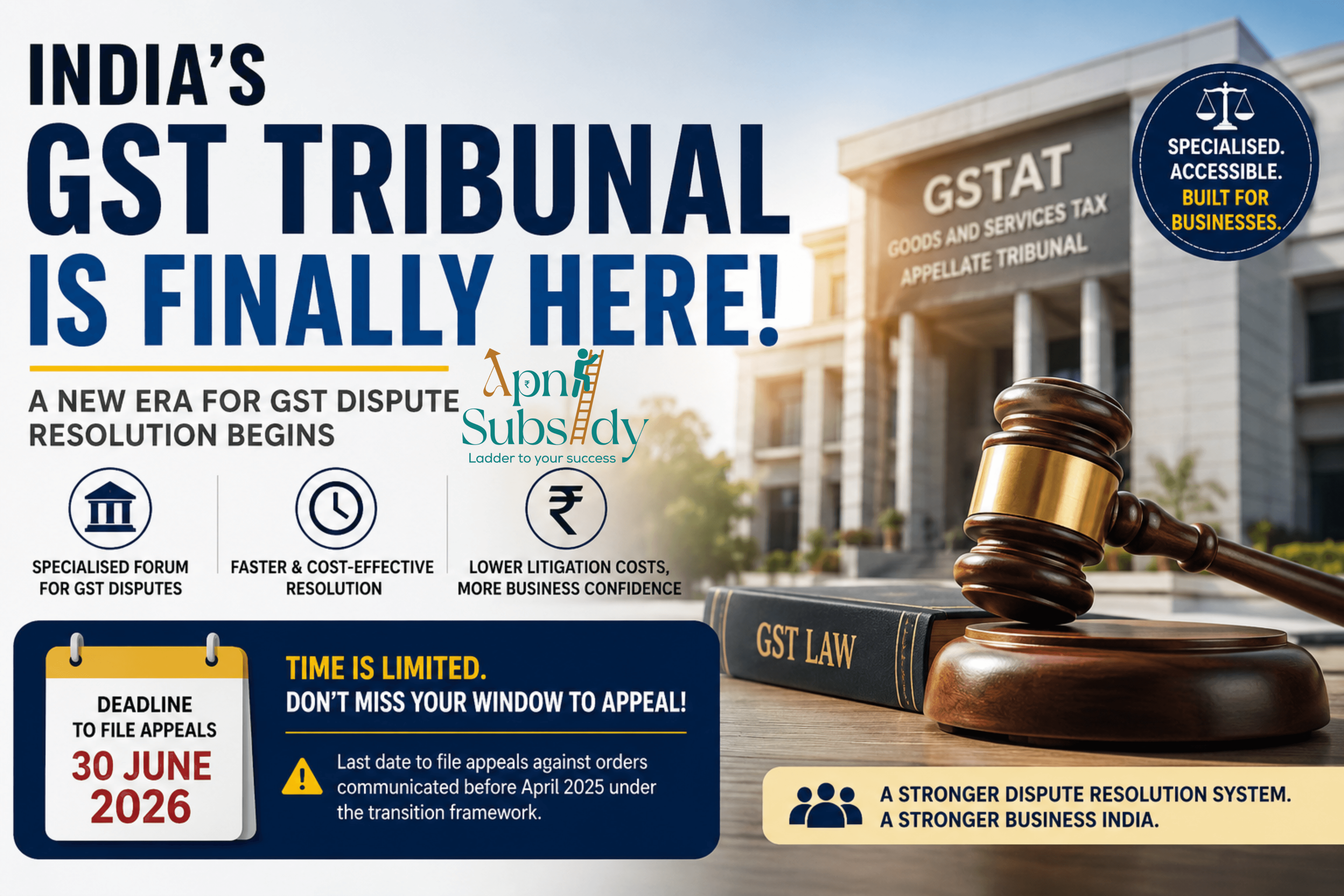
India's GST Tribunal Is Finally Here — But Thousands of Businesses May Miss the Deadline That Matters
India's GST Tribunal Is Finally Here — But Thousands of Businesses May Miss the Deadline That Matters
For eight years, businesses that wanted to challenge a GST order faced an unusual problem. The law had created a dedicated appellate tribunal, but the tribunal itself never became operational. In practice, many companies had little choice but to approach High Courts, an expensive and time-consuming route that discouraged countless appeals.
That situation has finally changed.
The Goods and Services Tax Appellate Tribunal (GSTAT) is now becoming operational across India, offering businesses a specialized forum to resolve tax disputes. Yet the bigger story isn't simply that the tribunal exists—it's that thousands of businesses are now racing against a filing deadline that many may not even know exists.
A Promise Made in 2017, Delivered Years Later
When GST was introduced in 2017, the Central Goods and Services Tax Act envisioned a dedicated appellate tribunal under Section 109. The objective was straightforward: create a faster, more specialized mechanism for resolving tax disputes before they reached already burdened High Courts.
Instead, years of legal challenges, disagreements over appointments, and administrative delays kept the tribunal on paper rather than in practice.
The result was predictable. Businesses facing adverse GST orders either accepted them without contest or pursued lengthy litigation through the High Courts, significantly increasing both costs and uncertainty.
The Rollout Has Finally Begun
The rollout began with the Principal Bench in Delhi and has gradually expanded to other locations, with additional state benches continuing to become operational across the country.
For India's vast MSME ecosystem, this decentralization could prove especially valuable. Small manufacturers, traders, and service providers will increasingly have access to a specialized appellate forum closer to their own regions rather than relying on distant courts.
Lower litigation costs and quicker dispute resolution could improve the ease of doing business for thousands of enterprises that previously considered legal action financially impractical.
The Deadline Businesses Cannot Ignore
The tribunal's launch comes with an important procedural consequence.
The government has fixed 30 June 2026 as the last date for filing appeals against GST orders that were communicated before April 2025 under the transition framework.
For businesses that postponed appeals because no tribunal existed, this creates a narrow opportunity to revive long-pending disputes.
Many MSMEs may have tax demands sitting unresolved simply because owners believed there was no practical appellate mechanism available. Some may have archived the paperwork years ago without realizing that the creation of the tribunal has effectively reopened a pathway—but only for a limited period.
Once this window closes, those appeal rights may be lost.
Why This Matters Beyond Litigation
The establishment of GSTAT is more than an administrative reform.
Tax uncertainty directly affects working capital, borrowing capacity, investor confidence, and expansion decisions. An unresolved tax dispute can prevent businesses from planning future investments or securing financing on favorable terms.
A functioning appellate structure also creates greater consistency in tax administration. Businesses are more likely to comply voluntarily when they believe disputes can be resolved efficiently through a specialized institution rather than prolonged court battles.
For startups and growing enterprises, that predictability carries significant economic value.
A Second Structural Change Few Are Talking About
The tribunal's Principal Bench has also assumed responsibility as the National Appellate Authority for Advance Rulings.
For years, businesses operating across multiple states have faced conflicting advance rulings on nearly identical transactions, creating uncertainty over GST treatment depending on jurisdiction.
Centralizing appeals under one authority has the potential to reduce these inconsistencies and gradually produce a more uniform interpretation of GST law across India.
Whether that objective is achieved will depend on future decisions, but the institutional framework now exists.
Advisors Are Likely to See a Last-Minute Rush
Chartered accountants, tax consultants, and legal professionals are already preparing for increased demand from businesses revisiting dormant GST disputes.
Many entrepreneurs may only become aware of the transition deadline after discussions with their advisors. Others may discover old assessment orders that were never formally challenged simply because no practical forum existed at the time.
For those businesses, timing could become just as important as the merits of the case itself.
The Bigger Picture
The launch of the GST Appellate Tribunal may not generate the same headlines as a major tax cut or a large government incentive scheme, but it represents one of the most meaningful structural changes to India's GST framework since the tax regime was introduced.
A modern tax system is measured not only by how efficiently it collects revenue but also by how fairly and predictably disputes are resolved.
After years of waiting, businesses finally have the institution that was originally promised.
The remaining question is whether those holding unresolved GST disputes will realize they have one last opportunity to use it before the clock runs out.
Tags
Work With Us
Need help identifying the right subsidy, preparing documentation, or maximizing claim value? Our team can guide you end to end.
Get in Touch