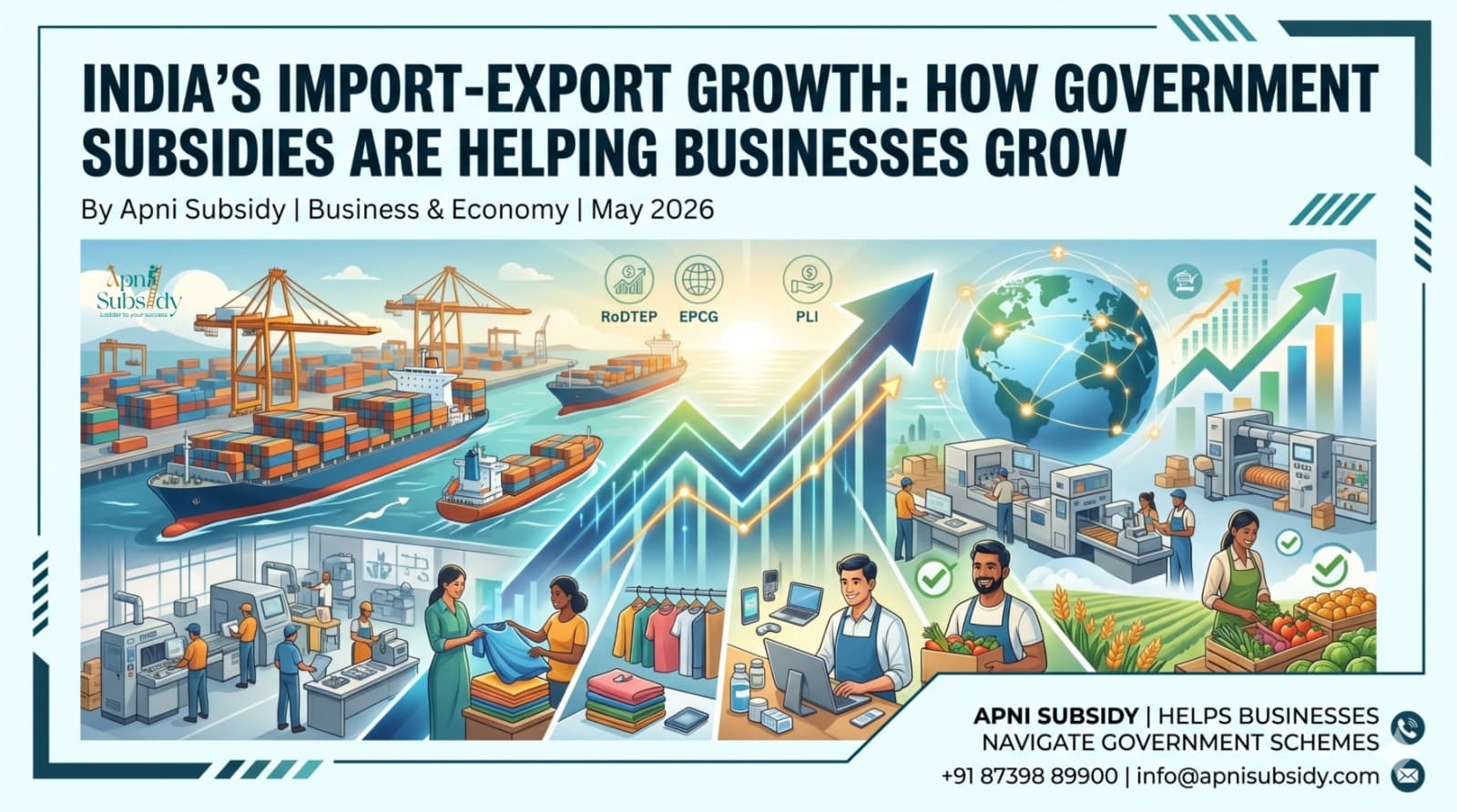
India's import-export growth: How government subsidies are helping businesses grow.
India's import-export growth: How government subsidies are helping businesses grow
India's exports have hit record levels over the past few years, and Indian businesses are reaching markets they weren't in before. The government has backed this with a range of subsidy and incentive programs — for manufacturers, exporters, and MSMEs — designed to reduce costs, attract investment, and sharpen competitiveness. For businesses, understanding what's actually available can have a direct effect on margins and growth prospects.
What's driving India's trade growth
Three things are shaping the trade picture right now.
Growing export demand
Indian products are finding buyers across more categories than before — electronics, pharmaceuticals, textiles and apparel, agricultural products, gems and jewellery, engineering goods. Improved manufacturing, government support, and rising global demand have helped exporters both enter new markets and deepen their presence in existing ones.
Reducing import dependence
India still imports large volumes of crude oil, semiconductors, edible oils, and industrial inputs. The government is pushing domestic production across several industries to reduce that exposure and build supply resilience.
Building trade relationships
India is strengthening trade partnerships and looking for market opportunities across Asia, Europe, the Middle East, and beyond — with the goal of giving Indian businesses better access and stronger export competitiveness.
Government schemes exporters should know about
RoDTEP
The Remission of Duties and Taxes on Exported Products scheme covers taxes and duties that don't get refunded through other mechanisms. Recovering those costs helps keep Indian products price-competitive abroad.
EPCG
The Export Promotion Capital Goods scheme allows businesses to import qualifying machinery and equipment at reduced or zero customs duty, against export obligations. If you're planning a production upgrade, it's worth checking whether EPCG applies before committing to a purchase.
Advance Authorisation
This lets exporters bring in raw materials and components duty-free when those inputs are used to manufacture export products. The customs saving is useful; the cash flow benefit often matters more.
PLI schemes
Production Linked Incentive schemes pay financial incentives to companies that grow output in target sectors — electronics, pharmaceuticals, food processing, textiles. The more you produce above a baseline, the more you receive. The compliance requirements are detailed, and claims take time, but the payouts for qualifying businesses can be substantial.
Rajasthan-based businesses
Rajasthan has real export depth in textiles, handicrafts, gems and jewellery, agro-based products, and stone and mineral products. The state government has its own initiatives on top of central programs — covering export competitiveness, technology adoption, and infrastructure. Central and state programs can sometimes be combined, which changes the investment calculus. It's worth checking both before making decisions.
Import substitution: the other side of the opportunity
Export growth is only part of the picture.
Under Atmanirbhar Bharat, the government is actively pushing businesses to manufacture domestically what India has historically imported at scale. Electronics, renewable energy equipment, defence manufacturing, and industrial components have all seen increased policy support.
For MSMEs, this means two directions for growth: exporting, and becoming a supplier within India's domestic manufacturing base. Both are worth evaluating.
What to focus on
Businesses aiming to grow in 2026 should:
Check eligibility for export-related incentive schemes — many businesses qualify for at least one and haven't applied
Assess whether technology upgrades or new machinery could improve productivity
Look into both central and state subsidy programs relevant to their sector
Stay current on changing trade policies and international market developments
Keep documentation and compliance records in order — most claim delays come down to paperwork, not policy
Conclusion
India's trade growth is creating concrete opportunities for manufacturers, exporters, and MSMEs. Government programs are helping businesses cut costs, modernise, and enter new markets. The businesses that benefit most are usually the ones that understand the available schemes and act before the window closes.
Whether you're planning to start exporting, scale up production, or invest in new equipment, the right subsidy or incentive can shift the economics considerably.
Apni Subsidy helps businesses identify relevant government schemes, prepare documentation, and navigate the application process.
Tags
Work With Us
Need help identifying the right subsidy, preparing documentation, or maximizing claim value? Our team can guide you end to end.
Get in Touch