MSME Payment Law 2026: New Rules Could Help Businesses Get Paid Faster
Parliament Just Rewrote the Law That's Supposed to Get MSMEs Paid on Time
For years, one of the biggest challenges faced by India's Micro, Small and Medium Enterprises (MSMEs) has been delayed payments from buyers.
A small supplier may deliver goods or services on time, raise an invoice, and still wait months to receive payment from a larger company or government-linked organisation. The MSME Development Act, 2006 provided a legal mechanism for addressing such disputes, but the process could often be slow.
That framework is now being significantly changed.
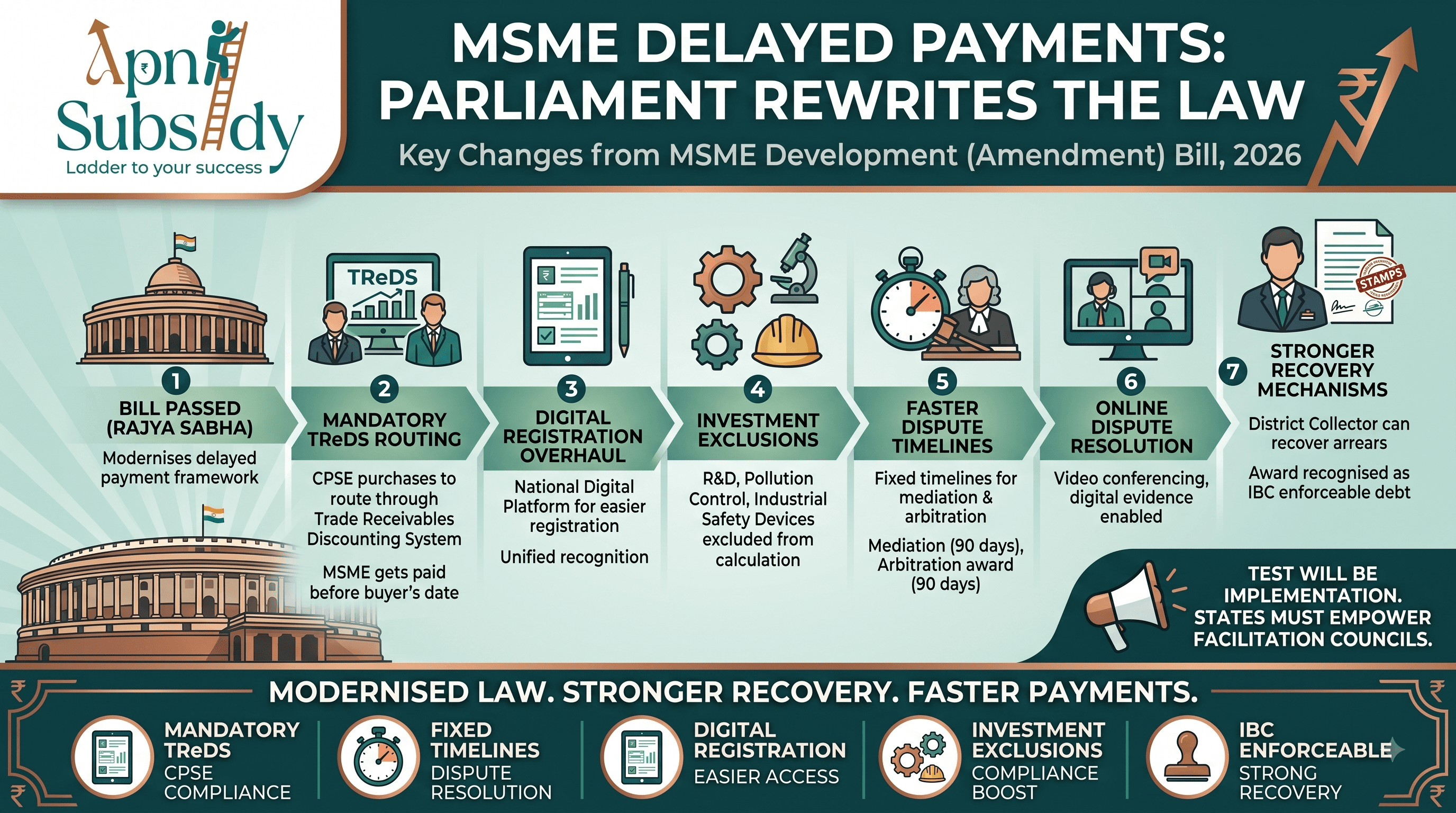
The MSME Development (Amendment) Bill, 2026, introduced in the Rajya Sabha on 28 July and passed by the House on 3 August, proposes major changes to the MSME Development Act. The amendments cover payment systems, registration, MSME classification, dispute resolution, recovery of awards, and penalties for non-compliance.
For MSMEs, the biggest question is simple: Will these changes actually help businesses get paid faster?
TReDS Payments Could Become Mandatory for CPSEs
One of the most important provisions is the proposed Section 15A.
Under the new provision, Central Public Sector Enterprises (CPSEs) would be required to route payments for purchases from MSMEs through the Trade Receivables Discounting System (TReDS).
TReDS is an RBI-authorised electronic platform that allows MSME suppliers to get their invoices financed by financiers, helping them receive money before the buyer's actual payment date.
Until now, participation by large organisations was not universally mandatory.
The amendment changes that for CPSE procurement.
It also gives the Central and State Governments the power to extend similar requirements to other public sector organisations and entities in the future.
Enterprises would also be required to disclose information about MSME invoices routed through the system, increasing transparency around outstanding payments.
MSME Registration Gets a Digital Overhaul
The proposed amendments also change how businesses register as MSMEs.
The new framework introduces a free and voluntary national digital platform where enterprises can register electronically and access applicable benefits.
State-level digital registration platforms can continue to operate alongside the national system.
The objective is to make registration simpler while creating a more unified digital system for MSME recognition and access to government benefits.
For businesses, easier registration could also improve access to credit, government schemes, and other formal support mechanisms.
Some Investments Will No Longer Affect MSME Classification
Another practical change concerns how investment is calculated when determining an enterprise's MSME classification.
Under the proposed framework, expenditure on certain areas—including:
Pollution control equipment
Research and development
Industrial safety devices
would be excluded from the investment calculation.
This is important because businesses that invest in compliance, safety, or innovation could otherwise see their investment figures increase enough to affect their MSME classification.
The change effectively encourages businesses to invest in these areas without the same concern that such spending could push them into a larger enterprise category.
Faster Timelines for Payment Disputes
Perhaps the most significant changes relate to MSME payment dispute resolution.
The amendment introduces specific timelines for the mediation and arbitration process.
Under the proposed framework:
Mediation must be completed within 90 days of the first appearance.
If mediation fails, arbitration must begin within 30 days.
The arbitral award must be issued within 90 days after completion of pleadings.
Fixed timelines could make a major difference for small businesses that cannot afford to keep working capital locked in unpaid invoices for extended periods.
Online Dispute Resolution Could Reduce the Burden
The amendment also enables the Central Government to establish an online dispute resolution mechanism.
This could allow proceedings to use:
Video conferencing
Electronic filing
Digital evidence
Electronic recording of proceedings
For an MSME located far away from the relevant Facilitation Council, this could significantly reduce the cost and time involved in pursuing a payment dispute.
Stronger Recovery Mechanism
The proposed framework also strengthens the process for recovering awarded amounts.
Once an award is made, the amount can be recovered in a manner similar to arrears of land revenue, through the District Collector or an equivalent authority.
The award would also be treated as an enforceable debt recognised under the Insolvency and Bankruptcy Code (IBC).
There is also a significant provision for buyers challenging an award.
A buyer challenging an award must deposit 75% of the awarded amount. If the challenge continues beyond six months, the court would be required to release at least half of the deposited amount to the supplier.
This could prevent suppliers from being left without access to their money while legal proceedings continue.
Penalties Become More Structured
The bill also proposes replacing the existing conviction-based penalty approach with a graded civil penalty system.
The framework would begin with a warning for a first violation and could eventually impose fines of up to ₹1 lakh for repeated non-compliance.
The Development Commissioner would act as the adjudicating authority, with a defined 30-day appeal period.
What Does This Mean for MSMEs?
The proposed amendments could make India's delayed-payment framework more structured and time-bound.
However, legislation alone cannot eliminate payment delays.
The real test will be implementation.
States will need to establish and strengthen Facilitation Councils, businesses will need to use the available mechanisms, and CPSEs will need to actually comply with mandatory TReDS routing.
For an MSME that has spent months waiting for payment from a large buyer, however, the introduction of defined timelines and stronger recovery mechanisms could represent a meaningful improvement.
Final Thoughts
The MSME Development (Amendment) Bill, 2026 represents a substantial attempt to modernise the legal framework surrounding India's small-business ecosystem.
From mandatory TReDS routing for CPSE purchases to digital registration, faster dispute resolution, online proceedings, and stronger recovery mechanisms, the proposed changes address several long-standing problems.
The real measure of success will not be how comprehensive the amendments look on paper, but how effectively they are implemented.
For MSMEs, the promise is straightforward: less time waiting for payments, clearer dispute timelines, and stronger mechanisms to recover money that is already owed.