Mumbai Is Running on Empty, and Its Businesses Are Feeling It First
Mumbai Is Running on Empty, and Its Businesses Are Feeling It First
A City Running Out of Water
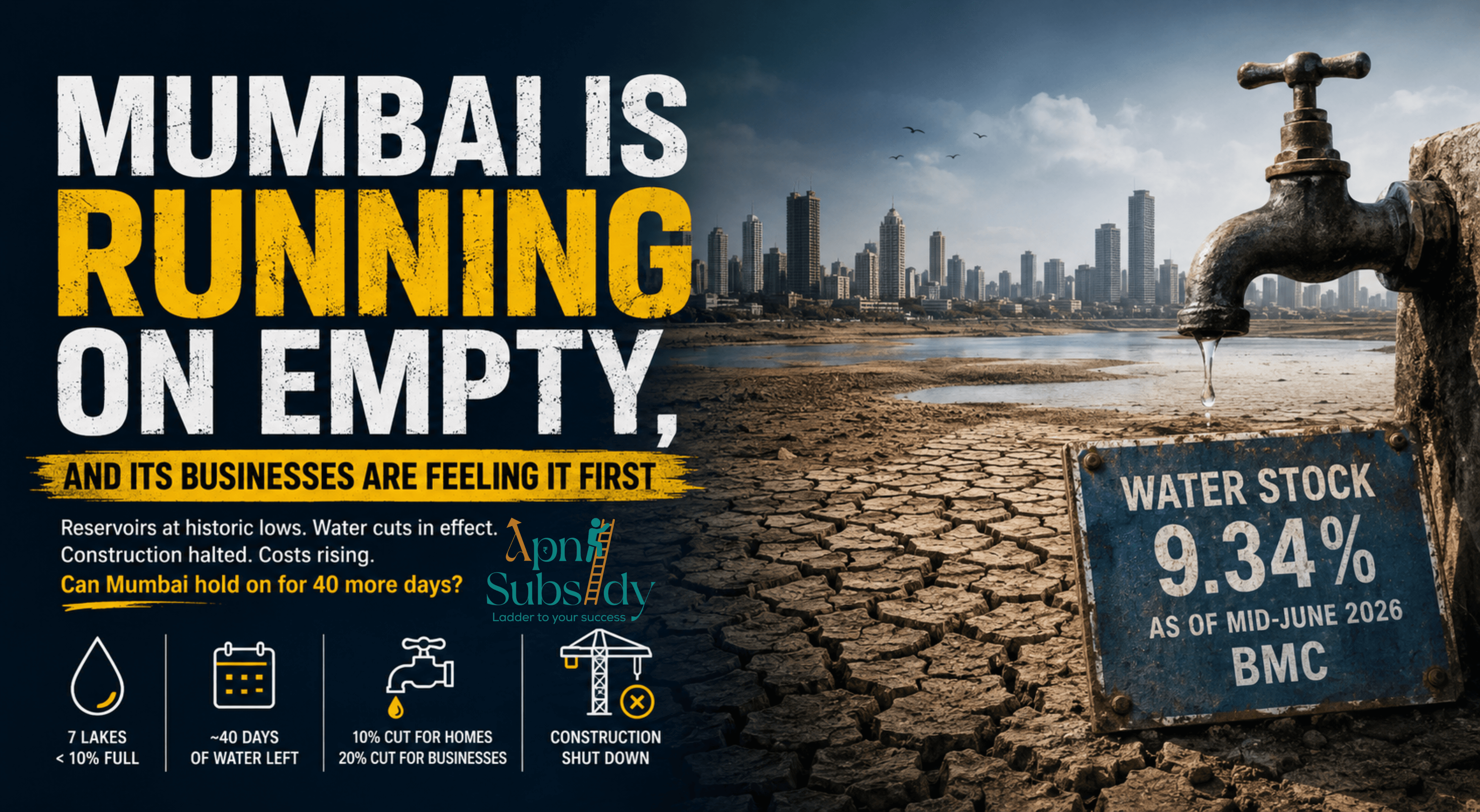
The seven lakes that keep Mumbai alive are, right now, less than ten percent full.
That is not a rough estimate or an alarmist headline. As of mid-June 2026, the Brihanmumbai Municipal Corporation (BMC) confirmed that the combined water stock across all seven reservoirs supplying India's financial capital had fallen to just 9.34% of total capacity.
Upper Vaitarna, one of the city's largest reservoirs, has already dropped to zero usable storage, while Tansa remains below 4% capacity. According to BMC estimates, Mumbai has roughly 40 days of drinking water left if substantial rainfall does not arrive soon.
The concern is not merely that the monsoon is late. The real problem is that rainfall has not reached the reservoir catchment areas that actually replenish the city's water supply.
Water Cuts Have Already Begun
To conserve remaining reserves, the BMC has implemented significant restrictions.
Beginning May 15, residential areas saw a 10% reduction in daily water supply, lowering citywide distribution from roughly 4,100 million litres per day to around 3,650 million litres. Commercial establishments—including offices, hotels, malls, and industries—were later subjected to a 20% supply cut.
Construction sites have had municipal water connections suspended entirely. Swimming pools have been cut off, while soft drink manufacturers and packaged water bottling plants have been instructed to use city water only for workers' drinking needs. Large industrial users, including Western Railway, Central Railway, oil refineries, and the Navy, have been directed to switch operational consumption to treated sewage water.
Why Small Businesses Feel the Pain First
Water shortages affect households, but businesses often experience the economic impact first.
A restaurant cannot easily operate on twenty percent less water while maintaining the same customer volume. Salons, laundries, food processors, textile units, and manufacturers that depend on water-intensive operations face difficult choices: reduce output or purchase water from private suppliers.
The latter option can be expensive. During Bengaluru's 2024 water crisis, private tanker prices surged several times over within weeks. Many Mumbai businesses fear a similar situation if reservoir levels continue to decline.
For small enterprises operating on thin margins, rising water costs can quickly become a serious financial burden.
Construction Comes to a Standstill
Among all sectors, construction may be experiencing the most immediate disruption.
With temporary water connections suspended, projects across Mumbai face delays, idle labour, and mounting costs. Contractors managing residential and commercial developments risk missing deadlines and triggering penalty clauses.
In a city already known for some of India's highest construction costs, prolonged water shortages could further inflate project expenses and slow infrastructure development.
Why Has Mumbai Reached This Point?
The underlying cause is straightforward: Mumbai depends almost entirely on rainfall-fed reservoirs.
This year, the monsoon has stalled. The India Meteorological Department (IMD) has linked the delayed rainfall pattern to El Niño conditions, which weaken the monsoon winds that typically bring moisture across the Arabian Sea into Maharashtra.
Although Mumbai itself has received occasional showers, that rainfall offers little relief. What matters is sustained precipitation over the distant catchment zones feeding the reservoirs, and that has largely been absent.
A Glimpse of a Larger Climate Trend
Climate researchers have warned for years that monsoons are becoming increasingly unpredictable.
Delayed rainfall, longer dry periods, and short bursts of intense precipitation are expected to become more common as global climate patterns shift. Mumbai's current situation illustrates how vulnerable large urban centres remain when essential resources depend heavily on seasonal weather.
For businesses, water security is becoming less of an environmental issue and more of a long-term operational risk.
The Structural Problems Beneath the Crisis
The current shortage is not solely a weather problem.
Mumbai's water distribution network is decades old, and substantial volumes are lost through leaks before reaching consumers. At the same time, heavily subsidised water pricing has reduced incentives for commercial buildings and housing societies to invest in rainwater harvesting, recycling systems, or conservation infrastructure.
When water is cheap, efficiency investments often appear unnecessary. During shortages, that calculation changes rapidly.
Bengaluru Offers a Warning
Mumbai is not alone.
Bengaluru has spent the past several years battling a slower but potentially deeper water crisis. Nearly half of the city's borewells have dried up, daily water deficits remain significant, and reports of contaminated drinking water have increased.
The city's 2024 crisis became so severe that some residents relied on workplace facilities for basic needs such as bathing. Improved rainfall in 2024 and 2025 provided temporary relief, but many underlying infrastructure challenges remain unresolved.
What This Means for Indian Business
The lesson extends beyond Mumbai and Bengaluru.
Water rationing today, power shortages tomorrow, and chronic congestion throughout—many of India's largest economic centres are increasingly showing signs of infrastructure stress.
Large corporations often possess backup systems and financial flexibility. Small businesses do not. They are usually the first to absorb rising costs and operational disruptions, and often the least equipped to manage them.
As urban populations grow and climate variability increases, resilience may become as important to business success as market demand or access to capital.
The Cost of Waiting for Rain
The rains will arrive eventually. They always do.
But the weeks before they arrive will carry real economic costs for businesses, workers, and consumers across Mumbai. The city's immediate challenge is surviving the next forty days.
Its longer-term challenge is ensuring that the same crisis does not return every few years.
Tags
Work With Us
Need help identifying the right subsidy, preparing documentation, or maximizing claim value? Our team can guide you end to end.