PMEGP Subsidy Explained: ₹50 Lakh Project Limit, 15–35% Margin Money and Who Can Apply
PMEGP Subsidy Explained: Project Limits, Subsidy Rates and Who Can Apply
The Prime Minister's Employment Generation Programme (PMEGP) is one of India's major credit-linked government subsidy schemes for people looking to start a new micro-enterprise.
Under the scheme, a bank provides financing for the project while the government provides margin money subsidy ranging from 15% to 35%, depending on the applicant's category and whether the business is located in an urban or rural area.
For entrepreneurs with limited capital, this government subsidy can reduce the amount they need to contribute themselves and can lower the effective burden of the bank-financed project.
However, one point needs particular attention in 2026: the last officially approved PMEGP continuation covered 2021-22 to 2025-26. Applicants should therefore verify the current status before preparing a fresh application.
What Is PMEGP?
PMEGP was launched in 2008 by merging the Prime Minister's Rojgar Yojana and the Rural Employment Generation Programme.
The scheme supports new micro-enterprises in the non-farm sector across both rural and urban areas.
The basic structure is straightforward:
The entrepreneur contributes part of the project cost.
A bank finances the remaining eligible amount.
The government provides margin money subsidy.
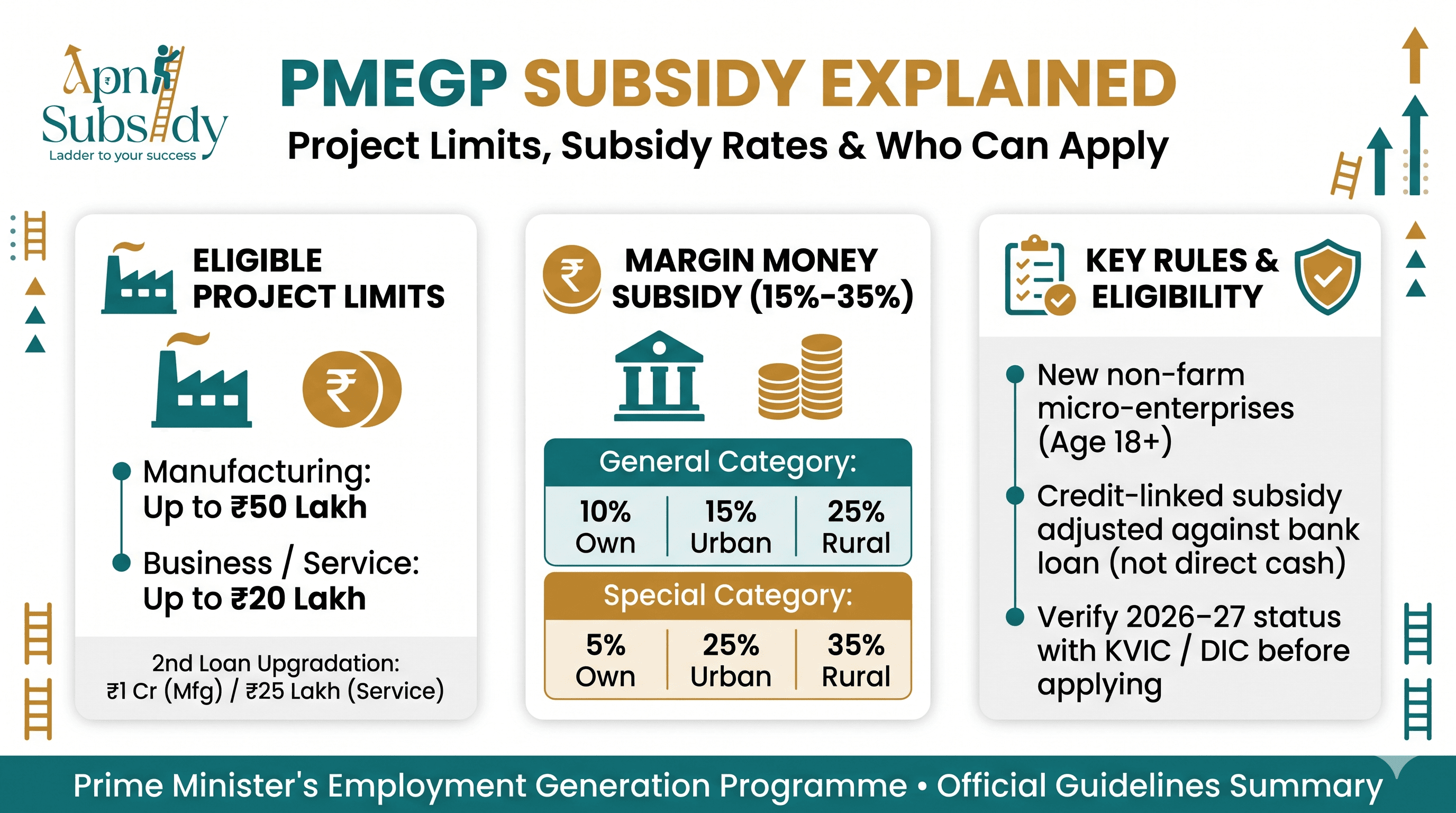
The subsidy is adjusted against the bank loan rather than being paid directly to the entrepreneur as cash.
PMEGP is implemented through the Khadi and Village Industries Commission (KVIC) under the Ministry of MSME.
What Is the PMEGP Project Cost Limit?
The maximum project cost eligible for PMEGP subsidy is:
Sector | Maximum eligible project cost |
Manufacturing | ₹50 lakh |
Business / Service | ₹20 lakh |
These limits were introduced when PMEGP was continued for five years from 2021-22 to 2025-26, with an approved outlay of ₹13,554 crore.
Therefore, the ₹50 lakh and ₹20 lakh limits should not be described as a new 2026 increase.
If the total cost of a project exceeds the applicable PMEGP limit, the bank may finance the additional amount, but government subsidy is not available on the amount above the eligible project-cost ceiling.
The cost of land is also not included in the project cost for PMEGP purposes.
How Much PMEGP Subsidy Can an Entrepreneur Get?
The PMEGP subsidy depends on two factors:
Applicant category
Rural or urban location of the enterprise
Applicant Category | Own Contribution | Urban Subsidy | Rural Subsidy |
General | 10% | 15% | 25% |
Special Category | 5% | 25% | 35% |
The special category includes SC, ST, OBC, minorities, women, ex-servicemen, persons with disabilities, applicants from the North Eastern Region, and applicants from hill and border areas.
Example of PMEGP Subsidy
Consider a ₹50 lakh manufacturing project in a rural area.
A general-category applicant would contribute 10%, or ₹5 lakh, and could be eligible for margin money subsidy of up to ₹12.5 lakh at the 25% rate.
A special-category applicant would contribute 5%, or ₹2.5 lakh, and could receive subsidy of up to ₹17.5 lakh at the 35% rate.
These are illustrative calculations. The actual financing and subsidy depend on the project's eligible expenditure, bank assessment and applicable scheme conditions.
Is PMEGP Subsidy Paid Directly to the Entrepreneur?
No.
PMEGP margin money is not normally handed over to the entrepreneur as direct cash.
The subsidy is paid to the financing bank and credited against the loan account. Under the guidelines, the margin money is kept in a term deposit for three years while the unit continues to operate.
This distinction is important because PMEGP is a credit-linked subsidy scheme, not simply a cash grant.
Who Is Eligible for PMEGP?
According to the scheme guidelines:
Individuals above 18 years of age can apply.
There is no income ceiling for individual applicants.
Self-help groups can also be eligible.
A minimum Class VIII qualification is required for projects above ₹10 lakh in manufacturing and ₹5 lakh in the service sector.
PMEGP subsidy is primarily intended for new projects.
Existing units that have already received government subsidy under another scheme are not eligible for a new PMEGP subsidy.
Existing PMEGP, REGP and MUDRA units may, however, qualify for a second loan for upgradation, subject to the applicable conditions.
PMEGP Second Loan for Existing Units
Entrepreneurs who already have eligible PMEGP, REGP or MUDRA units can potentially use the second-loan facility for expansion or upgradation.
The maximum project cost under this route is:
₹1 crore for manufacturing
₹25 lakh for service units
The subsidy is generally 15%, with a higher rate of 20% applicable in the North Eastern Region and hill states, subject to the scheme's prescribed limits.
This makes the second-loan route particularly relevant for existing micro-enterprises looking to expand their operations.
Is PMEGP Currently Open for New Applications?
This is the most important question for anyone planning to apply in 2026.
The official continuation approval available for PMEGP covers the period 2021-22 to 2025-26. A public continuation notification for 2026-27 onwards was not identified in the source material used for this article.
That means entrepreneurs should not assume that the previous PMEGP approval automatically continues into the new financial cycle.
Before preparing a project report or making financial commitments, applicants should verify the current status, subsidy rates and project limits with:
KVIC
State KVIB
District Industries Centre
Relevant implementing agency
Third-party websites may continue to show PMEGP as open, but applicants should rely on official sources for the current application status.
How to Apply for PMEGP
PMEGP applications are made through the KVIC PMEGP e-portal or through the relevant implementing agencies, including KVIC, State KVIB and District Industries Centre offices.
A typical application process involves preparing a viable project proposal, submitting the required documents, bank appraisal and completing the applicable Entrepreneurship Development Programme requirements.
A strong project report is particularly important because the bank still evaluates the project's viability and repayment capacity.
What Documents and Preparation Are Important?
The exact document list can vary depending on the application and implementing agency, but applicants may need documents such as:
Identity and address proof
Project report
Category certificate, where applicable
Business-related documents
Financial and project-cost information
Before applying, entrepreneurs should confirm the latest document requirements through the official PMEGP portal or implementing agency.
What Should Entrepreneurs Do Before Applying?
If you are planning to start a new manufacturing or service business, don't begin with the subsidy percentage alone.
A better approach is:
1. Verify the current PMEGP status
Confirm that fresh applications are being accepted.
2. Check your eligibility
Review your category, location, education requirement and whether your project qualifies as a new unit.
3. Build a realistic project report
Include machinery, working capital, expected sales, operating expenses and repayment capacity.
4. Evaluate the financing requirement
The subsidy is only one part of the funding structure. The bank's loan appraisal remains critical.
5. Compare other government schemes
If PMEGP is unavailable or unsuitable, another government subsidy, credit guarantee or business funding option may be more appropriate.
Need Help Finding the Right Government Subsidy or Business Funding Option?
Choosing a scheme based only on its advertised subsidy percentage can lead to the wrong financing decision.
Entrepreneurs should first understand their business activity, project cost, location, promoter contribution, funding requirement and eligibility before deciding which government scheme to pursue.
Apni Subsidy Consultancy Pvt. Ltd. provides government subsidy consultancy, business loan assistance, project funding guidance and MSME finance support.
For entrepreneurs searching for a subsidy consultant in Jaipur, government subsidy consultant in Jaipur, MSME consultant in Jaipur or business loan consultant in Jaipur, professional guidance can help evaluate whether PMEGP or another government-backed funding option is more suitable.
The objective should not simply be to find the highest subsidy. It should be to identify a funding structure that fits the business and can realistically be financed and repaid.
Conclusion
PMEGP remains an important credit-linked subsidy framework for new micro-enterprises, with subsidy rates ranging from 15% to 35% and eligible project-cost ceilings of ₹50 lakh for manufacturing and ₹20 lakh for business/service activities.
But entrepreneurs should be careful about one thing: these project limits are not a new 2026 revision. They originated from the scheme's 2021-22 to 2025-26 continuation.
For anyone planning a fresh application now, the first step should therefore be to verify the current PMEGP status with the official implementing authorities.
Once eligibility and scheme availability are confirmed, the next step is to prepare a realistic project report and evaluate the complete funding requirement rather than focusing only on the subsidy amount.