Shiprocket's IPO Reveals How Few Indian MSMEs Actually Sell Online
A Blockbuster IPO Just Put a Number on How Few MSMEs Actually Sell Online
India's e-commerce story is often told through the growth of marketplaces, digital payments, and online shoppers. But there is another side to the story that gets much less attention: how many small businesses are actually equipped to sell online at scale?
Shiprocket's recent stock market debut has put a striking number on that gap.
The e-commerce enablement and shipping aggregator's initial public offering (IPO), which was open from 12 to 14 August, was subscribed 99.38 times. When the company's shares listed on the NSE, they opened at around a 35% premium to the issue price.
But the more interesting number for India's MSME ecosystem came from Shiprocket's own management.
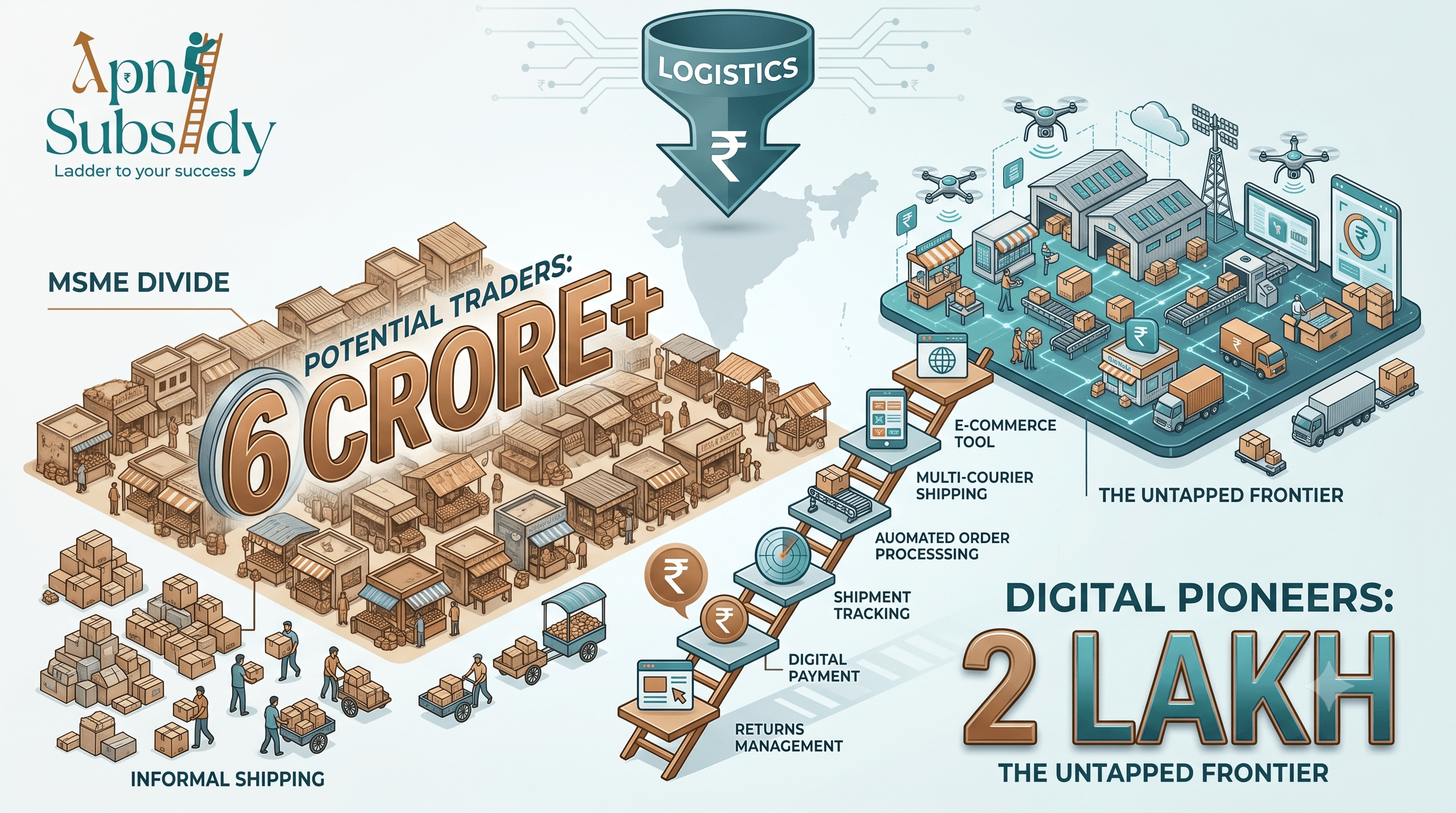
The company currently serves around 2 lakh MSMEs, while India has more than 6 crore MSMEs.
That means the organised e-commerce logistics market still has a massive untapped customer base.
What Does Shiprocket Actually Do?
Shiprocket operates in an area that may not sound exciting but is essential to online commerce: logistics and order fulfilment.
A small manufacturer or retailer can create a website, list products on an online marketplace, and start receiving orders. But getting the product from the seller to the customer involves an entirely different set of challenges.
Businesses need to manage:
Courier partners
Shipping rates
Order tracking
Returns
Cash-on-delivery reconciliation
Delivery performance
For a small business, negotiating and managing multiple logistics providers independently can be difficult.
Platforms such as Shiprocket bring multiple courier and logistics partners together through a single technology platform, allowing smaller sellers to access shipping infrastructure that would otherwise be difficult to manage.
In that sense, logistics platforms are part of the basic infrastructure that makes e-commerce practical for MSMEs.
The 2 Lakh vs 6 Crore Gap
This is where the numbers become particularly interesting.
Shiprocket reportedly serves approximately 2 lakh MSMEs out of a total MSME base exceeding 6 crore.
The company's founder and CEO, Saahil Goel, acknowledged the size of this gap after the listing, noting that Shiprocket has so far powered less than half a percent of India's MSMEs.
That is a surprisingly small penetration rate for a company operating in one of India's fastest-growing digital business ecosystems.
But it also reveals something important.
The opportunity isn't necessarily limited to finding new types of customers. There are already millions of businesses that could potentially benefit from organised e-commerce and logistics infrastructure but have not adopted it yet.
The Real E-Commerce Bottleneck May Be Logistics
Government programmes often focus on helping MSMEs overcome challenges such as access to finance, registration, compliance, and market access.
Those issues are undoubtedly important.
But the Shiprocket numbers highlight another problem: operational infrastructure.
An MSME may have a good product and even have customers willing to purchase online. Yet fulfilling those orders efficiently can still be difficult.
This is particularly relevant outside major metropolitan areas, where courier availability, delivery reliability, and logistics infrastructure can vary considerably.
A subsidy or loan can help a business purchase inventory or invest in production.
It cannot automatically solve the question of how that business will deliver hundreds of individual orders across the country.
Why Investors Are Paying Attention
The strong IPO subscription and listing performance also offer an interesting perspective on investor expectations.
A company serving around 2 lakh businesses while potentially addressing a market of more than 6 crore MSMEs has captured only a small portion of its potential market.
Investors are therefore looking beyond the company's current customer base.
If organised e-commerce logistics adoption among MSMEs increases significantly over the coming years, the addressable market for platforms supporting those businesses could expand substantially.
Even a relatively small increase in the percentage of MSMEs adopting organised digital commerce infrastructure would represent millions of potential businesses.
What This Means for MSME Owners
For an MSME owner still managing online orders through individual courier companies or informal shipping arrangements, the broader lesson is more important than Shiprocket's share price.
The infrastructure required to sell online is becoming increasingly accessible.
Businesses can now access tools for:
Multi-courier shipping
Automated order processing
Shipment tracking
Returns management
Digital payments
E-commerce integrations
Yet adoption remains relatively low compared with India's enormous MSME population.
This suggests that the next phase of India's MSME digitalisation may not simply be about getting businesses online.
It may be about helping them operate online efficiently.
The Bigger Opportunity
The story also shows why private-sector infrastructure and government policy need to work together.
Government initiatives can encourage formalisation, financing, exports, and digital adoption. Private platforms can provide the technology and operational infrastructure that allows businesses to actually use those opportunities.
For India's small businesses, that combination could be crucial.
Final Thoughts
Shiprocket's IPO has attracted attention because of its impressive subscription and market debut.
But for India's MSME sector, the more important story may be the gap behind those numbers.
A company serving around 2 lakh MSMEs in a country with more than 6 crore shows just how early organised e-commerce logistics adoption still is.
The tools already exist. The much bigger challenge is getting them into the hands of the millions of small businesses that have yet to use them.
For MSMEs looking to expand beyond their local market, building a reliable online sales and fulfilment system could increasingly become a competitive advantage—not just an optional digital upgrade.