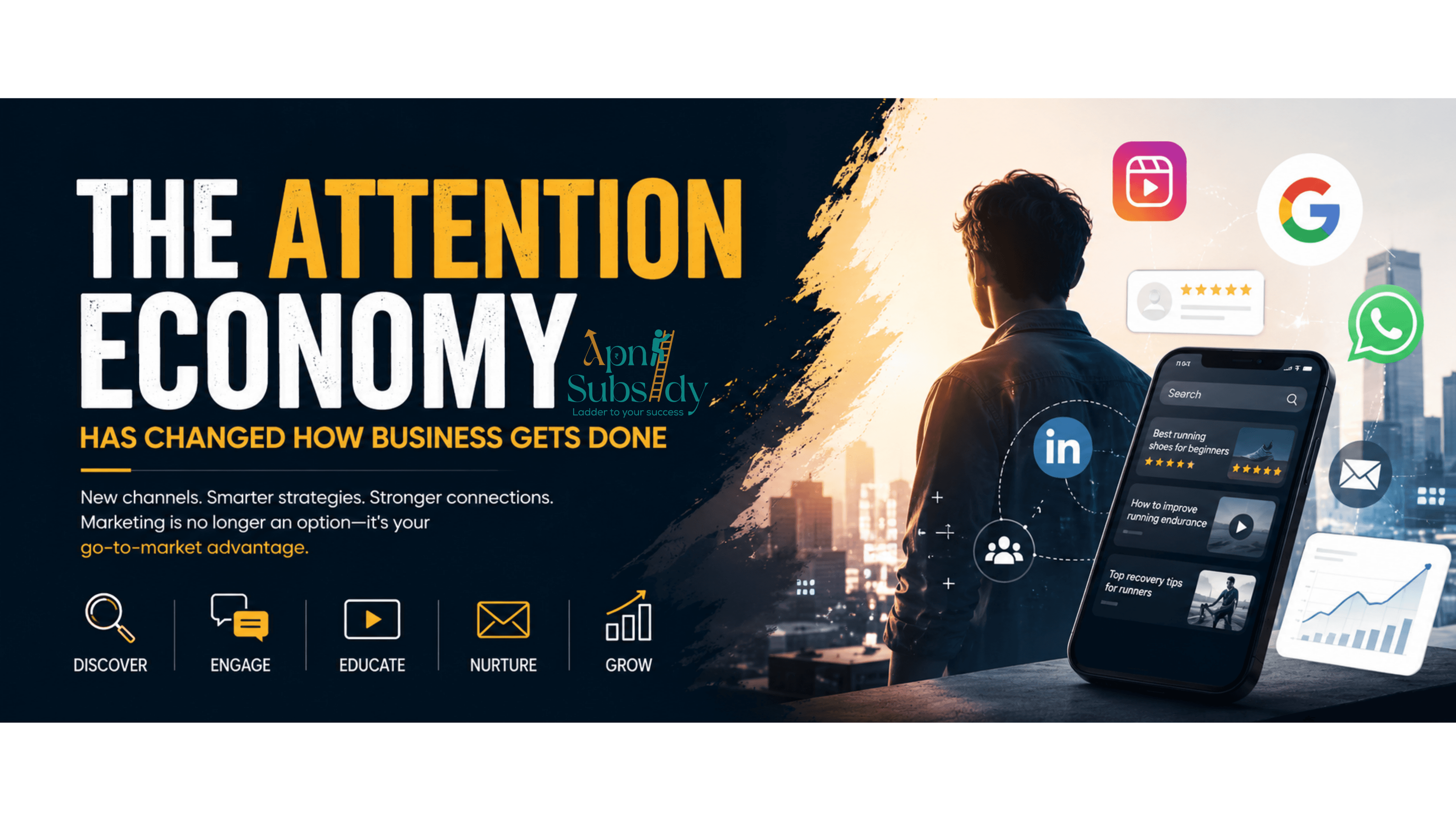
The Attention Economy Has Changed How Business Gets Done.
The Attention Economy Has Changed How Business Gets Done
Why Winning Attention Matters More Than Ever
A decade ago, a small-town bakery in Pune could grow its customer base through little more than foot traffic and word of mouth. Today, attracting a thousand new customers is more likely to happen through Instagram Reels, a well-optimized Google Business profile, or a WhatsApp broadcast list.
The product itself may not have changed, but the way people discover it certainly has. In the digital era, attention has become one of the most valuable business assets, fundamentally changing how companies market, sell, and grow.
For many small and medium-sized businesses, digital marketing is no longer just another department—it has become the entire go-to-market strategy.
Customer Discovery Has Been Completely Rewritten
Modern consumers don't wait to be sold to. They research first.
Someone buying industrial equipment will likely compare reviews, watch product demonstrations, and evaluate a company's LinkedIn presence before ever speaking to a salesperson. A first-time parent searching for a pediatrician may browse Google reviews, parenting forums, and Instagram posts before booking an appointment.
By the time direct contact happens, much of the purchasing decision has already been made. Businesses that only focus on closing sales often lose to competitors that educate and build trust earlier in the customer journey.
Search Engines Reward Businesses That Solve Problems
Search has become one of the most influential customer acquisition channels.
Companies that rank for questions their audience is actively asking gain visibility long before competitors enter the conversation. This is why content marketing has become so effective. Detailed guides, educational articles, and honest explanations improve search rankings while simultaneously establishing credibility.
Brands that genuinely answer customer questions often create stronger long-term relationships than those focused solely on promotional messaging.
Social Media Is About Conversations, Not Just Content
Social media initially gave businesses direct access to customers, but organic reach has gradually declined as platforms prioritized paid promotion.
As a result, simply posting frequently is no longer enough.
Brands that engage with customers, respond thoughtfully to complaints, and build active communities often earn more trust than companies with visually perfect but impersonal feeds. Across platforms, practical and useful content consistently outperforms generic aspirational posts.
The Rise of Short-Form Video Has Leveled the Playing Field
Reels, Shorts, and TikTok-style videos have shifted attention away from expensive production toward authenticity.
A founder casually explaining a product feature often performs better than a polished corporate advertisement because audiences value expertise and relatability over perfection.
This creates a structural advantage for startups and smaller businesses, which can produce fast, genuine content without the bureaucracy or overhead that large corporations often face.
Why Email Marketing Still Delivers Exceptional Value
While social media followers can disappear with algorithm changes, an email subscriber list remains a business-owned asset.
That distinction matters.
When platform updates reduce visibility overnight, email provides a direct communication channel with engaged customers. Well-designed retention campaigns frequently generate stronger returns and lower acquisition costs than many paid advertising channels.
Ownership of the audience has become one of digital marketing's most valuable competitive advantages.
Data Has Made Marketing Smarter—But More Complex
Performance marketing promised precise measurement and efficient spending. Reality has proved more complicated.
Purchases are influenced by multiple touchpoints, yet most analytics systems attribute conversions to only one. Meanwhile, growing privacy regulations and the decline of third-party cookies are forcing companies to rethink how they collect and use customer information.
Increasingly, successful businesses are investing in first-party data gathered directly from their own customers through websites, newsletters, and loyalty programs.
Rising Advertising Costs Demand Better Strategies
As competition for digital advertising space has intensified, customer acquisition costs have climbed significantly.
Businesses that once relied almost entirely on paid search or social media advertising are discovering that scaling profitably has become more difficult.
The strongest performers now treat paid advertising as an amplifier rather than the foundation of their marketing strategy. Content creation, community building, and brand trust provide the long-term engine, while paid campaigns accelerate growth where appropriate.
Personalization Is Finally Becoming Practical
Advances in data collection now allow businesses to communicate more intelligently with customers.
Instead of repeatedly advertising running shoes to someone who has already purchased them, brands can recommend training plans, recovery products, or complementary accessories based on previous behavior.
This contextual approach makes communication feel genuinely helpful rather than intrusive, strengthening customer relationships over time.
The Bigger Picture: Marketing Has Become a Trust-Building Exercise
The most significant transformation isn't technological—it's strategic.
Digital marketing has made it possible for small startups with limited budgets but clear expertise to compete against established corporations with vastly larger advertising resources. Large companies may possess stronger distribution networks, but they cannot automatically purchase credibility or authenticity.
The businesses succeeding in today's attention economy understand that marketing is no longer just advertising. It is the ongoing process of consistently providing value, solving problems, and earning trust.
Those still searching for the next perfectly efficient advertising platform may be asking the wrong question. The real competitive advantage lies in becoming genuinely useful to the people a business aims to serve.
Tags
Work With Us
Need help identifying the right subsidy, preparing documentation, or maximizing claim value? Our team can guide you end to end.
Get in Touch