The Government Just Launched Four New Portals for Small Businesses. Here's What They Actually Do.
The Government Just Launched Four New Portals for Small Businesses. Here's What They Actually Do.
Every year on June 27, the Ministry of MSME celebrates Udyami Bharat with speeches highlighting the sector's contribution to India's economy. Small businesses account for millions of jobs, contribute significantly to exports, and remain one of the country's most important growth engines.
Most years, the headlines end there.
This year was different.
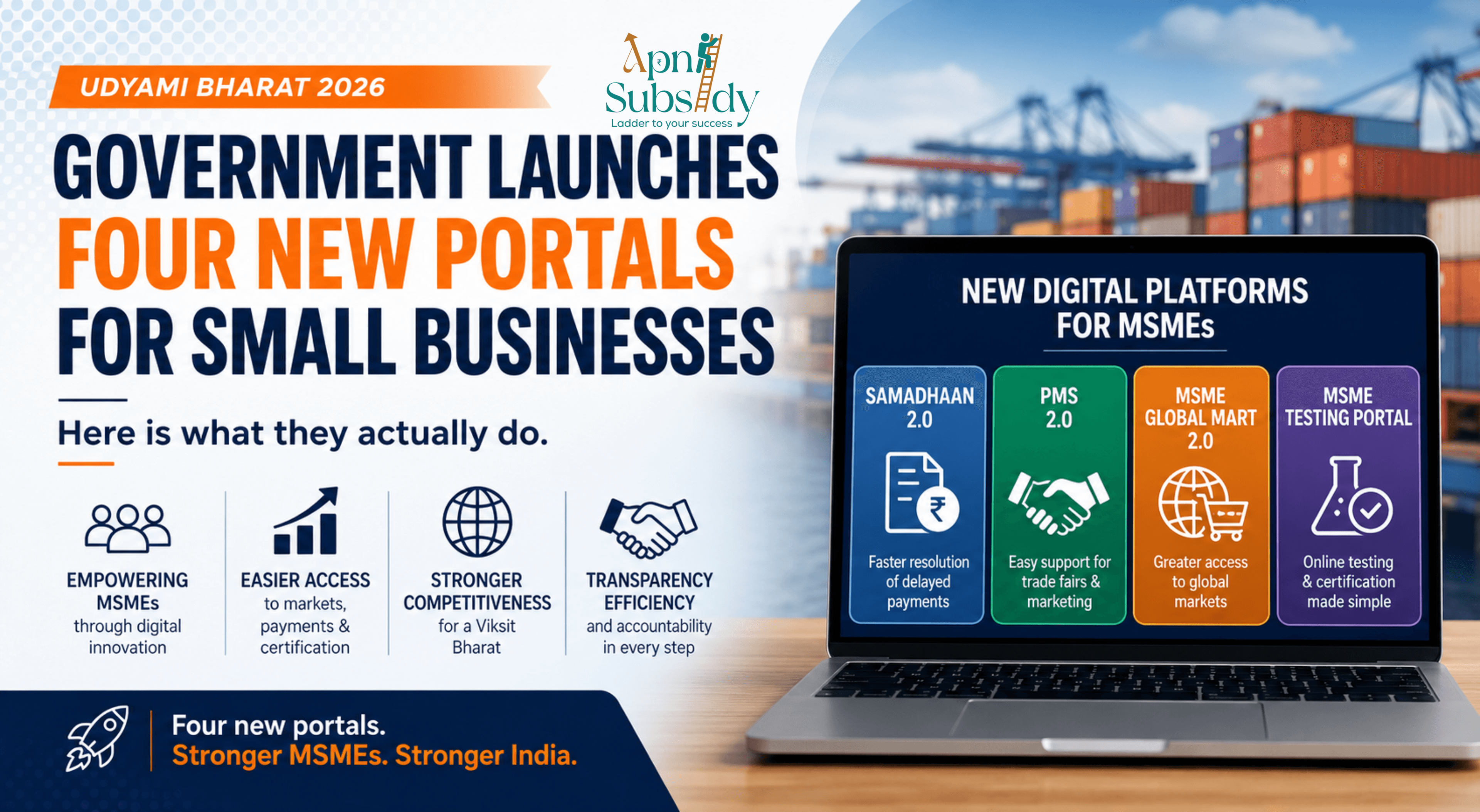
At the Udyami Bharat 2026 event in New Delhi's Dr. Ambedkar International Centre, the government launched four new digital platforms aimed at solving some of the everyday problems that India's small businesses face-from delayed payments and trade fair participation to exports and product testing.
Rather than introducing another broad policy announcement, each platform targets a specific bottleneck in the MSME ecosystem. Here's what they do and why they matter.
1. Samadhaan 2.0: Tackling the Delayed Payments Problem
For many small businesses, getting paid on time is often harder than winning the order itself.
The original Samadhaan portal allowed micro and small enterprises to report delayed payments from government buyers. By June 2026, it had received 2,56,892 applications involving claims worth ₹55,244 crore. However, only 58,148 cases had been resolved, highlighting the limitations of the existing system.
Samadhaan 2.0 introduces an important structural change.
Instead of placing the entire burden on small businesses to report unpaid invoices, central ministries, government departments, and public sector enterprises must now submit mandatory monthly reports on their outstanding dues.
Whether this improves payment timelines will depend on enforcement. But shifting some accountability to the buyers is a meaningful step in the right direction.
2. PMS 2.0: Making Trade Fair Participation Easier
Trade fairs and exhibitions help small manufacturers find new customers, distributors, and export opportunities.
Until now, accessing support under the Procurement and Marketing Support (PMS) Scheme often meant dealing with paperwork, multiple approvals, and offline processes.
The upgraded PMS 2.0 portal connects directly with the Udyam Registration database. Businesses can now apply for participation, receive approvals, and claim reimbursements entirely online.
For a manufacturer in a Tier-2 or Tier-3 city looking to showcase products at a national exhibition, removing paperwork and office visits could save both time and money.
3. MSME Global Mart 2.0: Opening More Doors to Global Markets
Helping Indian MSMEs reach international buyers has long been a government priority.
The upgraded MSME Global Mart 2.0 attempts to make that easier by integrating with the Open Network for Digital Commerce (ONDC).
If the integration performs as intended, businesses could list products once and gain visibility across multiple participating marketplaces rather than managing separate listings on different platforms.
For exporters of handicrafts, textiles, processed foods, and other products, that could significantly expand market reach.
That said, ONDC-linked initiatives have delivered mixed results so far. The direction is promising, but the platform's long-term success will ultimately depend on adoption by both buyers and sellers.
4. MSME Testing Portal: Bringing Product Certification Online
Quality certification is often a prerequisite for supplying large companies or exporting products overseas.
Previously, arranging product testing usually involved multiple offline steps-booking appointments, visiting testing centres, submitting samples, making payments, tracking applications, and collecting certificates.
The new MSME Testing Portal brings this entire process online.
Manufacturers can now schedule tests, submit applications, pay fees digitally, track progress, and download certificates through a single interface.
For small businesses obtaining certification for the first time, this could remove a significant amount of administrative friction.
Beyond the Announcements
The Udyami Bharat event also featured discussions on women entrepreneurship and building globally competitive MSMEs-topics that appear regularly at such events.
The portal launches, however, have more immediate practical value.
Whether it's getting paid faster, accessing trade fairs more easily, expanding into export markets, or obtaining product certifications, these platforms address everyday operational challenges that many businesses face.
The Bigger Challenge
As of June 2026, the Udyam platform has more than 8.7 crore registered MSMEs.
Yet a large number of these businesses have never used any government digital service beyond completing their initial registration.
That may be the biggest challenge of all.
Launching digital platforms is relatively straightforward. Ensuring millions of small businesses know they exist, understand how to use them, and actually benefit from them is a far more difficult task.
If these four portals achieve widespread adoption, they could reduce several long-standing pain points for India's MSME sector. If not, they risk becoming well-designed systems that many of the businesses they were built for never use.
Tags
Work With Us
Need help identifying the right subsidy, preparing documentation, or maximizing claim value? Our team can guide you end to end.
Get in Touch