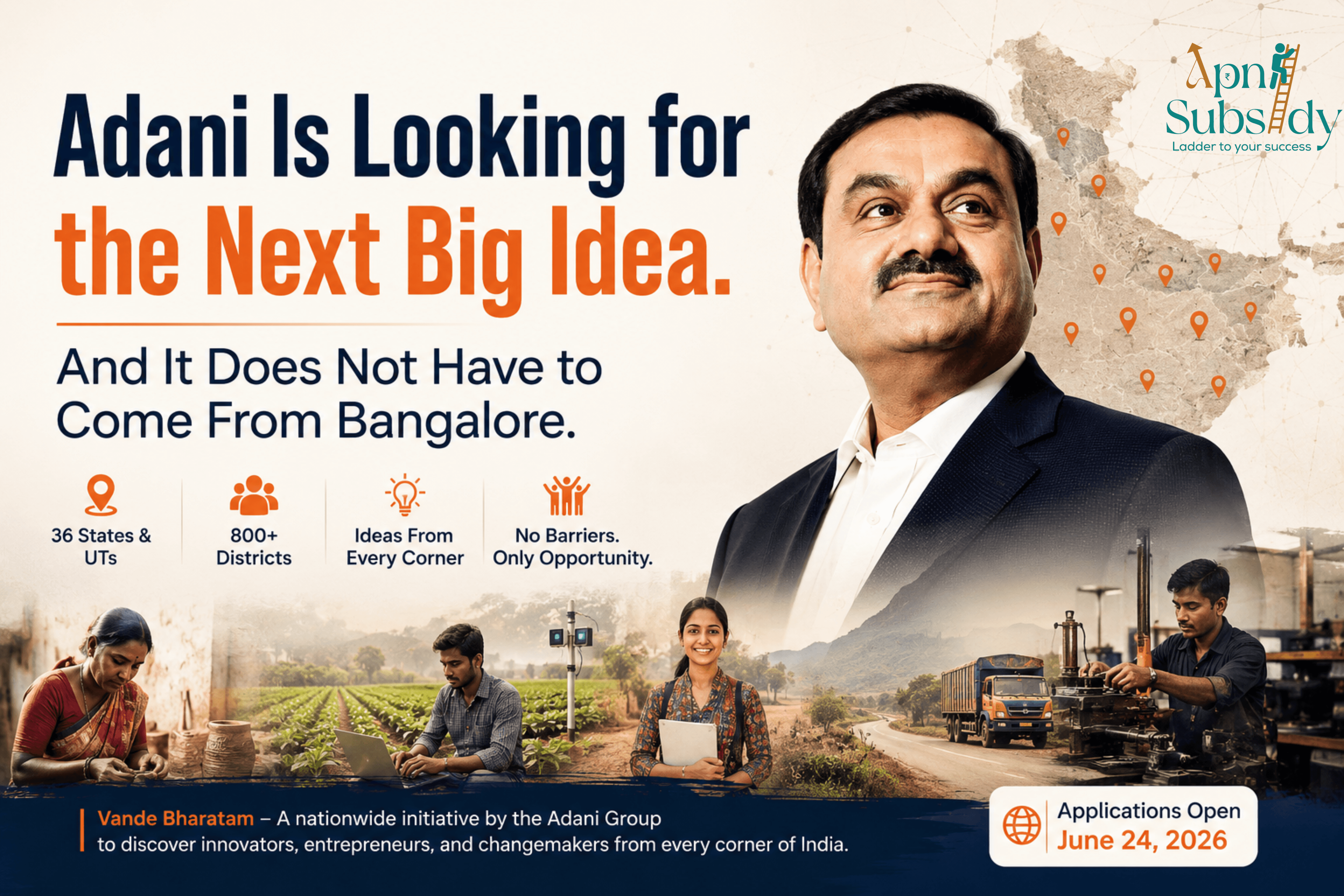
Vande Bharatam Wants to Find the Next Big Idea - From Every Corner of India
Vande Bharatam Wants to Find the Next Big Idea - From Every Corner of India
For decades, India's startup story has largely been written by a handful of cities.
Bengaluru became the country's technology capital. Mumbai emerged as the financial powerhouse. Delhi-NCR built one of the largest startup ecosystems in Asia, while Hyderabad and Pune steadily developed thriving communities of founders and investors. Together, these cities have produced the overwhelming majority of India's funded startups.
That concentration has left much of the country on the sidelines.
Government data has consistently shown that more than 80 percent of India's startup founders come from just a few major urban centres. Meanwhile, millions of aspiring entrepreneurs living in smaller cities, towns, and villages often struggle to access the investors, mentors, incubators, and professional networks that help transform ideas into successful businesses.
The talent has always existed.
The opportunity often has not.
On June 24, 2026, coinciding with his 64th birthday, Gautam Adani announced a new initiative that aims to change exactly that.
A Nationwide Search for India's Hidden Entrepreneurs
Called Vande Bharatam, the programme is a nationwide entrepreneurship initiative launched by the Adani Group to discover innovators, founders, and problem-solvers from every corner of India-not just those already connected to established startup ecosystems.
Applications opened on the programme's dedicated website the same day.
Unlike many startup competitions that primarily attract founders from metropolitan cities, Vande Bharatam has been designed to reach every one of India's 36 states and union territories, covering more than 800 districts while supporting applications in multiple Indian languages.
The idea is simple but ambitious: great businesses can emerge from anywhere.
You Don't Need a Startup to Apply
Perhaps the most striking feature of the programme is who it welcomes.
Applicants do not need to have a registered company.
There is no minimum age requirement.
There is no educational qualification bar.
A person with nothing more than a promising idea can apply. So can someone who has built a prototype, launched a small business, or even established an enterprise that has struggled to gain visibility or attract investors.
The programme also casts a remarkably wide net across industries.
Technology startups are eligible, but so are businesses in manufacturing, agriculture, sustainability, traditional crafts, social innovation, and community-based enterprises.
Rather than focusing exclusively on software or venture-funded businesses, Vande Bharatam appears designed to recognise entrepreneurship in all its forms.
Bringing More People Into India's Startup Ecosystem
Another notable aspect of the initiative is its focus on inclusion.
The programme includes dedicated pathways for women entrepreneurs, tribal innovators, rural founders, and differently-abled entrepreneurs-groups that are often underrepresented in mainstream startup accelerators despite playing an increasingly important role in local economies.
This reflects a broader shift taking place across India's entrepreneurial landscape, where innovation is increasingly emerging from outside the country's largest metropolitan regions.
How the Selection Process Works
The programme follows a multi-stage evaluation process.
Applications will first be assessed at the state and regional levels.
From there, 75 finalists will be selected to participate in an intensive programme in Ahmedabad, where they will receive mentorship from experienced entrepreneurs and industry experts, interact with investors, gain incubation support, and explore strategic partnership opportunities.
The initiative will conclude around Independence Day, when the Adani Group plans to recognise winners across multiple categories and announce prize money along with additional support for selected ventures.
Why Gautam Adani Says This Matters
Speaking during the launch, Gautam Adani connected the programme to his own entrepreneurial journey.
"When I began my journey, I had nothing. There is no shortage of talent in our nation, but opportunity has not always reached every corner of the country."
The statement carries significance considering Adani's own background.
Before leading one of India's largest business groups, he began as a small commodity trader in Ahmedabad, gradually expanding into infrastructure, logistics, energy, ports, airports, and several other sectors over the following decades.
Whether one views the Adani Group positively or critically, the programme reflects an acknowledgement that entrepreneurial talent exists far beyond India's established startup hubs.
The Timing Is No Coincidence
The launch comes at a time when India's startup ecosystem is undergoing a noticeable transformation.
As of March 2026, India has more than 2.23 lakh DPIIT-recognised startups.
Perhaps even more importantly, government data indicates that roughly half of these recognised startups now originate from tier-two and tier-three cities—a significant increase compared with just a few years ago, when metropolitan centres dominated the ecosystem.
This trend suggests that entrepreneurship is becoming more geographically distributed.
Founders are increasingly building businesses focused on agriculture, rural healthcare, local manufacturing, logistics, education, regional languages, handicrafts, and other sectors closely tied to India's diverse local economies.
Vande Bharatam appears designed to accelerate that momentum by connecting promising entrepreneurs with mentorship, visibility, and investment opportunities that might otherwise remain out of reach.
Why Small Business Owners Should Pay Attention
For many first-generation entrepreneurs, one of the biggest obstacles isn't the lack of an idea.
It's the lack of access.
Access to investors.
Access to experienced mentors.
Access to people who can help transform a local solution into a scalable business.
Vande Bharatam attempts to bridge some of those gaps.
If you've been developing a business idea, running a small enterprise with growth potential, or solving a problem within your community, this programme could offer a pathway to resources that are typically concentrated in India's major startup hubs.
Importantly, applicants are not expected to arrive with polished investor presentations, co-founders, or formal startup registrations.
They simply need a credible idea and the willingness to pursue it.
The Bigger Picture
India has never lacked entrepreneurial ambition.
From village artisans and small manufacturers to software developers and agritech innovators, talented people have always existed across the country.
The challenge has often been ensuring that opportunity reaches them as well.
Whether Vande Bharatam ultimately becomes a transformative platform or simply another corporate initiative will depend on how effectively it identifies and supports entrepreneurs after the competition ends.
But its central premise is difficult to argue with.
The next great Indian company may not emerge from Bengaluru, Mumbai, or Delhi.
It could just as easily begin in a small town that has never before appeared on India's startup map.
Tags
Work With Us
Need help identifying the right subsidy, preparing documentation, or maximizing claim value? Our team can guide you end to end.
Get in Touch