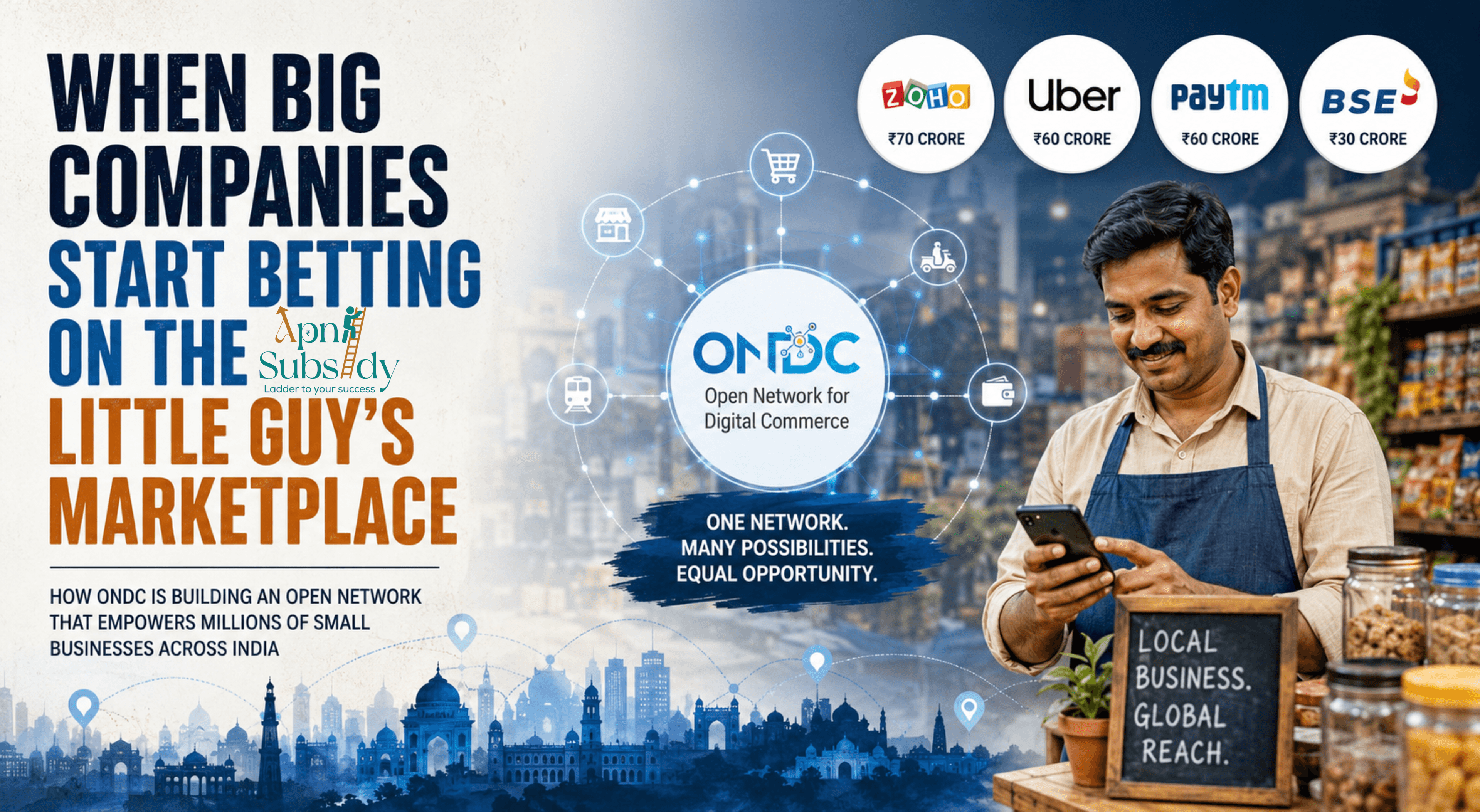
When Big Companies Start Betting on the Little Guy's Marketplace
When Big Companies Start Betting on the Little Guy's Marketplace
There is a quiet idea sitting at the heart of India's digital economy – one that most people have heard of but few fully understand.
What if buying and selling online did not have to happen inside Amazon or Flipkart? What if a kirana store owner anywhere in India could reach customers without giving away a large portion of every sale to a platform that sets its own rules?
That idea is ONDC (Open Network for Digital Commerce). And recently, some of India's biggest companies decided to put serious money behind it.
A Major Vote of Confidence
In May 2026, ONDC raised ₹220 crore from four investors—Zoho, Uber, Paytm, and BSE Technologies. The funding is part of a larger ₹430 crore fundraising plan, with additional contributions expected from State Bank of India, Amul, Punjab National Bank, and others.
Among the new investors:
Zoho invested ₹70 crore
Uber invested ₹60 crore
Paytm invested ₹60 crore
BSE Technologies invested ₹30 crore
For a government-backed initiative that began as an ambitious experiment in 2022, this marks a significant milestone. It suggests that major private-sector companies now see long-term commercial potential in the network.
What Exactly Is ONDC?
To understand why this matters, it helps to understand how online commerce works today.
Most small businesses that want to sell online join large platforms such as Amazon, Flipkart, or Swiggy. These platforms provide access to millions of customers, but they also charge commissions, determine visibility, and control the marketplace ecosystem.
For small sellers, competing with larger brands on these platforms can be difficult.
ONDC takes a different approach.
Rather than being a marketplace itself, ONDC functions as an open network. A useful comparison is UPI. Just as UPI allows customers using different banking apps to transfer money seamlessly, ONDC enables buyers and sellers across different commerce apps to connect with one another.
A customer using Paytm can order from a seller listed on Magicpin. A logistics provider on one platform can serve a merchant on another. No single company controls the entire transaction chain.
Leveling the Playing Field
The objective is straightforward: make digital commerce more accessible and competitive.
A halwai in Indore, a handloom weaver in Varanasi, or a grocery store owner in Coimbatore can join the ONDC network and become discoverable across multiple buyer applications without depending entirely on a single platform's algorithms or policies.
For many small businesses, that represents a meaningful shift in bargaining power.
The Growth So Far
The network has already achieved considerable scale.
Today, ONDC is active in 616 cities across India and has onboarded more than 7.64 lakh sellers and service providers.
During FY26, the network processed 21.8 crore transactions across categories including:
Retail
Food delivery
Logistics
Travel
Financial services
In addition, more than three lakh metro and bus tickets are now being booked daily through ONDC-powered channels—something few would have predicted just a couple of years ago.
Enter ONDC 2.0
The newly raised capital is intended to support the next phase of expansion, which ONDC refers to as ONDC 2.0.
The focus areas include:
Using AI to simplify seller onboarding and operations
Developing DigiCatalog, a nationwide digital product catalog system
Expanding deeper into logistics, mobility, and financial services
Strengthening network infrastructure and user experience
The goal is not merely to add more merchants but to make participation easier and more scalable.
Why Zoho's Investment Matters
Among the investors, Zoho's involvement deserves particular attention.
Zoho's software ecosystem is widely used by small and medium-sized businesses for accounting, inventory management, CRM, and operations. The company has already integrated several of its products with ONDC.
This means a business managing its operations through Zoho can potentially list products on ONDC directly from the same workflow.
For MSMEs, reducing complexity is often just as important as reducing costs. Integrations like these help transform ONDC from a policy vision into a practical business tool.
Uber's Bigger Play
Uber's investment is equally interesting.
The company has already enabled metro ticket bookings through ONDC, with more than one crore rides booked through the integration. Now Uber is exploring opportunities to leverage ONDC's logistics infrastructure to expand delivery services.
This points to a broader reality: ONDC is evolving beyond e-commerce. It is increasingly becoming a digital infrastructure layer for commerce, mobility, logistics, and services.
Challenges Remain
Despite the momentum, ONDC still faces significant challenges.
In retail, it competes against well-funded players such as Blinkit, Zepto, and Swiggy Instamart, all of which have invested heavily in warehouses, fulfillment systems, and rapid delivery capabilities.
Consumer trust also remains a hurdle. Many shoppers prefer familiar apps with established reputations. Building a consistent user experience across multiple interconnected applications is inherently more complex than managing a single platform.
The open-network model offers flexibility, but maintaining reliability across that ecosystem requires sustained effort.
Why This Matters
The latest fundraising round sends an important signal.
Zoho did not invest ₹70 crore for publicity. Uber did not commit ₹60 crore as a gesture of goodwill. These are commercially driven companies making calculated decisions based on future opportunities.
When private capital begins aligning with public policy objectives, the likelihood of creating durable infrastructure increases significantly.
For India's small businesses, entrepreneurs, local retailers, and independent sellers—many of whom have long operated under commission-heavy platform models—that is a development worth watching closely.
Because if ONDC succeeds, the future of digital commerce in India may belong not just to the biggest platforms, but to the millions of businesses that power the country's economy every day.
Tags
Work With Us
Need help identifying the right subsidy, preparing documentation, or maximizing claim value? Our team can guide you end to end.