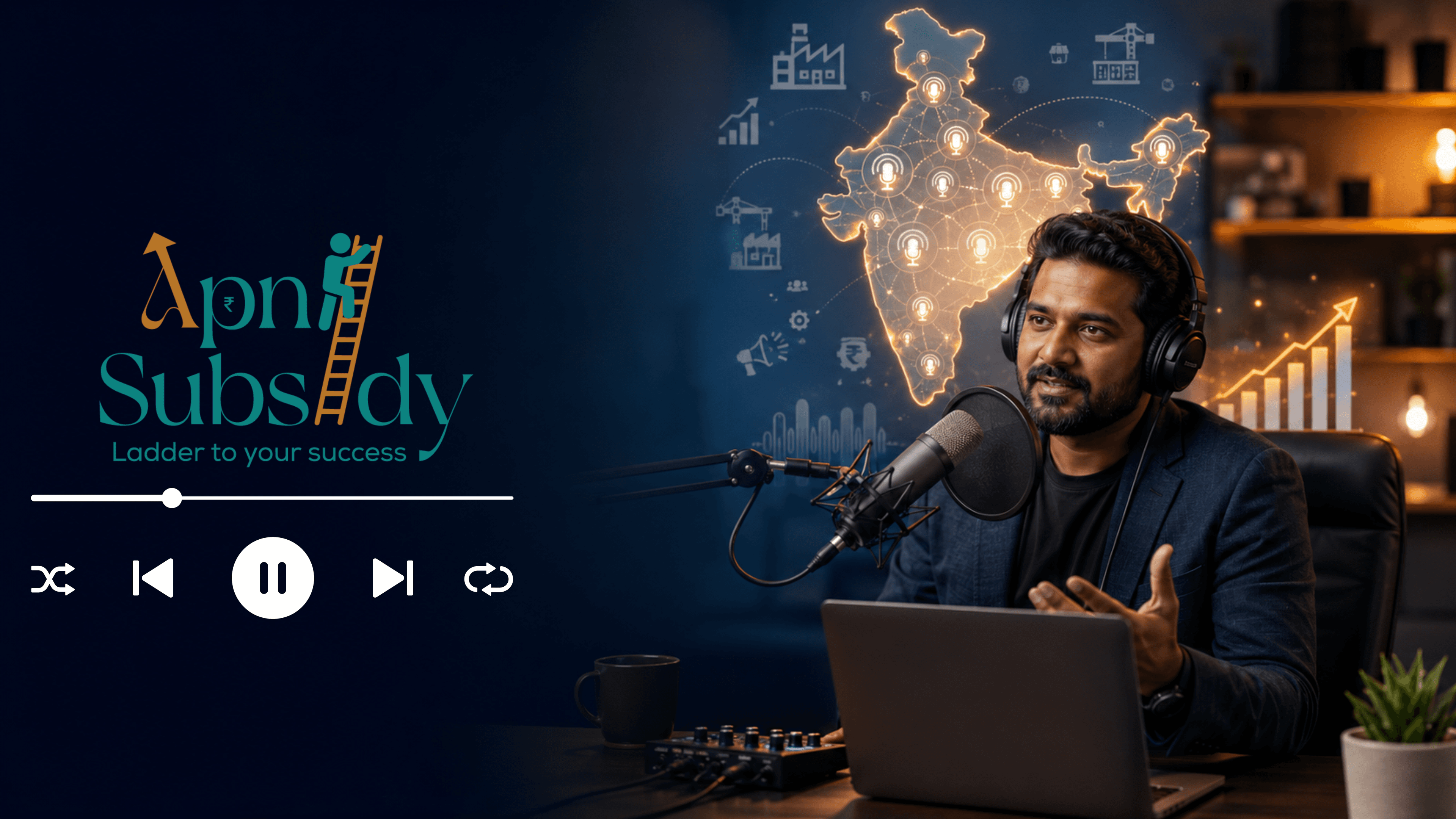
Why Indian Businesses Are Turning to Podcasts to Build Trust and Grow Their Brand
Why Indian Businesses Are Turning to Podcasts to Build Trust and Grow Their Brand
A garment exporter in Surat does not have a PR agency. He cannot afford full-page newspaper advertisements, and his products are unlikely to become the next viral Instagram trend.
Yet, twice every month, he switches on a microphone and talks about textile exports, fabric sourcing, and the realities of running a manufacturing business.
Today, that podcast attracts over 11,000 regular listeners, has generated multiple partnership inquiries, and even created a waiting list for his export consultation services.
This is not just a story about podcasts.
It is a story about where attention is moving—and why smart Indian businesses are following it.
India Is Becoming a Podcast Powerhouse
Podcasting has quietly become one of India's fastest-growing digital media segments.
In 2025, India crossed 200 million podcast listeners, making it the world's third-largest podcast market, behind only the United States and China. The industry was valued at approximately $840 million and is expected to grow at nearly 28% annually, with several market estimates projecting it to surpass $4 billion by 2030.
Those numbers matter because podcasts offer something increasingly rare on the internet:
Undivided attention.
Unlike social media feeds where users scroll every few seconds, podcast listeners often spend 30 to 60 minutes with a single creator. There are no endless notifications competing for attention, no constant algorithmic distractions, and no pressure to capture someone's interest in the first three seconds.
That level of engagement is incredibly difficult—and expensive—to achieve through traditional advertising.
Businesses Are Selling Trust, Not Just Products
Companies in Western markets discovered the power of podcasting years ago.
Now Indian businesses are beginning to realize that podcasts are not primarily sales channels—they are trust-building platforms.
One notable example is Tata Steel, which launched its FiredUp podcast in late 2024. Instead of promoting steel products, the series features conversations with industry leaders and innovators, positioning the company as a thought leader in manufacturing.
Similarly, Reserve Bank of India announced plans to launch educational podcasts designed to simplify financial concepts for everyday Indians.
These are not experimental marketing campaigns.
They are long-term investments in credibility.
Small Businesses Have Even More to Gain
Large corporations may have bigger marketing budgets, but podcasts often create an even greater advantage for smaller businesses.
Imagine a chartered accountant in Pune who publishes a weekly Hindi podcast explaining GST updates and tax-saving strategies in simple language.
Her listeners begin to trust her expertise long before they ever need professional help. By the time they reach out, they already know how she thinks, how she explains complex topics, and whether they relate to her approach.
The podcast has already done much of the relationship-building.
Instead of starting as a cold lead, every new client conversation begins with familiarity.
That is one of podcasting's greatest business advantages.
The Regional Language Opportunity Is Massive
India's podcast boom is not being driven by English alone.
Hindi currently accounts for roughly 38% of the country's podcast audience, while Tamil and Telugu are among the fastest-growing language segments.
For local businesses, this creates an opportunity that is surprisingly underutilized.
A textile entrepreneur in Coimbatore discussing manufacturing challenges in Tamil is not competing with celebrity podcasters or business influencers.
They are serving a highly specific audience with highly relevant knowledge.
Regional expertise often beats mass appeal.
Customers naturally trust businesses that communicate in their own language and understand local realities.
Starting a Business Podcast Is More Affordable Than Ever
Many business owners assume podcasting requires expensive equipment or a professional studio.
In reality, the barriers to entry are remarkably low.
A quality microphone typically costs between ₹3,000 and ₹8,000, while platforms such as Spotify for Podcasters allow creators to publish episodes at no cost.
A consistent 30-minute episode every two weeks is often enough to build a meaningful audience over 12 to 18 months.
The biggest investment is not money.
It is consistency.
Your Perspective Is More Valuable Than Perfect Production
The podcasts that generate real business value rarely have the best editing or the most polished production.
What they have is a clear point of view.
Listeners do not want another generic business news summary.
They want practical experience.
A logistics startup founder discussing the challenges of last-mile delivery in Tier-2 cities.
A spice brand founder explaining how to build a regional FMCG business.
An MSME owner sharing lessons from securing government loans.
These conversations cannot be copied from articles or AI summaries because they come from firsthand experience.
That authenticity is what attracts loyal listeners.
Monetisation Is Still Evolving—But the Opportunity Is Growing
Podcast advertising in India is still developing.
Compared with Western markets, sponsorship rates remain relatively low, and many brands are still learning how to measure podcast performance.
However, the direction is clear.
India's influencer marketing industry is projected to reach ₹3,375 crore by 2026, and an increasing share of those marketing budgets is moving toward long-form audio.
Brands including Durex and Mamaearth have already invested in podcast content to connect with highly engaged niche audiences instead of relying solely on mass-market advertising.
As advertisers become more comfortable with podcast metrics, monetisation opportunities are likely to expand significantly.
The Real Question Is Not Whether Podcasting Works
The evidence is becoming increasingly difficult to ignore.
Podcasting helps businesses build authority, educate customers, attract qualified leads, and establish long-term trust.
The more important question is this:
Do you have a unique perspective that your audience cannot easily find elsewhere?
A generic podcast offering broad "business tips" will struggle to stand out.
But a podcast about operating a cold storage business in Rajasthan, building a homegrown spice brand, exporting handicrafts, or navigating MSME finance as a first-generation entrepreneur serves a very specific audience with very specific needs.
And that is exactly where podcasting delivers its greatest value.
Final Thoughts
The microphone is no longer the barrier.
It is inexpensive, accessible, and available to almost anyone.
The real challenge is developing a point of view that is worth listening to.
Many business owners assume someone else is already telling their story.
More often than not, they are mistaken.
And in a digital economy where trust has become one of the most valuable business assets, the businesses willing to share their knowledge today may quietly build the strongest audiences tomorrow.
Tags
Work With Us
Need help identifying the right subsidy, preparing documentation, or maximizing claim value? Our team can guide you end to end.
Get in Touch