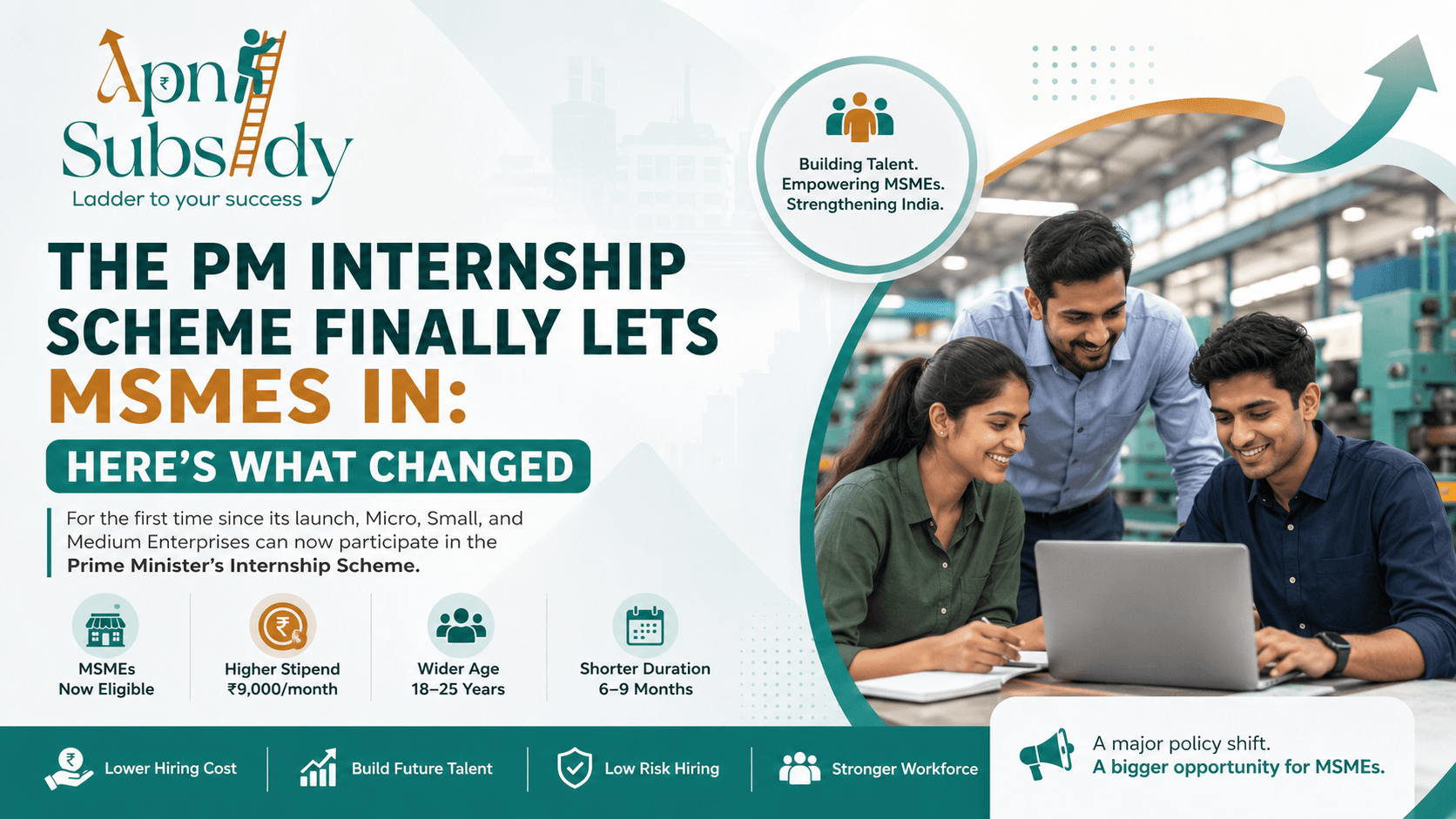
The PM Internship Scheme Finally Lets MSMEs In: Here's What Changed
The PM Internship Scheme Finally Lets MSMEs In: Here's What Changed
For the first time since its launch, Micro, Small, and Medium Enterprises (MSMEs) can now participate in the Prime Minister's Internship Scheme (PMIS).
This marks a significant policy shift.
In February 2025, the Government of India clarified in Parliament that MSMEs were not eligible under the scheme. The MSME Minister, in a written reply to the Rajya Sabha, confirmed that the pilot phase was limited to large corporations.
That has now changed.
With Pilot Round 3, which went live in April 2026, MSMEs have officially been brought into the programme alongside Global Capability Centres (GCCs), professional bodies such as the Institute of Chartered Accountants of India (ICAI), and several public sector organisations.
For thousands of small businesses looking to build talent without significantly increasing hiring costs, this expansion could create valuable new opportunities.
What is the PM Internship Scheme?
The Prime Minister's Internship Scheme is designed to provide young people with structured workplace experience while helping businesses access emerging talent.
The model is straightforward:
A company hires a young person as an intern.
The internship runs for a fixed duration.
The Government pays the majority of the intern's monthly stipend directly into the intern's bank account.
This reduces the financial burden on employers while giving students and young professionals practical industry exposure.
For MSMEs that often operate with limited recruitment budgets, this can make hiring interns considerably more affordable.
What's New in Pilot Round 3?
The latest version of the scheme introduces several important changes that make it more practical for small businesses.
1. MSMEs Are Now Eligible
The biggest change is the inclusion of MSMEs.
Earlier pilot rounds focused primarily on India's largest companies based on Corporate Social Responsibility (CSR) spending, along with selected Central Public Sector Enterprises (CPSEs).
Round 3 expands participation to include:
MSMEs
Global Capability Centres (GCCs)
Professional institutes
Statutory bodies
Public sector organisations
This significantly broadens the pool of employers that can participate.
2. Higher Monthly Stipend
The monthly stipend has increased from ₹5,000 to ₹9,000.
Since the Government bears most of this cost, businesses can onboard interns with lower financial commitment than traditional hiring.
3. Wider Age Eligibility
The eligible age range has expanded from 21–24 years to 18–25 years.
This allows recent school graduates, diploma holders, and fresh college graduates to participate, giving businesses access to a larger talent pool.
4. Shorter Internship Duration
Instead of the earlier 12-month internship, the programme now runs for 6–9 months.
This shorter duration aligns better with how many MSMEs manage manpower requirements and project-based work.
Why This Matters for MSMEs
Hiring new employees is often a difficult decision for small businesses.
Every recruitment involves salary costs, training time, and uncertainty about whether the candidate will become productive.
The PM Internship Scheme reduces this risk.
Since the Government supports the stipend, businesses can:
Train potential future employees
Evaluate candidates before offering permanent roles
Build internal talent without significantly increasing payroll expenses
For growing MSMEs, this creates a low-risk pathway to strengthen their workforce.
A Stronger Focus on Local Employment
Another notable aspect of Pilot Round 3 is the government's emphasis on regional participation.
Many MSMEs operate in industrial clusters located outside major metropolitan cities.
In the past, internship opportunities were often concentrated in large urban centres, making it difficult for students from smaller towns to access them—and equally difficult for local businesses to attract young talent.
To address this, the Government is:
Working with industry associations
Engaging MSME clusters across industrial regions
Partnering with organisations such as the National Cadet Corps (NCC) and Mera Yuva Bharat (MY Bharat) to increase awareness among young people
The objective is to encourage internships closer to where candidates live, benefiting both local businesses and local youth.
More Organisations Join the Programme
Pilot Round 3 also expands participation beyond private companies.
New participants include organisations such as:
Airports Authority of India (AAI)
Shipping Corporation of India (SCI)
Institute of Chartered Accountants of India (ICAI)
Institute of Company Secretaries of India (ICSI)
Institute of Cost Accountants of India (ICMAI)
The Government has also indicated that discussions are ongoing with additional industry bodies to further expand the programme.
What Happens Next?
The pilot phase has now been extended until December 2026, with an ambitious target of 1.10 lakh internship placements across all participating organisations, including MSMEs.
How actively small businesses participate will ultimately determine whether this policy expansion delivers meaningful employment opportunities or remains an underutilised initiative.
Final Thoughts
The inclusion of MSMEs in the Prime Minister's Internship Scheme represents an important shift in the government's approach to workforce development.
For small businesses, it offers an opportunity to access young talent with significantly lower hiring costs. For students and recent graduates, it creates more pathways to gain real-world work experience closer to home.
After initially being excluded from the scheme, MSMEs are now officially part of the programme. Businesses planning to expand their teams or build a future talent pipeline should closely examine the scheme before the current pilot window closes.