PMEGP Project Limit Doubled to ₹50 Lakh: What Entrepreneurs Need to Know
PMEGP's Project Ceiling Just Doubled. Here's What That Actually Means for a First-Time Entrepreneur
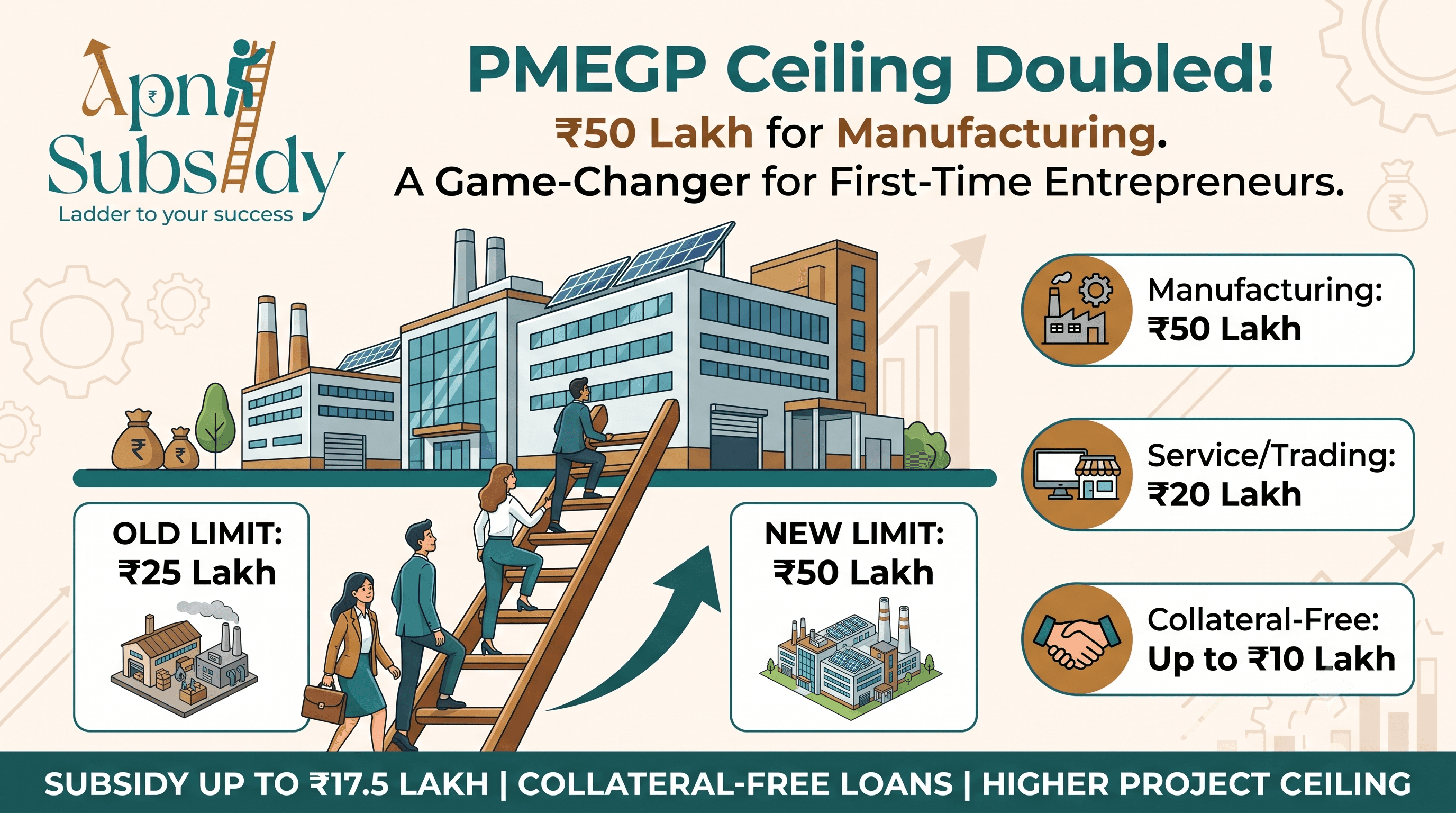
For years, anyone applying to the Prime Minister's Employment Generation Programme (PMEGP) to start a manufacturing unit faced the same limitation: the maximum project cost was capped at ₹25 lakh.
That ceiling has now doubled to ₹50 lakh under the revised guidelines. At the same time, the government's budget allocation for PMEGP has increased from ₹2,954 crore last year to ₹4,500 crore this financial year.
For a scheme designed to help people with business ideas but limited capital become entrepreneurs and employers, these changes could make a significant difference.
What Is PMEGP?
The Prime Minister's Employment Generation Programme was launched in 2008 after the government merged two earlier self-employment schemes: the Prime Minister's Rojgar Yojana (PMRY) and the Rural Employment Generation Programme (REGP).
The scheme is implemented through the Khadi and Village Industries Commission (KVIC) under the Ministry of MSME.
Its basic structure is relatively simple. The entrepreneur contributes a portion of the project cost, a bank finances the remaining amount through a loan, and the government provides a credit-linked subsidy that is adjusted against the loan.
In simple terms, PMEGP is not a conventional loan. A portion of the financing can effectively be covered through a government subsidy, provided the proposed business is established and remains operational under the scheme's conditions.
PMEGP Project Limits Have Doubled
The biggest change under the revised guidelines is the increase in the maximum eligible project cost.
Project Type | Earlier Limit | New Limit |
Manufacturing | ₹25 lakh | ₹50 lakh |
Service/Trading | ₹10 lakh | ₹20 lakh |
This means entrepreneurs planning larger manufacturing or service businesses can now build projects that were previously too large to fit within PMEGP's limits.
The increase is particularly relevant for businesses that require machinery, equipment, infrastructure, or higher initial working capital.
How Much PMEGP Subsidy Can You Get?
The subsidy under PMEGP continues to range between 15% and 35% of the eligible project cost.
The exact percentage depends on factors such as:
Applicant category
Urban or rural location
Whether the applicant belongs to a special category
Special categories include women, SC/ST, OBC, minorities, ex-servicemen and differently-abled applicants.
Rural and special-category applicants generally qualify for higher subsidy rates. Their own contribution is also lower.
For example, at the new ₹50 lakh manufacturing ceiling:
A general-category applicant in a rural area could receive up to ₹12.5 lakh as subsidy.
A special-category applicant in the same rural setting could receive up to ₹17.5 lakh.
These subsidy amounts do not have to be repaid, subject to the scheme's applicable conditions. The remaining project financing comes primarily through the bank loan, while the applicant contributes the required margin money.
The Collateral-Free Financing Advantage
The higher project ceiling isn't the only important development.
Under RBI guidelines applicable to PMEGP loans, banks are not permitted to demand collateral security for PMEGP loans up to ₹10 lakh.
This matters because collateral has traditionally been a major obstacle for first-time entrepreneurs. Someone may have a viable business plan but lack property or other assets that can be pledged as security.
Removing the collateral requirement for eligible loans up to ₹10 lakh can make it easier for such applicants to access formal business finance.
Who Is Eligible for PMEGP?
The revised project limits do not fundamentally change the basic eligibility requirements.
Applicants must generally:
Be at least 18 years old.
Have passed at least Class 8 if the project cost exceeds ₹10 lakh for manufacturing or ₹5 lakh for service businesses.
Not already own an existing business receiving benefits under the scheme.
Not have previously received a government subsidy under a similar scheme for the same purpose.
However, existing PMEGP units can potentially access a second-loan facility for expansion, subject to separate eligibility conditions.
Why the Higher Budget Allocation Matters
The government's PMEGP allocation has increased from ₹2,954 crore to ₹4,500 crore this financial year.
That increase suggests the government expects greater demand as entrepreneurs become eligible for larger projects under the revised limits.
Yet funding alone has never been the only challenge. A significant amount of PMEGP's annual allocation has reportedly remained unused because eligible entrepreneurs either aren't aware of the scheme or struggle with the application, documentation and bank-financing process.
That makes awareness and execution just as important as the increase in funding.
What This Means for First-Time Entrepreneurs
The change is particularly significant for entrepreneurs who previously had a viable manufacturing idea but couldn't make it work within the old ₹25 lakh ceiling.
With the limit now at ₹50 lakh, businesses requiring more expensive machinery, larger facilities or greater initial investment can potentially fit within PMEGP's framework.
For someone who has been sitting on a manufacturing idea that was simply too large for the old PMEGP limit, the box just got considerably bigger.
The opportunity now is to understand the eligibility rules, prepare a viable project report, arrange the required contribution and navigate the bank-financing process effectively.
For first-time entrepreneurs, PMEGP's bigger project ceiling could turn more business ideas into actual enterprises—and potentially more entrepreneurs into employers.