RBI's 3 Tools Bridging the MSME Credit Gap: What They Mean
The RBI Governor Named Three Tools Closing the MSME Credit Gap. Here's What They Actually Do.
Speaking at the Global Fintech Fest in Mumbai on September 8, RBI Governor Sanjay Malhotra highlighted how fintech companies are helping bridge India's MSME credit gap.
According to Malhotra, fintech is making it possible to extend formal, collateral-light credit to small businesses that traditional lending models have often struggled to assess.
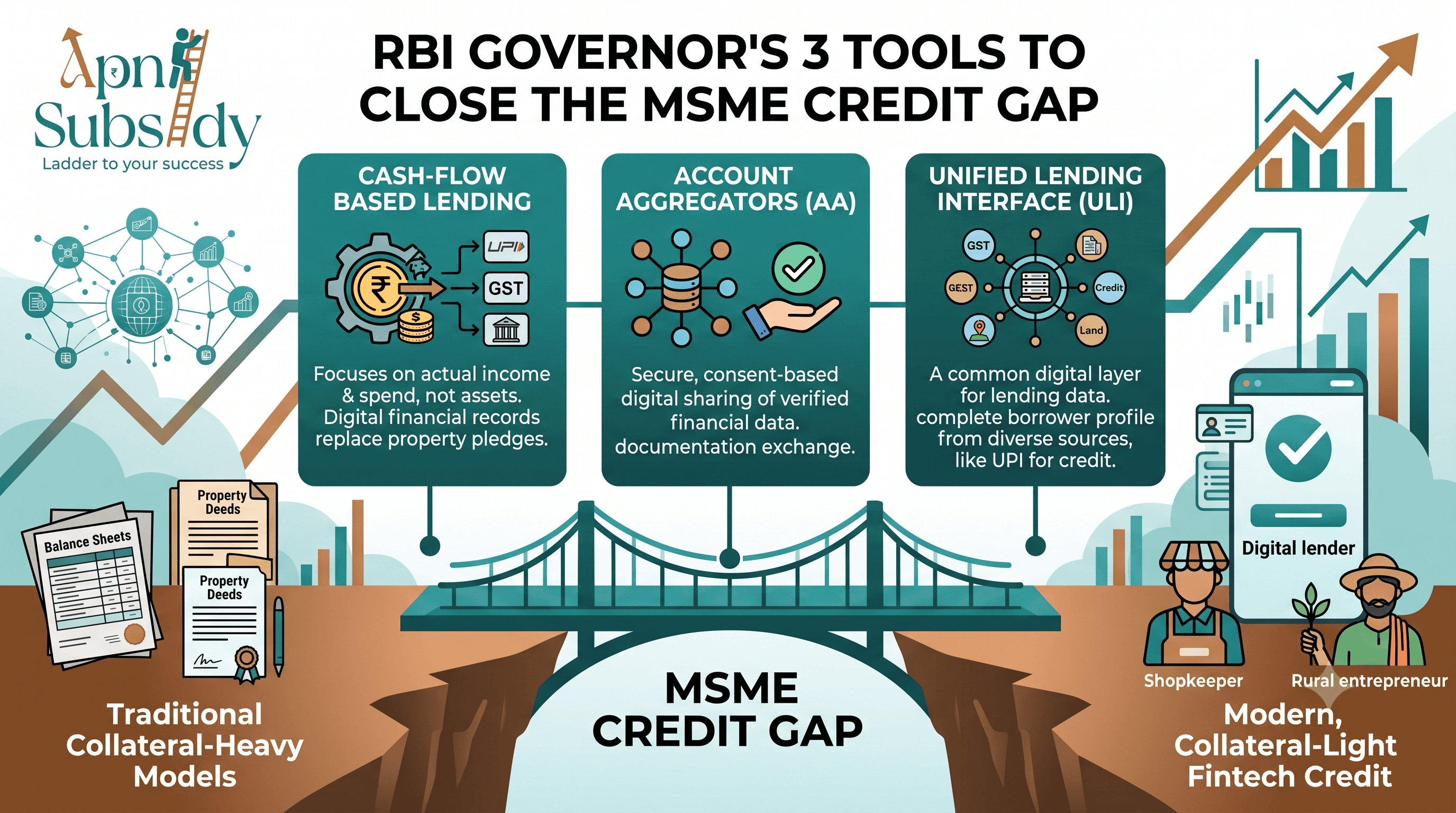
He specifically highlighted three mechanisms driving this change:
Cash-flow based lending
Account Aggregators
Unified Lending Interface (ULI)
For MSME owners, understanding these three tools can help explain why lenders today may evaluate a business differently from a traditional bank loan process.
1. Cash-Flow Based Lending: Looking at What Your Business Earns
Traditional lending has often focused heavily on collateral, balance sheets and existing financial records.
For a small business without significant property or assets to pledge, this can become a major barrier—even when the business has consistent revenue.
Cash-flow based lending takes a different approach.
Instead of primarily asking “What does the business own?”, lenders can look at “How much does the business actually earn and spend?”
Digital financial information such as:
UPI transaction history
Bank statements
GST filings
Digital payment records
Other transaction data
can help lenders assess a business's actual cash flows and repayment capacity.
For an MSME with genuine revenue but limited collateral, this can potentially make the difference between being rejected under a traditional assessment and qualifying for formal credit.
2. Account Aggregators: Making Financial Data Easier to Share
Cash-flow based lending requires reliable financial data. That's where Account Aggregators (AAs) come in.
An Account Aggregator is a licensed intermediary that allows individuals and businesses to securely share their financial information with a lender based on their consent.
Instead of collecting bank statements, tax documents and other financial records manually from different institutions, a borrower can digitally authorise participating entities to access the required information.
This can significantly reduce paperwork and documentation delays.
The borrower also remains in control of the data being shared, including what information is shared and the purpose for which it is accessed.
For small businesses, this can turn what was once a lengthy documentation process into a much faster digital exercise.
3. Unified Lending Interface: Building a Common Digital Layer for Lending
The Unified Lending Interface (ULI) is perhaps the newest and least familiar of the three mechanisms.
Its broader idea is comparable to what UPI did for digital payments: create a common, standardised digital infrastructure that can make lending more efficient.
Rather than requiring lenders to establish separate connections with multiple data sources, ULI is designed to facilitate access to relevant financial and non-financial information through a common interface, with the borrower's consent.
Depending on the lending use case, such data can include information related to areas such as:
GST
Credit history
Land records
Agricultural information
Other relevant financial and non-financial data
The goal is to help lenders build a more complete picture of a borrower without spending excessive time assembling information from different systems.
This is particularly important for small-ticket MSME loans, where lengthy underwriting and documentation processes can make lending expensive and inefficient for financial institutions.
How Fintech Is Changing MSME Credit
Malhotra connected these technologies to a broader transformation in India's financial system.
Digital infrastructure such as UPI, Aadhaar-enabled payments and the Jan Dhan ecosystem has expanded access to formal financial services beyond traditional bank branches.
For shopkeepers in smaller towns, entrepreneurs in rural areas and other underserved borrowers, digital systems can make it easier to transact, save and potentially access credit.
The RBI has also created platforms such as its Regulatory Sandbox and the Reserve Bank Innovation Hub to engage with fintech companies and startups and encourage innovation within the financial system.
What This Means for MSME Owners
For a small business owner who has previously been rejected for a loan because of insufficient collateral, these technologies are more than just policy terminology.
Cash-flow based lending can help lenders assess actual business performance.
Account Aggregators can make it easier and faster for borrowers to securely share verified financial information.
ULI aims to standardise and simplify the process of connecting lenders with relevant financial and non-financial data.
Together, these mechanisms point toward a lending system where business performance and digitally verifiable financial activity can play a larger role alongside traditional collateral-based assessments.
For MSMEs looking for finance, understanding these tools can also help identify lenders and loan products that assess businesses based on their actual cash flows rather than relying only on property and conventional paperwork.