RBI Clarifies UPI Credit Lines: What Every MSME Should Know
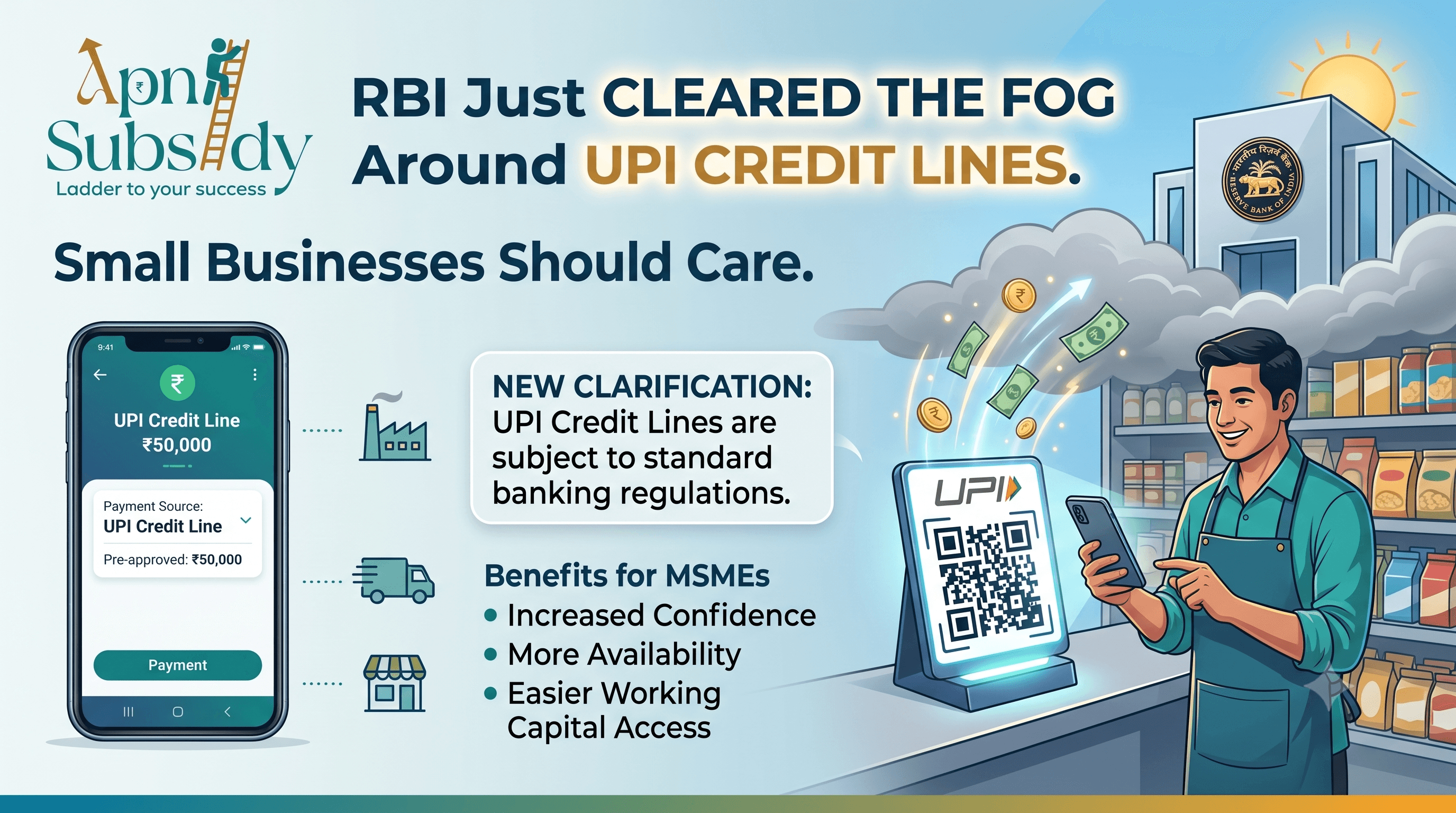
RBI Just Cleared the Fog Around UPI Credit Lines. Small Businesses Should Care.
The Reserve Bank of India (RBI) has recently introduced an important clarification that could influence how banks offer UPI-linked credit lines to individuals and small businesses.
While the announcement may appear technical at first glance, its impact is significant—especially for Micro, Small, and Medium Enterprises (MSMEs) that rely on quick access to working capital.
The latest amendment confirms that credit facilities accessed through UPI will be regulated based on the underlying loan itself, not the payment platform used to access it.
For businesses using—or planning to use—UPI-based credit, this brings much-needed regulatory clarity.
What Is a UPI-Linked Credit Line?
Over the past few years, several banks have introduced a feature commonly known as Credit Line on UPI.
Instead of making payments only from a savings account, eligible customers can use a pre-approved credit limit linked directly to UPI.
The process is simple:
A bank sanctions a credit line in advance.
The customer links that credit line to UPI.
Payments are made by scanning any UPI QR code.
The amount spent is deducted from the available credit limit instead of the bank balance.
For MSMEs, this creates a convenient way to access short-term funds without applying for a new loan every time cash is needed.
Why This Matters for Small Businesses
Many small businesses experience temporary cash flow gaps.
Examples include:
Purchasing inventory before customer payments arrive.
Paying suppliers on time.
Managing seasonal demand.
Covering short-term operating expenses.
Traditional business loans often require documentation, collateral, and lengthy approval processes.
A UPI-linked credit line allows eligible businesses to access funds instantly for smaller transactions, making it easier to manage daily operations.
For kirana stores, manufacturers, wholesalers, traders, and service providers, this can become a valuable working capital tool.
What Has RBI Clarified?
The RBI has amended its Credit Facilities Directions for both commercial banks and small finance banks.
The clarification states that:
A credit facility accessed through UPI is still treated as a normal bank credit product.
The regulatory treatment depends on the nature of the loan—not the technology or payment channel used.
Banks must follow the same rules for provisioning, capital requirements, and asset classification that apply to other forms of lending.
Only credit facilities already permitted under existing regulations can be offered through UPI.
In simple terms, using UPI does not create a separate category of lending.
The credit remains subject to the same banking regulations as a traditional loan or overdraft facility.
Why Banks Needed This Clarity
Before this clarification, some banks were cautious about expanding UPI-linked credit products.
Although customers could borrow through UPI, there was uncertainty around how these facilities would be treated for:
Capital adequacy
Loan provisioning
Non-performing asset (NPA) classification
Regulatory compliance
Without clear guidance, scaling these products involved additional regulatory risk.
The RBI's clarification removes that uncertainty.
Banks now have a clear framework for offering these products while remaining compliant with banking regulations.
What This Means for MSMEs
For business owners, the RBI's clarification has two important implications.
1. Greater Confidence
Businesses can now be assured that UPI-linked credit lines are not unregulated fintech products.
They remain fully governed by India's banking framework and follow the same repayment and compliance standards as conventional bank loans.
This provides greater transparency and regulatory protection for borrowers.
2. Wider Availability
With regulatory uncertainty removed, banks—particularly Small Finance Banks (SFBs)—may be more willing to expand these credit products.
This could improve access to formal credit for businesses that previously struggled to obtain traditional working capital loans.
For many MSMEs, this could become an easier entry point into the formal credit ecosystem.
Convenience Comes with Responsibility
While UPI-linked credit offers flexibility, it should not be viewed as unlimited working capital.
Because borrowing is as easy as making a regular UPI payment, businesses may find themselves using credit more frequently than intended.
Every transaction still creates a repayment obligation.
Responsible borrowing remains essential.
Businesses should:
Use the facility for genuine short-term working capital needs.
Monitor outstanding balances regularly.
Make repayments on time.
Avoid relying on the credit line for recurring operational expenses.
Used wisely, the facility can improve cash flow management.
Used carelessly, it can create unnecessary debt.
Final Thoughts
The RBI's latest clarification does not introduce a new loan product—it simply provides regulatory certainty for one that already exists.
That certainty is likely to encourage more banks to offer UPI-linked credit lines, making short-term credit more accessible to India's MSMEs.
For businesses already using these facilities, nothing changes in day-to-day usage.
For those waiting on the sidelines, however, the path is now much clearer.
As digital lending continues to evolve alongside India's UPI ecosystem, UPI-based credit lines may become an increasingly important financing option for small businesses seeking fast, regulated, and flexible access to working capital.