The Ten-Minute Economy Is Winning Customers — But Is It Losing the Bigger Argument?
The Ten-Minute Economy Is Winning Customers — But Is It Losing the Bigger Argument?
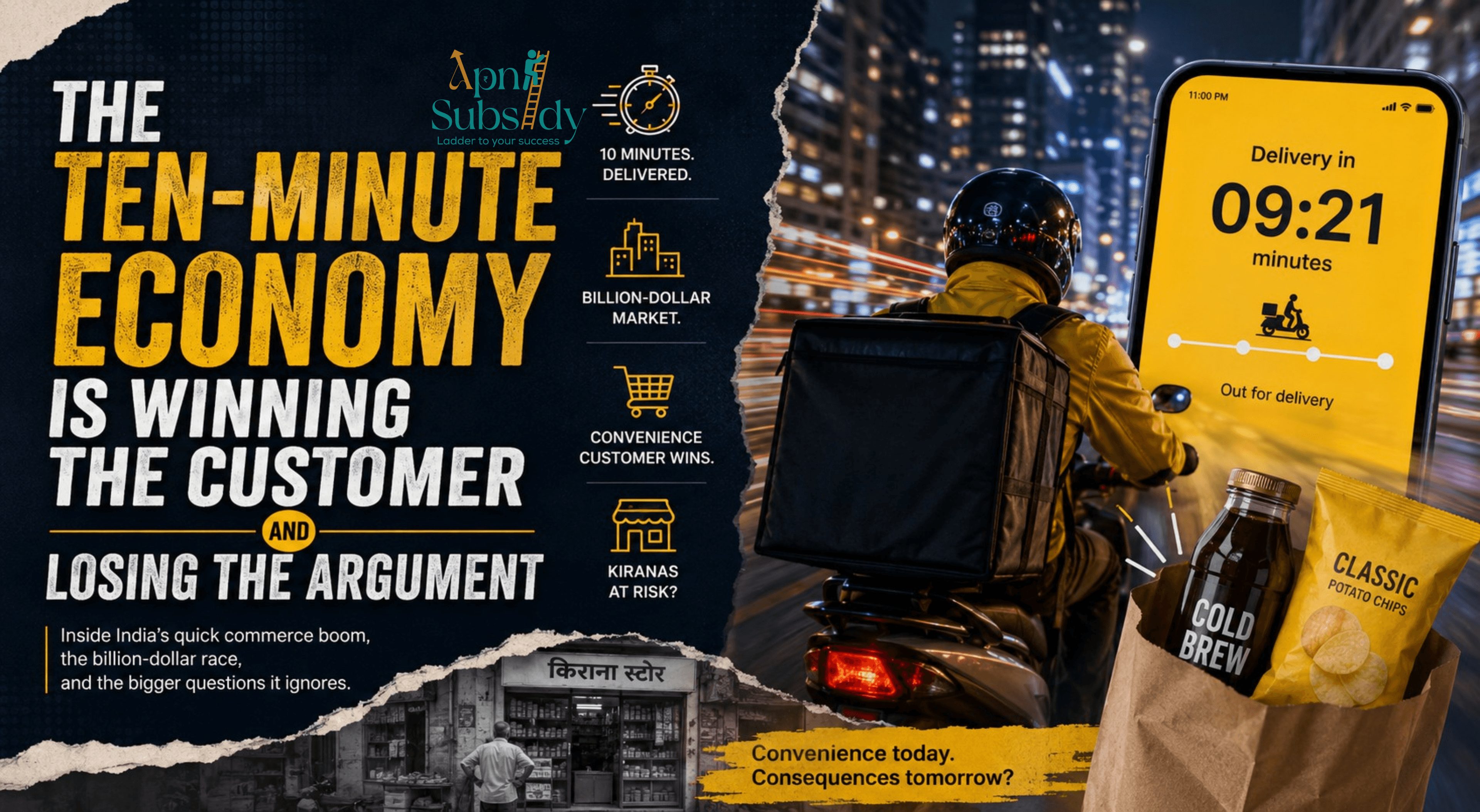
Imagine it's 11 p.m.
You suddenly crave a cold brew and a bag of chips. You open Blinkit, place an order, and before you've even finished scrolling Instagram, the doorbell rings.
Welcome to India's ten-minute economy.
Over the past few years, quick commerce has quietly transformed the way millions of Indians shop. Nobody officially decided that groceries should arrive in under ten minutes, but consumers embraced the convenience almost overnight. Today, the industry has become too large to ignore, raising an important question:
Is quick commerce simply a smarter way to shop, or is it disrupting India's traditional retail ecosystem?
The Industry Is Growing at an Extraordinary Pace
India's quick commerce market is now worth an estimated $10–11 billion in Gross Merchandise Value (GMV) in 2026, making it the third-largest market globally, behind only China and the United States.
The competition has intensified:
Blinkit, owned by Eternal (formerly Zomato), controls over 40% of the market and operates around 2,100 dark stores, with another 900 planned by March 2027.
Zepto reported revenues of ₹11,110 crore in FY25, growing roughly 150% year-on-year, while expanding into categories like pharmacy and beauty.
Swiggy Instamart runs approximately 1,100–1,200 dark stores across India.
Flipkart Minutes, launched in August 2024, has already crossed 800 outlets and plans to double that number.
Amazon has also entered aggressively with 450–500 dark stores in different stages of operation.
Across India's top eight cities alone, more than 3,800 dark stores now operate, creating intense competition and overlapping delivery networks.
Profitability Is Finally Becoming Reality
For years, critics argued that quick commerce could never make money.
That assumption is beginning to change.
Blinkit achieved positive adjusted EBITDA in March 2024, while Zepto continues moving closer to contribution-level profitability despite rapid expansion.
Analysts at Bernstein have described 2026 as "another year of discovery"—not because survival is uncertain, but because companies are still determining which cities, product categories, and order sizes create sustainable profits.
The Hidden Business Behind Quick Commerce
Delivery fees are only part of the story.
A significant share of profits increasingly comes from advertising.
Brands pay platforms like Blinkit, Zepto, and Instamart to appear prominently in search results because shoppers are already ready to buy. The gap between seeing an advertisement and completing a purchase is only a few seconds.
Industry estimates suggest these platforms could generate nearly ₹4,900 crore in advertising revenue during 2026, making retail media one of their most valuable revenue streams.
But What About India's Kirana Stores?
This is where the debate becomes more complicated.
India has roughly 12 million neighbourhood kirana stores, many of which have served local communities for decades.
Trade associations argue that venture-funded quick commerce companies can afford to sell products at prices traditional stores simply cannot match.
The platforms respond that some kirana owners have successfully partnered with them by becoming fulfillment centres or dark-store operators.
While that is true, the opportunity is not equally accessible.
Many small shop owners lack the capital needed for refrigeration, technology upgrades, inventory systems, and platform onboarding. For them, adapting is not a simple business pivot—it may be impossible.
Can Quick Commerce Succeed Beyond Metro Cities?
Another major challenge lies in expansion.
The business model that works in Bengaluru, Gurugram, or Mumbai doesn't necessarily translate to smaller cities.
Tier-2 and Tier-3 markets often have:
Lower order volumes
Higher last-mile delivery costs
Consumers who still prefer shopping locally
Greater marketing expenses required to change buying habits
As investors increasingly focus on profitability rather than growth alone, these markets remain difficult to crack.
The Final Verdict
One thing is now clear: quick commerce is not a passing trend.
Consumers have embraced the convenience, investors continue backing the sector, and companies are expanding aggressively.
The bigger question, however, remains unanswered.
Can an industry built on ultra-fast deliveries, investor-funded discounts, and gig-worker logistics sustain itself in the long run without attracting significant regulatory scrutiny?
For now, the customer seems unconcerned.
They open the app, tap "Order Now," watch the countdown timer, and answer the door a few minutes later.
Whether that convenience comes at a broader economic cost is a debate India is only beginning to have.