Why Your MSME's Next Big Marketing Move Might Cost Less Than You Think
Why Your MSME's Next Big Marketing Move Might Cost Less Than You Think
For most small business owners in India, "digital marketing" used to mean one thing: pay someone to run Facebook ads,Instagram ads and hope for the best. The results were often poor, the costs unpredictable, and what you actually got for the money — nearly impossible to know.
That's changing. And it's changing faster than most small businesses realize.
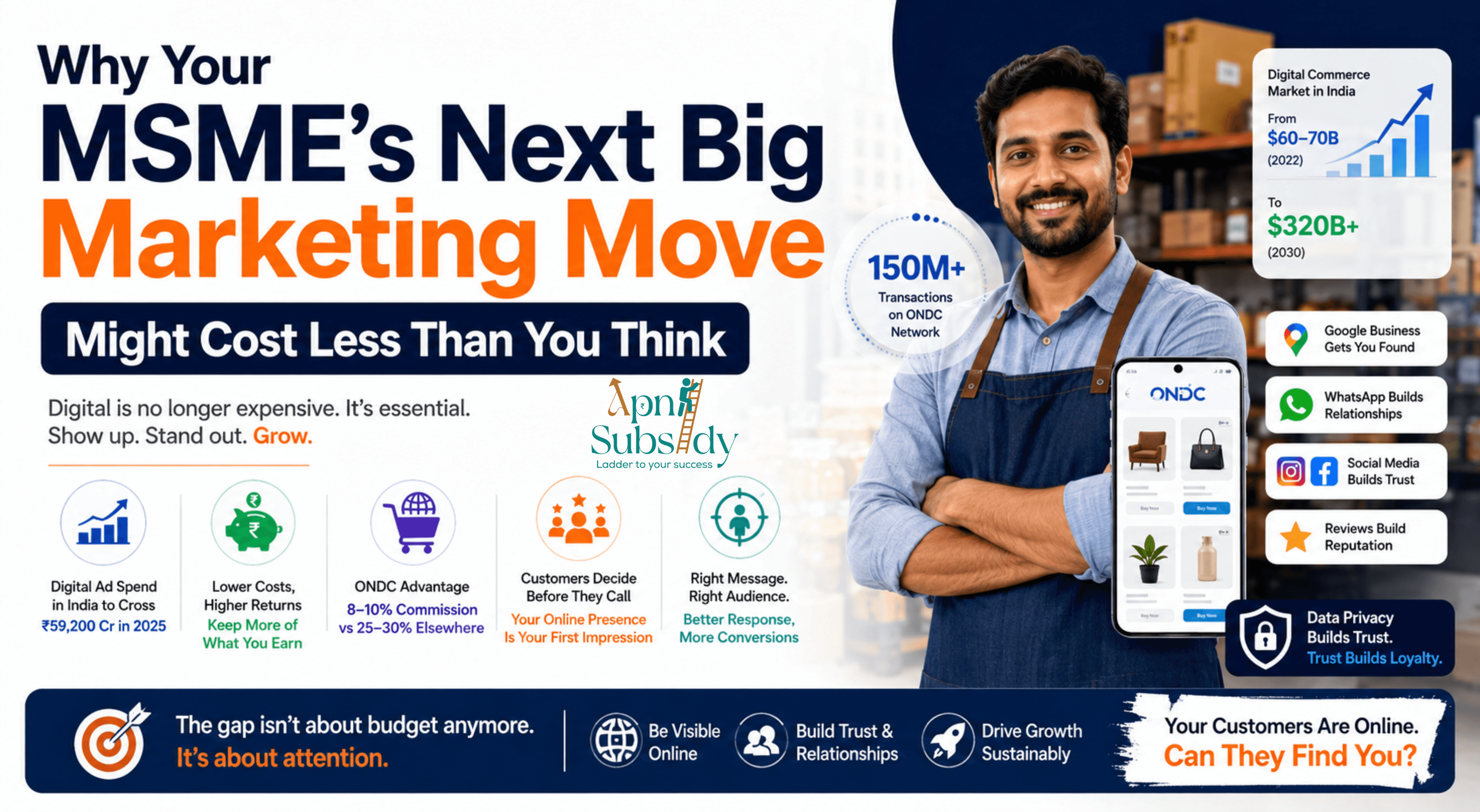
Digital advertising in India is on track to cross INR 59,200 crore in 2025 — more than what's being spent on TV, print, and radio combined. But the bigger story isn't the total spend. It's who benefits now that the costs have come down.
The tools aren't expensive anymore
Five years ago, running targeted digital campaigns, managing customer data, and tracking sales online required either a big marketing team or a big budget. Most MSMEs had neither. That gap has closed. A well-set-up Google Business Profile, a consistent WhatsApp presence, and two active social media accounts can now do what a dedicated marketing department used to cost lakhs to achieve.
Small businesses in Jodhpur, Varanasi, Nagpur etc.- they're finding buyers they'd never have reached through a newspaper ad or a local broker. The ones doing it well aren't doing anything complicated. They're just showing up consistently where their customers already spend time.
What ONDC actually means in practice
ONDC (OPEN NETWORK DIGITAL MARKET)is a government-backed open digital commerce network that allows businesses to sell online across multiple platforms without being locked into a single marketplace.
Why it's relevant for MSMEs: ONDC helps MSMEs reach more customers while paying lower commissions (around 8–10% compared to 25–30% on many traditional marketplaces), allowing them to retain more profit and compete more effectively in the digital economy.
If you sell products online and you're not looking at ONDC yet, the commission math alone is worth your attention. Platforms like Amazon and Flipkart charge sellers 25 to 30 percent in commission. ONDC charges 8 to 10 percent. On five lakh rupees in monthly sales, that difference is roughly one lakh rupees staying in your pocket every month instead of going to a marketplace.
The network has crossed 150 million transactions since launch, with sellers now registered from over 600 cities. It's not a pilot project anymore. India's digital commerce market is expected to grow from around $60–70 billion in 2022 to over $320 billion by 2030, and ONDC is built to carry a large part of that volume. Getting familiar with it now makes sense.
Customers decide before they call you
Here's what's actually changed about buyer behavior — and most small businesses still haven't adjusted to it. Before a potential customer contacts you, they've already formed an opinion. They've looked at your Google reviews. They've checked your Instagram or Facebook page. They've seen whether you respond to complaints or ignore them.
By the time they reach out, the first impression is already done. It happened on a screen, without you in the room.
A CPA Australia survey found that 80 percent of Indian small businesses grew last year — above the Asia-Pacific average of 63 percent — and better customer experience and technology adoption were named as the main reasons. The businesses behind that number aren't just good at their work. They're making sure that's visible online too.
Stop sending the same message to everyone
One thing digital marketing does better than any billboard or pamphlet is let you speak to different people differently. A subsidy consultant in Rajasthan serves a first-generation entrepreneur who has never heard of CGTMSE, and also a mid-sized manufacturer looking for specific export credit guarantees. The message that works for one is completely wrong for the other.
CGTMSE (Credit Guarantee Fund Trust for Micro and Small Enterprises) is a government-backed scheme that helps MSMEs get business loans without providing collateral or security to banks.
Segmenting your audience doesn't require expensive software. It requires knowing who your customers are and writing to each group with their actual problem in mind. Businesses that do this — even roughly — get better responses and more conversions. Businesses that send the same message to everyone get ignored.
Data privacy isn't a legal issue — it's a trust issue
India now has data protection regulations that affect how businesses collect and use customer information. The businesses that treat this seriously gain something that paid advertising can't manufacture: trust.
Small businesses have an advantage here that large companies don't. You can actually know your customers personally. A WhatsApp group where people opted in. A newsletter your clients actually asked to receive. A follow-up call after you complete a job. These things cost almost nothing and build more loyalty than most paid campaigns manage to.
What the next two years need from you
87 percent of Indian small businesses expect to grow in 2026. That's a confident number. But confidence without action doesn't compound.
The businesses that will actually hit that growth have one thing in common: they're getting the basics right now. A clean, mobile-friendly website. An updated and active online presence. A simple system for collecting reviews and responding to them. A clear, plain-language message about what they do and who they help.
The gap between an MSME that has figured out digital marketing and one that hasn't is not about budget anymore. It's about attention.
Your customers are already online. The question is whether they can find you when they go looking.
Conclusion
Digital marketing is no longer a luxury for MSMEs—it's a necessity. The businesses that embrace affordable digital tools, build trust online, and stay visible where customers spend their time will have the best chance to grow. In today's market, success is less about having a bigger budget and more about being easier for customers to find and trust.
Tags
Work With Us
Need help identifying the right subsidy, preparing documentation, or maximizing claim value? Our team can guide you end to end.
Get in Touch